
Courses
Marketing AI automation is doing two opposite things to marketers in India at the same time. It’s making some of them nervous about their jobs, and on the other hand, it’s quietly making others more valuable than they’ve ever been.
You’ve probably felt the first part already. More campaigns to run, smaller budgets to run them with, and bosses asking why results aren’t faster. Meanwhile, every second reel on your feed claims AI will either replace you or make you ₹40 lakh a year. Both claims are wrong, and by the end of this article, you’ll know exactly why marketing AI automation matters for your career, along with the statistics, the practical skills employers pay for, and the myths you can finally stop worrying about.
In simple words, marketing automation means using software to handle marketing work that repeats: sending emails, posting on social media, and following up with people who showed interest. Instead of one person doing the same task 500 times, a system does it. That’s the basic marketing automation meaning, and it has been around for over a decade.
So what is AI automation? It’s an upgrade. Old automation followed fixed rules a human wrote: “If someone fills the form, send Email A.” It never got smarter. AI-powered marketing automation learns, it watches how people behave, and makes its own calls about who should get which message in which word; and at what time.
Here’s an easy way to picture it. Old automation is a ceiling fan: it spins exactly how you set it. AI-driven marketing automation is a smart AC: it senses the room and adjusts itself.
That single difference is why your career is a part of this story. Rule-following software just needed operators. Learning software needs people who can direct it, and India is short of them.
India’s digital market has a feature almost no other country has: it runs in dozens of languages at once.
A brand in Kolkata might need the same campaign in Bengali, Hindi, and English each with a different tone, on different platforms, at different times of day. Doing that manually needs a small army. Marketing AI automation does it without one, which is exactly why Indian companies from e-commerce brands to banks to local institutes are adopting these tools fast.
WhatsApp makes the opportunity even bigger. India is one of WhatsApp’s largest markets, and businesses here increasingly use AI to send messages tailored to each person’s language and interest, a kind of personal touch at a scale no team of humans could match.
Now the catch: the companies bought the tools, but they can’t find enough people to run them. NASSCOM projects India’s demand for AI-skilled professionals will cross one million by 2026, while Ministry of Electronics & IT data shows only around 16% of the country’s IT workforce currently has AI skills. The shortage is not coming. It’s here.
And shortages, as any economics student will tell you, raise prices. In this case, the price is your salary. Hold that thought.
Step Into the World of Digital MarketingLearn from Digital Marketing Experts |
|
| Diploma in Digital Marketing | |
| More Learning Options for you: Advanced Diploma in Digital Marketing | Google Ads Certification Training | Certification Course |
Here’s how to use AI in marketing as it actually plays out. I am going to give you some examples of AI in digital marketing that you’ve experienced as a customer without noticing:
Email. AI studies when each person usually checks their inbox and sends the message at that exact moment. It also tests different subject lines automatically and keeps the winner.
WhatsApp and SMS. AI matches the message language and offer to each person, Bengali for one customer, Hindi for another and knows who prefers a discount versus who responds to urgency.
Ads. When you see an ad for the exact product you almost bought last week, that’s AI sorting millions of people into groups and deciding where the ad money works hardest. Google and Meta’s systems now do most of this targeting on their own.
Websites and apps. AI predicts which users are about to lose interest and nudges them back with a well-timed message. Chat assistants answer routine questions at 2 a.m. and pass the tricky ones to humans.
Reports. The hours marketers once lost copying numbers into spreadsheets every Monday? Dashboards now update themselves.
Look at the pattern in all these marketing automation examples. AI took over the repetitive work of typing, sorting, scheduling, and copying. It did not take over deciding what the brand should say, which idea deserves the budget, or whether the numbers actually make sense.
That gap between doing and deciding is where the money is. The data proves it.
A warning first: this topic is drowning in fake numbers. You’ll find blogs claiming “open rates up 20%!” and “costs down 30%!” with no source attached. Treat every unsourced percentage as decoration, not data. Here are three numbers with real names behind them. Read them together:
Almost everyone has the tools. McKinsey’s State of AI research found nearly 90% of organisations now use AI somewhere in their operations.
Almost nobody has mastered them. Gartner’s research found that only about 9% of organisations have reached genuine maturity with AI, using it well, across the business, with results to show.
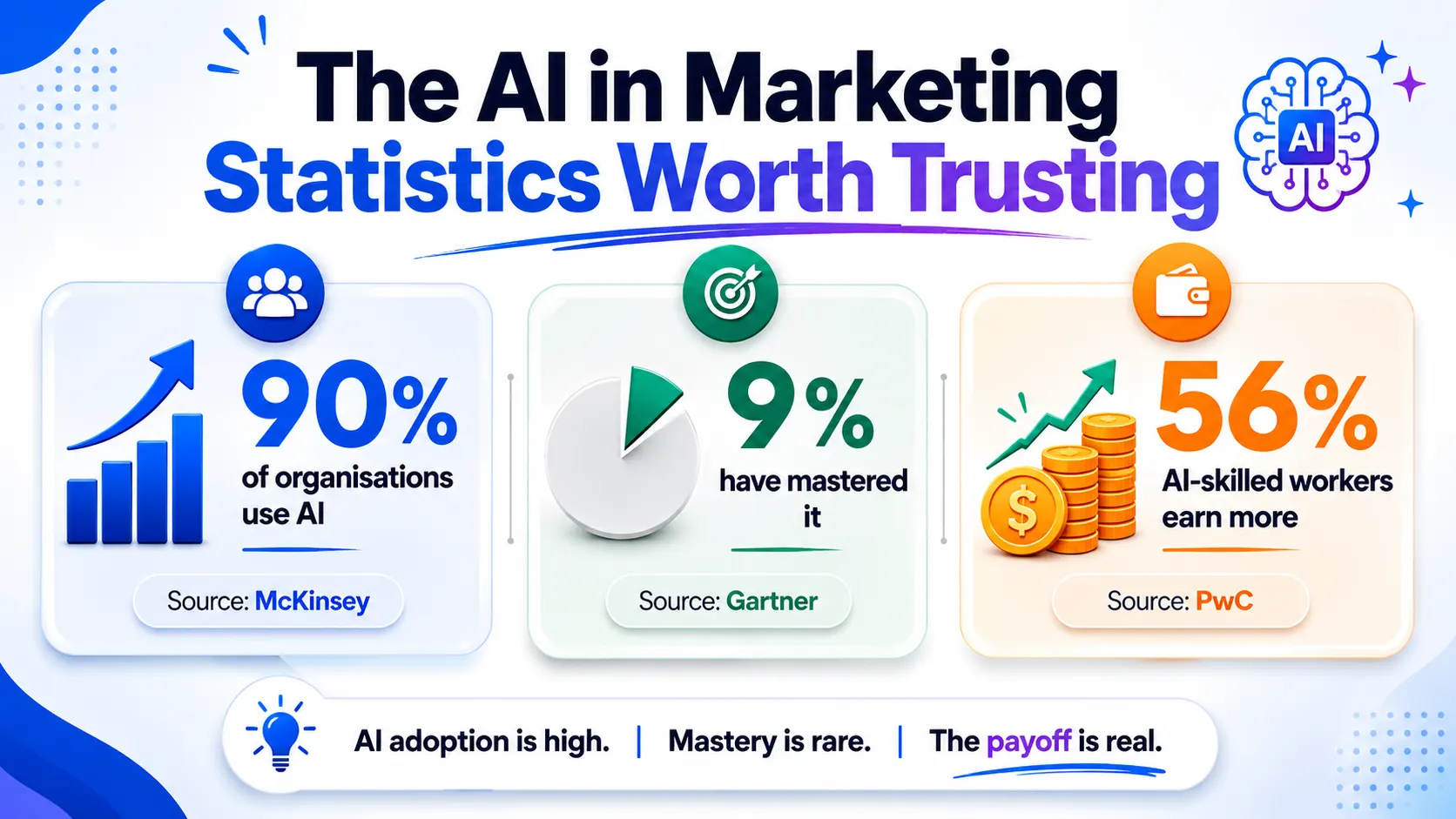
The people who close that gap get paid for it. PwC’s Global AI Jobs Barometer, built on close to a billion job advertisements worldwide, found that workers with in-demand AI skills earned 56% more than colleagues doing the same job without them. A year earlier, that figure was 25%. It more than doubled in twelve months.
Nine out of ten companies bought the engine. One in ten can drive it. The drivers are charging accordingly. That’s the entire opportunity in three sentences.
The title promised myth-busting. Here are the three biggest, each killed with the facts above.
Myth 1: “AI will replace marketers.” AI replaces tasks, not judgment. It writes a hundred ad drafts in a minute and has no idea which one fits your customer. Every example in this article still needs a human deciding the strategy, checking the output, and catching the mistakes AI makes with total confidence. The marketers losing ground are the ones who only ever did the repetitive part.
Myth 2: “This is only for big companies with big budgets.” A decade ago, maybe. Today, the same AI features sit inside affordable tools that a two-person team in Howrah can use. Small Indian businesses are often faster adopters because they can’t afford to hire armies, which means smaller companies need AI-skilled marketers too, not just the giants.
Myth 3: “AI marketing skills = ₹40 lakh salary.” Those figures belong to engineers who build AI systems at product companies, not marketers who use them. Quoting their pay to a marketing student is like quoting a pilot’s salary to someone joining a travel agency. The real numbers are next, and they’re still very good news.
According to PayScale’s 2026 data, a digital marketing analyst in India averages around ₹4.1 lakh per year, with experienced professionals reaching ₹6.6 lakh and beyond. That’s the genuine base, with no hype.
Now apply the PwC finding: AI-skilled professionals earn up to 56% more than peers in the same roles. The skills don’t teleport a fresher to engineer money. What they do is move you onto a faster ladder; a higher starting point, and quicker jumps at every stage, because you belong to the small group companies are competing to hire.
AI marketing automation jobs are also widening beyond one title. Companies now hire marketers specifically to run automation systems, manage AI tools, and turn their output into results roles that barely existed five years ago, and that reward exactly the doing-versus-deciding gap this article keeps pointing at.
Slower than Instagram promises. Far better than the average. And real.
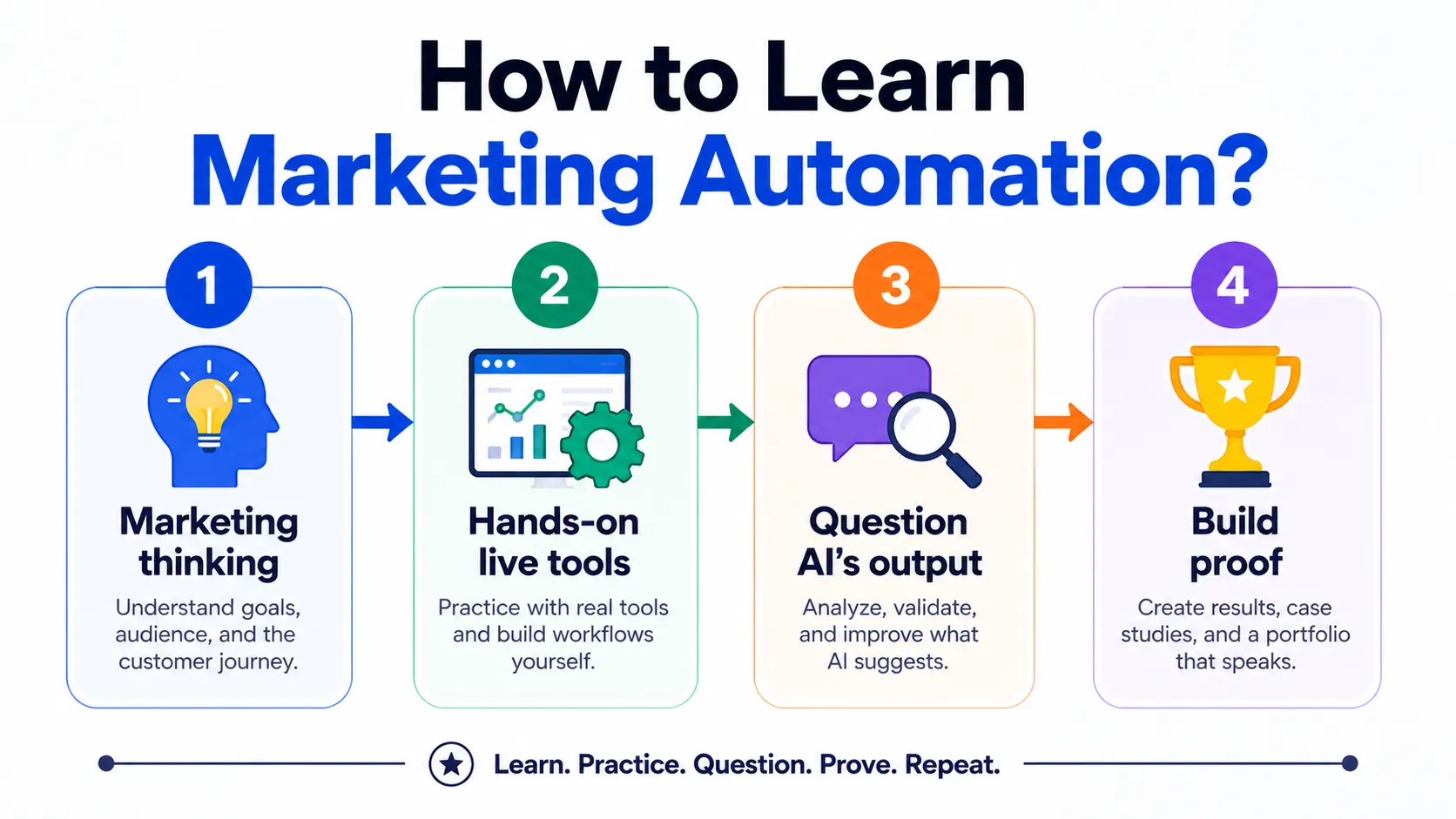
Here’s where most people go wrong with how to learn marketing automation: they collect certificates first and touch real tools never. Then interviews go nowhere, because employers in India check proof, not paper. Do it in this order instead:
1. Marketing thinking first. If you don’t understand what makes people buy and what makes a message land, AI just helps you do the wrong thing faster.
2. Hands on live tools, not slideshows. Build one real campaign, an email sequence, a WhatsApp flow, even a small one. One built campaign teaches more than ten recorded lectures.
3. Learn to question AI’s output. This is the rarest skill in the market. AI confidently produces wrong facts, off-brand copy, and misleading numbers. The person who catches those mistakes is worth more than the person who can only generate them.
4. Build proof. “I set up this automation, and here’s what happened” wins interviews. Certificates alone don’t.
Few related topics for your knowledge
If you’re choosing a course, use one filter: does it put you on live projects with current tools, or hand you recorded videos and a certificate? Free content genuinely works for step one, but it can’t give you steps two and four: live projects, tool access, mentors, and proof of work. Use free resources to start; don’t mistake them for the journey.
AI tools and automation are now a core part of how modern digital marketing is taught, not a separate subject. If you’re in Kolkata and want the structured path of live campaigns, real tools, and portfolio proof that employers actually check, that’s exactly how we built our digital marketing courses at IDCM, the Advanced Diploma in Digital Marketing and also the Diploma in Digital Marketing, where working with AI-powered marketing tools is built into the training rather than tacked on.
The companies bought the engines. Very few people can drive them. Decide which side of that shortage you’re standing on, while the gap is still wide open.
It means using AI software to handle repetitive marketing work emails, ads, follow-ups, reports and to make smart calls like who should see which message and when. Humans set the direction; AI handles the repetition at a scale no team could match manually.
It replaces tasks, not careers. Repetitive work is shrinking, but demand for people who can direct AI tools is rising. NASSCOM projects over a million AI-skilled roles in India by 2026, far more than the available talent today.
PayScale’s 2026 data puts the average digital marketing analyst in India around ₹4.1 lakh a year. PwC’s global research found AI-skilled professionals earn up to 56% more than peers in the same role the skills raise both your starting point and your growth speed.
Faster than the usual path, but not overnight. The first year is about building proof; once you can show real automation work, jumps in salary and responsibility tend to come at the 1–3 year mark, sooner than for marketers without AI skills, because demand outstrips supply.
Start with the basics most Indian companies actually use: an email and automation tool, an AI writing assistant for drafts, and the built-in AI inside Google and Meta ad platforms. Master a few deeply rather than collecting many employers hire for judgment, not tool counts.
E-commerce brands, edtech, fintech, agencies, and increasingly small and mid-sized businesses across cities like Bengaluru, Mumbai, Delhi, and Kolkata. Common roles include digital marketing executive, marketing automation specialist, performance marketer, and growth marketer.
The concepts, yes, YouTube and tool tutorials cover them well. What free routes can’t provide is live project experience, mentor feedback, and proof of work, which is what employers in India actually verify in interviews.
Choose hands-on training with current AI tools and live campaigns over recorded lectures. IDCM’s digital marketing courses in Kolkata are built on this model real projects, current tools, and portfolio proof you can show employers.


 }})