
Courses
Digital marketing for insurance agents is one of the few service niches in India where you can see the demand sitting in government data, and where very few trained people are competing for the work.
Starting with the number, in 2024-25, Indian life insurers collected 6.73% more premium than the previous year, and they sold 7.39% fewer new individual policies. Policy count fell from 291.77 lakh to 270.22 lakh. Premium income climbed. New customers dropped.
That gap lands on the agent’s head.
India has roughly 29 lakh individual life insurance agents. Most of them still find clients through relatives, walk-ins and cold calls. Very few have a working website, a Google listing that ranks, or any follow-up system beyond a personal phone.
If you finish a digital marketing course and you can set up a Google Business Profile, write a landing page, and build a follow-up sequence that stays inside the law, someone will pay you for it. This guide covers what that work looks like, what IRDAI allows you to publish, and the order in which to learn the skills.
Digital marketing for insurance agents is the work of helping a licensed insurance agent get found online and follow up with the people who enquire. The usual scope covers local search listings, a simple website, content written in plain language, WhatsApp and email follow-up, review management, and paid ads. In India, every piece of it sits under IRDAI advertising rules.
The scope split matters legally. The agent holds the licence and gives the advice. You handle visibility and the follow-up systems.
Three numbers explain the pressure.
Coverage is not growing. India’s insurance penetration stayed flat at 3.7% of GDP in 2024-25. Life was 2.7%, non-life was 1%. The world average in 2024 was 7.3%. India is the 10th largest insurance market by premium volume with a 1.8% global share, and still less than half the world average on penetration.
The sector is huge. In FY 2024-25 the industry issued 41.84 crore policies and collected ₹11.93 lakh crore in premium. So the money is there. Reaching new buyers is the problem.
Agents get removed for missing targets. In 2023-24, life insurers appointed 9.75 lakh agents and terminated 6.98 lakh. Every insurer sets a minimum business guarantee, and agents who miss it lose the appointment. For an agent, a steady flow of enquiries is survival.
Read those three together and the client’s problem becomes specific. The agent does not want a brand campaign. The agent wants 15 enquiries a month from people within 10 kilometres who are actually looking for a policy.
Six services, in the order most agents will buy them.
An agent’s biggest missed opportunity is usually a Google listing that is empty, unclaimed, or has the wrong category. You claim it, pick the right category, add the office photos, service areas, working hours and a WhatsApp click-to-chat link, then post weekly updates.
This is the fastest result you can show a new client. Most agents have never seen their own Search and Maps impressions.
Agents rarely need a 12-page site. They need 4 pages that load fast on a cheap Android phone: home, about the agent with licence details, the lines of insurance handled, and a contact page with a short form.
Then you add pages that answer what people type into Google. Claim process questions. Documents needed. Premium payment queries. Renewal reminders.
Most Indian insurance enquiries die in follow-up, not in the first conversation. You set up a WhatsApp Business account, write a 4-message follow-up sequence, and build renewal and birthday reminders.
Get the opt-in right. Store proof of consent. Give a clear way to stop the messages.
An agent in Howrah selling to a Bengali-speaking family does not need English blog posts about term insurance theory. Short explainer videos, WhatsApp-forwardable images, and simple posts in Bengali or Hindi do more.
Your job is turning policy language into sentences a 55-year-old shopkeeper understands, without changing what the policy actually says.
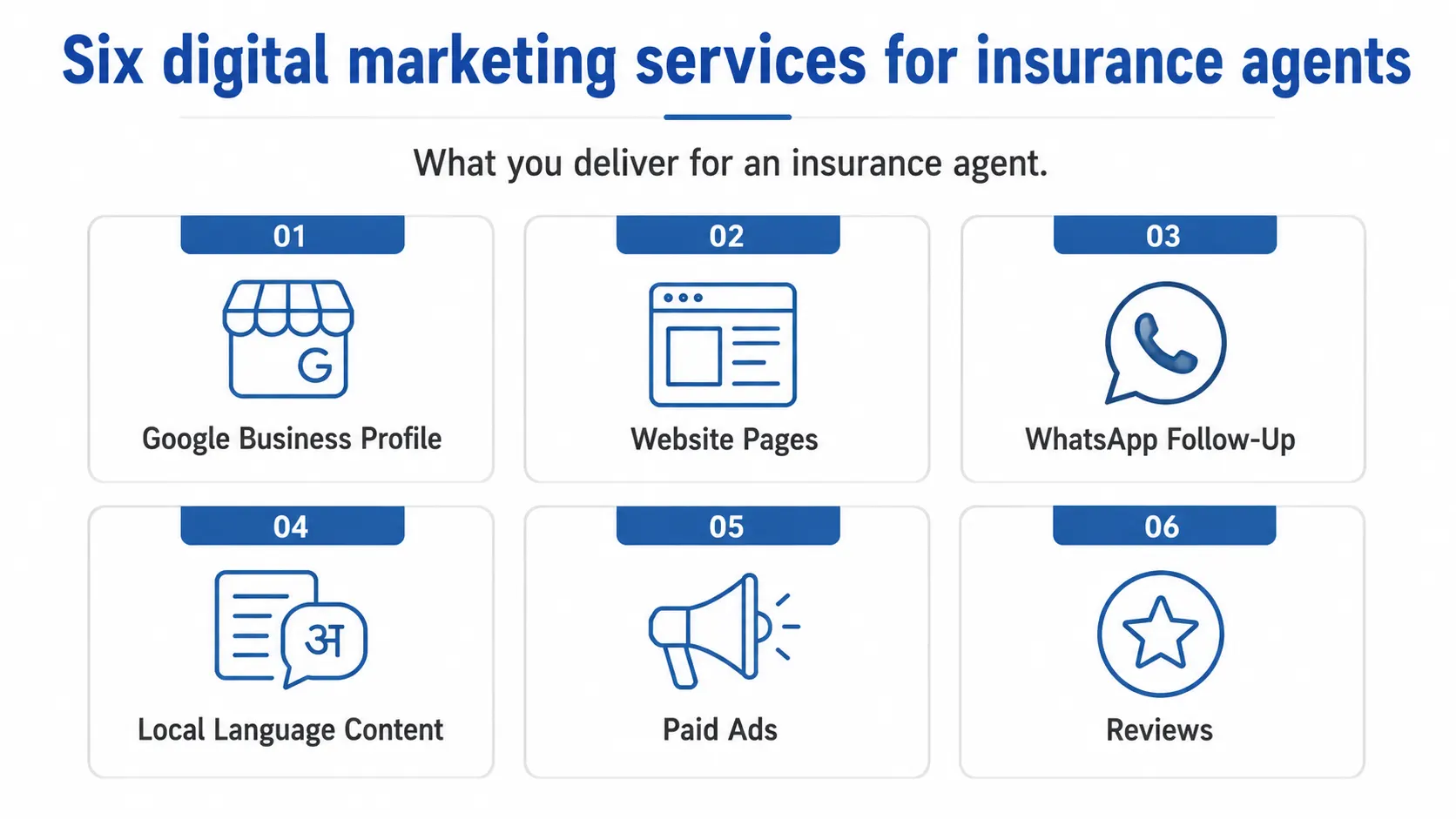
Google Search ads on local intent terms and Meta lead forms both work for agents. Budgets are small, often ₹200 to ₹500 a day, so keyword hygiene and negative keyword lists matter more than clever creative.
Every ad needs the insurer’s written approval before it runs if it names a product, a benefit or a number. More on this below.
You build a simple process: ask for a Google review after every claim the agent helps settle, respond to all reviews within a week, and report on the rating monthly.
Never write fake reviews and never offer anything in exchange for one. That single decision protects your career.
This section is why a trained marketer earns more than a freelancer who has never read the regulations.
Most articles online still cite the IRDAI (Insurance Advertisements and Disclosure) Regulations, 2021. Those were repealed. Regulation 58 of the IRDAI (Protection of Policyholders’ Interests, Operations and Allied Matters of Insurers) Regulations, 2024 repealed them with effect from 1 April 2024.
The current framework has three documents:
What this means in practice:
| Rule | What it means for your work |
|---|---|
| Broad definition of “advertisement” | Any communication meant to influence someone towards buying a policy counts. A WhatsApp forward, an Instagram reel and a Google ad are all advertisements. |
| Agents advertise for the insurer | A distribution channel may promote the insurer’s products. An agent cannot present a product as their own offering. |
| Names and benefits must match the filing | You cannot rename a plan or round up a benefit to make the copy read better. |
| Risk disclosures are compulsory | Unit-linked and index-linked products cannot be advertised as investment products. Risk factors and warning statements must appear. |
| Ratings need an independent source | The rating body must be independent of the insurer, and no payment can be made to obtain the rating. |
IRDAI named mis-selling a significant concern in its 2024-25 annual report. Grievances filed under Unfair Business Practices rose from 23,335 in 2023-24 to 26,667 in 2024-25, taking their share of total life insurance grievances to 22.14%.
Follow those three and you will be more careful than most agencies currently serving this sector.
Learn in this order. Each one earns money before you move to the next.
Add one more thing that is not a tool. Read the two IRDAI master circulars once. You will be the only person in the room who has.
Two agents at a modest monthly retainer, delivered properly, is a working portfolio and a reference you can use for the next five.
Two things decide whether this becomes a career or a short experiment.
The first is proof. An agent judges you on whether their Google listing improved and whether the phone rang more this month than last. Take your first client early, even at no charge, and collect before-and-after screenshots from week 1.
The second is the compliance habit. Running a Meta lead form takes a fortnight to learn. Reading the 2 IRDAI master circulars takes one afternoon, and almost nobody working in this sector has done it. The marketers who have are the ones who keep the account.
Digital marketing for insurance agents is steady, unglamorous work. The channels are simple, the rules are strict, and clients pay monthly and stay for years when you keep your word about what you can deliver.
Learn the fundamentals properly, read the regulations once, and find your first agent within walking distance of your home.
It is the work of getting a licensed insurance agent found online and helping them follow up with enquiries. It includes their Google listing, website, content, WhatsApp and email follow-up, reviews and paid ads.
No. You are providing marketing services, not soliciting or selling insurance. The licensed agent gives all product advice and makes the sale. Keep that division clear in your contract.
Only with the insurer’s written approval, obtained through the agent, before the ad goes live. Generic material about the agent’s name, contact details, experience and the lines of insurance they handle is treated differently from product-specific material.
Local search plus WhatsApp follow-up, for most agents. Insurance buying is local and trust-led, and the enquiry usually needs several touches before it converts.
Google Business Profile improvements often show in Maps impressions within 2 to 4 weeks. Website content ranking usually takes 3 to 6 months. Say this honestly at the start rather than promising quick numbers.
Both exist. Insurance-focused digital marketing agencies hire for local SEO, content and paid ads roles. Many people also build a freelance base of 3 to 5 agents while studying or working.
Do not promise returns, use the word guaranteed, invent statistics, buy or write fake reviews, or publish product details without the insurer’s approval. Every one of those creates a compliance problem for your client and ends the relationship.

 }})