
Courses

Generative Engine Optimisation is dominating the discussions in 2026’s tech landscape. Today, you might be learning some new words like ‘Organic traffic is shrinking’ and ‘high rankings aren’t delivering results’. It’s not a hype, but a reality for marketers in 2026.
In 2026, AI search engines like Perplexity and ChatGPT power 50% of queries worldwide. McKinsey predicts that the percentage will reach 75% by 2028, assuming its statistics are believed.

The traditional SEO traffic is declining as customers prefer ‘zero click’ answers. Yes, it may be another bitter pill that businesses need to swallow.
Now, if you ask me, why is this shift taking place? What is the solution? Will machines replace humans in the future? Is there anything to fix? How to get more visibility across the AI platforms?
Generative Engine optimisation is the answer. It is a practice to structure your content so that AI can put it into its systems. Hence, instead of getting a general ‘AI Overview’, your brand can become a part of the ‘answer’.
Generative engine optimisation is the practice of structuring and writing content to rank highly in AI-generated responses. Traditional SEO aims to crack the search engine results pages (SERPs). But GEO focuses on being the source authority in synthesised answers.
It does not work like Google’s ranking algorithm. GEO combines semantic search with large language models. In doing so, AI presents answers from the sources it trusts, and this is where the shift takes place.
Now, AI gives you a direct answer, instead of website links. So, today, you are producing content not only to rank high. Your content needs to be a trusted source that the AI engines choose to include.
Thus, in the current scenario of digital content, GEO has a vital role to play. People build it based on the fundamentals of SEO. The key principle includes precise content structure, strong authority over the topic and keyword alignment. Generative engine optimisation adds another layer to it, ensuring AI systems analyse and present your expertise.
Generative engine optimisation works closely with AI search optimisation. But the question is how? With each passing day, there is an increased fan base for AI-powered search. ChatGPT creates history by hitting 100 million users faster than any application.
The other AI platforms like Grok, Gemini and Perplexity are also in the race. A report published on Perplexity’s official site confirms a surge in the search, with 780 million queries in May 2025. Google’s AI overview now appears in billions of searches each month. Gradually, the dependence on AI assistants is increasing.

Just like a good marketing professional, AI helps in shaping purchase decisions. So, whenAI-generatedd answers mention your business, you can instantly be a part of customers’ consideration.
In brief, GEO’s key role in AI search optimisation:
Today, AI-driven results are a part of the search process. Google’s AI overview can deliver a full answer in the results. A report from the Boston Institute of Analytics highlights that globally, 65% of the search attempts end without a click. In March 2025, it is noted that the organic click rates were down from 44.2% to 40.3%.
Furthermore, Reddit clicks and publisher data click rates reduced between 18% to 64%. The Global media sites have also noticed this pattern. Statistics display a traffic fall from 2.3 billion to 1.7 billion in one year.

Within an emerging tradition of zero click rates, GEO benefits in a bit different way. In a zero-click trend, content visibility is as important as ranking. Hence, structuring the content is key to getting AI visibility.
Generative engine optimisation does not define a single traffic. If you want visibility, you must treat GEO as a practice. It makes your content easier for AI to find, analyse and interpret. Similar to SEO, GEO is a way of content creation, but in a more strategic way. Authority, Trust and technical optimisation are the pillars which GEO advocates for. Now comes the most important question: How to optimise content for getting a rank on AI? This section will guide you through it:
In the previous sections of this blog, I have mentioned the word ‘trust’ quite a few times. Why do you think trust becomes an important factor in Generative engine optimisation? It is because AI pulls out only the sources it can trust. So, building an authority plays a key role in AI rankings.

If the engine fails to verify your expertise, you may fail to get cited. Hence, you need to have a strong author profile. There has to be a name and face in your content. Make research your ultimate best friend for content creation.
Statistics, credentials, and logical reasoning are the proof that you are a well-informed creator. Use your own experience and share only insights you’ve personally gained.
Google’s search quality rater guidelines specify Experience, Expertise, Authoritativeness, and Trustworthiness. AI engines often rely on these principles.
Adhering to it helps ensure the credibility of your content. Coming up with real-life examples, insights and case studies is the best way to gain experience.

Your expertise is visible through author attribution, which links your previous work and credentials. You can build authority over a niche through backlinking from credible sources.
Build trust with your readers by being transparent in your approach. You can put a list of contact information, links (https) and publish accurate data.
Hence, E-E-A-T is your checklist for each piece of content you want to publish. It is not a direct ranking factor, but helps you to perform well. Also, it enhances your chance to pop up in AI-generated results.
If the search engine fails to index, crawl and understand your site, AI engines will not either. So, technical SEO has a key role in supporting both. Make your website faster by optimising images and removing unnecessary code. Use a content delivery network if you have visitors from around the world.

Your site must work well on mobile and pass the essential web vitals standards. Use a clear and logical URL structure with internal links so that important pages are easy to locate.
A regular site audit often helps you to spot broken links, duplicate content, or indexing problems before they affect your search visibility.
Tools like AIOSEO, Google Search Console, and Screaming Frog help to improve the technical aspect. A clearer technical setup increases your chances of showing up in search results and AI answers.
AI search engines work in a different way than regular search engines. In using AI, people type full questions instead of typing a few keywords. To match this search pattern, your content needs to be a direct answer to the question that people are asking. Use longer, more natural phrases that sound like real conversations.

Think about how someone would invite loud, and use similar phrases in your headings and subheadings. Include questions or ‘wh’ words that start with “who,” “what,” “where,” “when,” and “how” to make it easier for AI to understand and match your content.
Break down complicated topics into smaller, easy-to-read sections. This helps AI pick out the key information more effectively. Don’t try to stuff too many keywords. Just focus on making your content clear and meaningful. Explain the topic as if you’re a real person talking about it, so AI models can better understand and use the information.
Have you ever experienced AI searches giving you a full list of YouTube videos? Or shorts, or perhaps Instagram reels? Do you know why it is happening these days? It is because AI engines do not just refer to written articles. We refer to videos, podcasts, and visual content when they add contextual value to the answer.

You need to share your expertise across various multimodal formats. The original images, charts, and infographics ensure a simple explanation of complex topics. Short videos or audio clips are also valuable in summarising key points of your content.
But an added nuance here is that, currently, AI can not listen to podcasts or watch videos. It extracts the information through optimisation, similar to metadata, captions, alt text, and structured data.
Format diversification is your way to reach audiences who prefer watching or listening over reading. It gives AI more channels to distribute or surface your content. Overdependence on writing limits your potential visibility on the list.

AI platforms do not just get info from regular websites. They also look through the public content on forums, question answer sites and social media platforms.
When your brand is mentioned in these places, search engines actively associate your name with your expertise. Participate in discussions on sites like Reddit, Quora, and specialised industry forums.
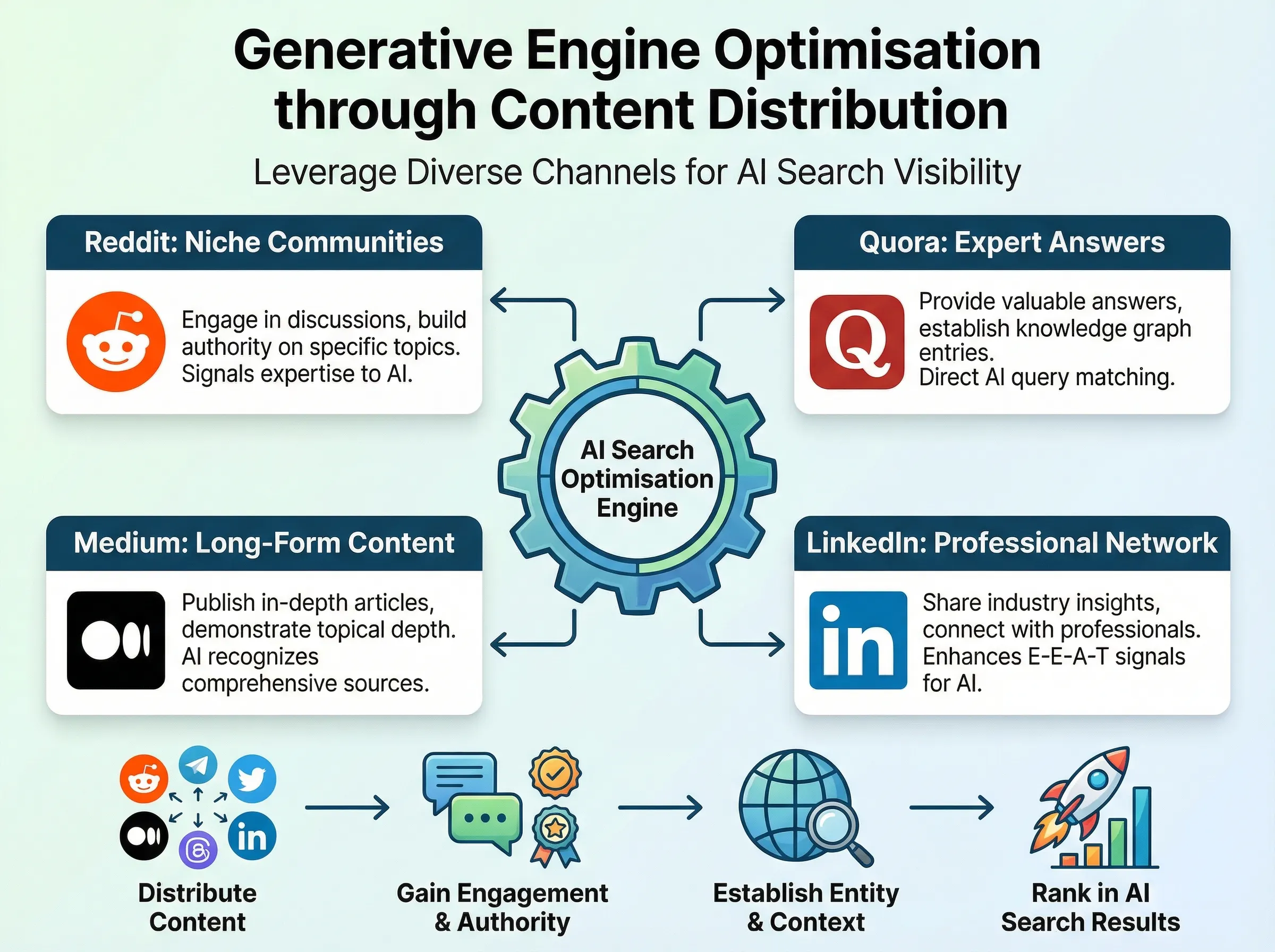
Offer helpful insights, answer questions, and include links to more detailed resources when it makes sense. Turn your blog posts into shorter updates on LinkedIn or Twitter threads so your ideas reach people beyond your website.
Search is evolving quickly, and GEO is going to adapt along with it. Here are some of the important changes you should not miss if you want to keep reaching your audience.
Google’s AI mode has been revolutionary in AI-driven search trends. It gives people complete AI-generated answers. It reduces the necessity to go through the website links. When this approach becomes a daily habit, the AI boxes will be the first thing people will read.
Now, imagine if your brand does not appear, the visibility will shrink drastically. If you want to compete, your content needs to be structured, well researched, statistically sound and easy in language. This will help Google’s systems to pull into the AI summaries.

Search is getting smarter by anticipating what users might need before they even ask. Predictive tools can assume what someone might look for using things like how they behave, where they’re located, and their past searches. Based on these, the tools can deliver answers today. The spectrum of multimodal search allows text, images, and videos into a single search.
To be visible in these results, your content needs to have value in different forms. Clearly written copy, keyword-rich images, and video transcripts that link it all together.
Few related topics for your knowledge
To sum up our discussion, I need to say a few things. Generative engine optimisation should not be your future project. It is already reshaping how people find information daily. With each passing month, more searches are ending with AI-generated answers. If you are not popping up there, you might end up losing visibility.
The shift underscores how you share and spread your knowledge so that AI can understand and rely on it. This means having stronger E-E-A-T signals, using different types of content, and being where your audience asks questions.
Hence, you don’t need to change everything all at once. You can start with a particular niche to produce your content. Work on it to make it easier for AI to interpret and track where it shows up.
GEO is a practice of writing and structuring content so that it gets a rank in AI searches.
Generative engine optimisation is getting more importance than traditional SEO because today, the AI-powered searches have become more dominant. It drives the zero-click searches, where the user gets a direct answer, without visiting the sites.
Clearly written with a precise structure and well-researched content is the best fit for Generative engine optimisation. Adding infographics, supporting statistics, and multimedia formats increases the chance of getting a rank in the AI search results.


 }})