
Courses
What is search engine marketing and why does it make the difference between a brand nobody knows and one that everyone is buying from?
In order to point out the difference, let me tell you about Myntra.
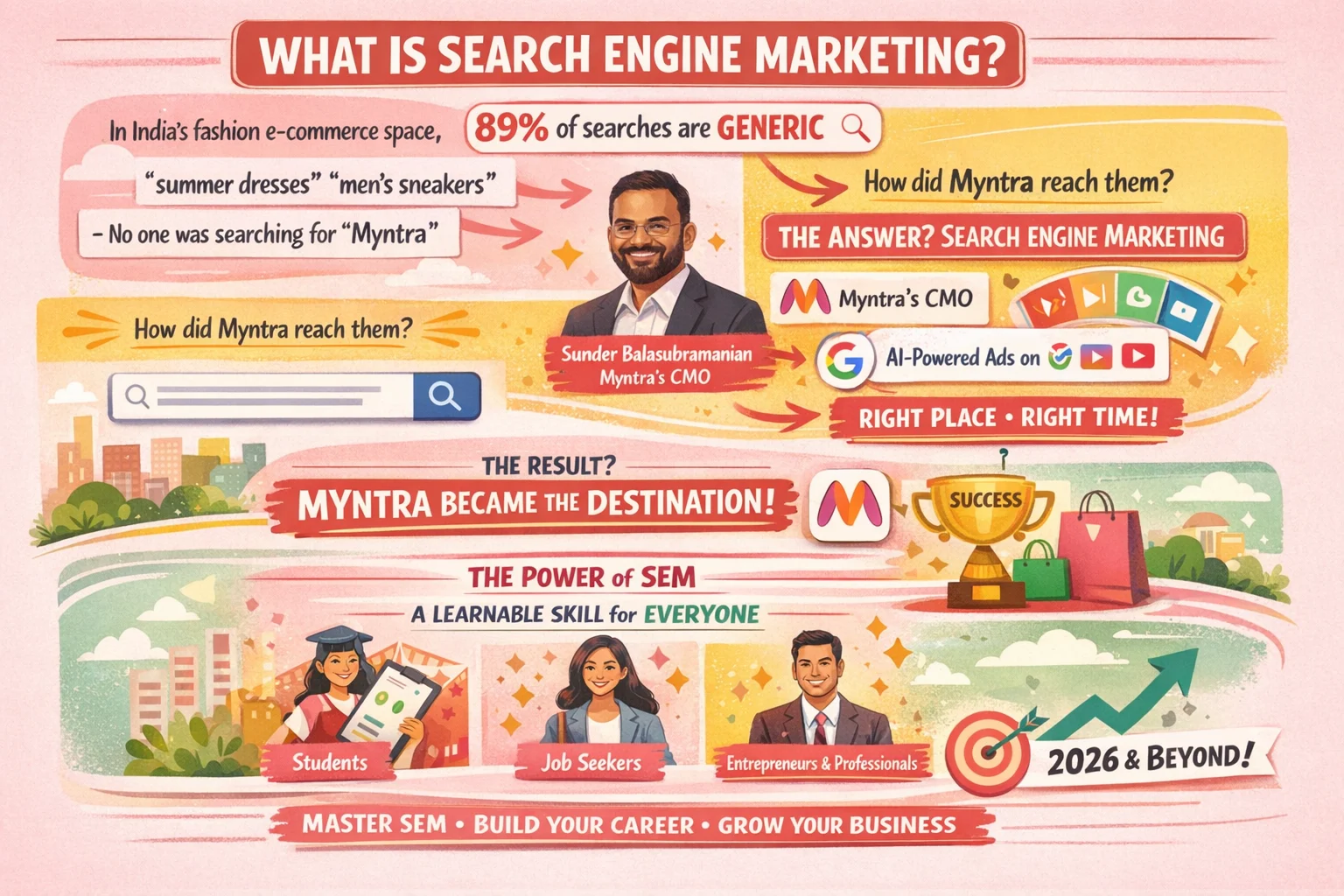
In India’s crowded fashion e-commerce space, Myntra faced a problem that would keep any marketing team up at night. Around 89% of fashion-related searches in India are completely generic, meaning a potential customer searching “summer dresses” or “men’s sneakers” is not typing Myntra’s name. They are not looking for Myntra specifically. They are just looking.
So how does a brand show up at that exact moment, before the customer has even decided where to buy?
The answer was Search Engine Marketing.
Myntra’s Chief Marketing Officer Sunder Balasubramanian worked with Google to deploy full-funnel AI-powered ad solutions across Search, video, and apps reaching customers at scale, precisely at the moment purchase intent occurred. They did not wait for customers to find them. They showed up on the SERP or the search results pages right when those customers were looking.
The result? Myntra did not just survive the competition. It became the destination.
That is the power of search engine marketing when it is done right. In today’s market scenario, this is not a strategy reserved for large corporations with crores in ad budgets. It is a skill. A learnable, practical, career-defining skill that students, professionals, and business owners across India are using right now to change their outcomes.
Whether you are a student figuring out what career to build, a job seeker looking for a skill that actually gets you hired, or a professional ready to level up; understanding SEM is one of the smartest moves you can make in 2026.
This guide will walk you through everything, from what search engine marketing actually means, to how it works, what mistakes to avoid, and what it can do for your career and your business.
Let us get into it.
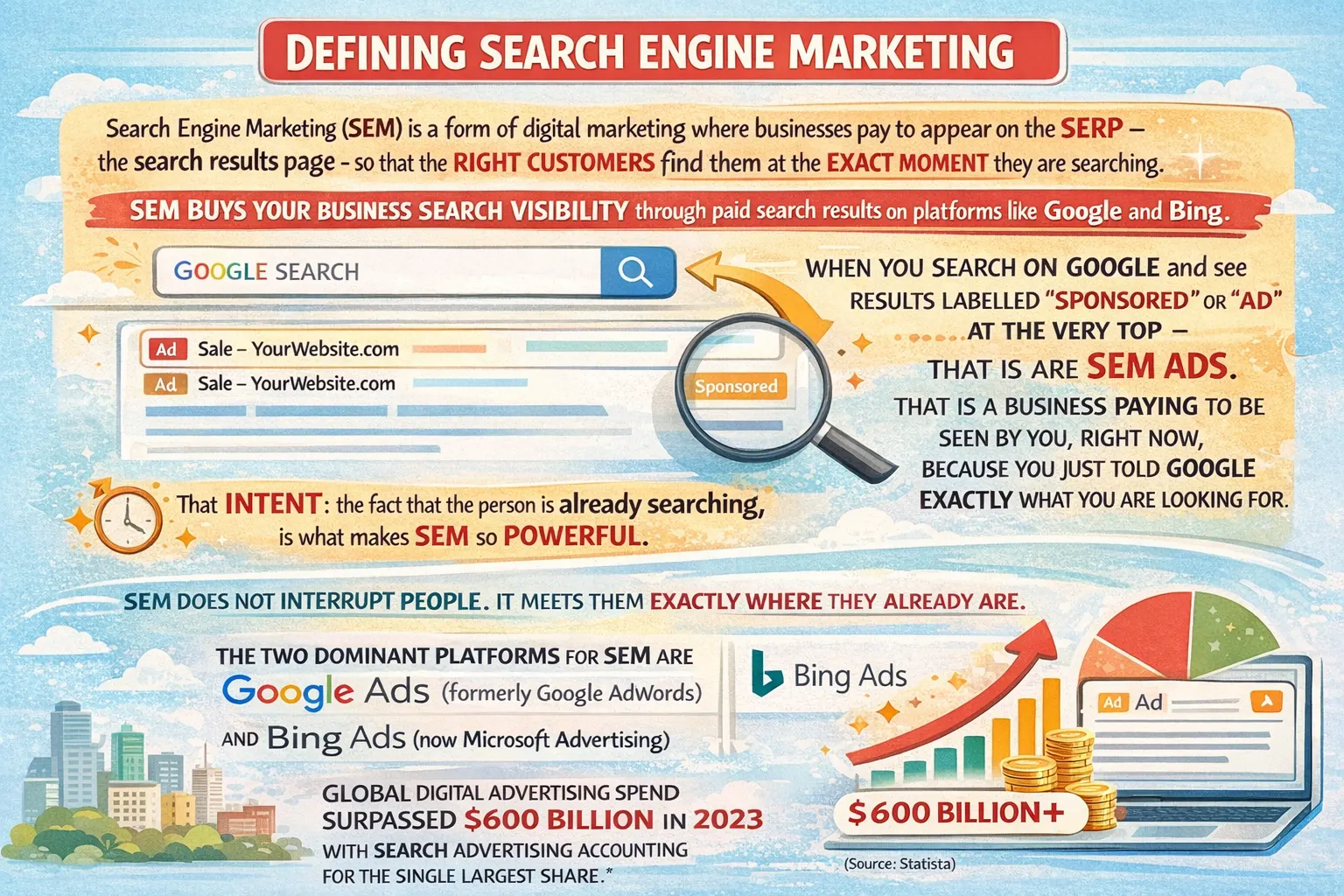
Search Engine Marketing (SEM) is a form of digital marketing where businesses pay to appear on the SERP, the search results page so that the right customers find them at the exact moment they are searching.
In plain words: SEM buys your business search visibility through paid search results on platforms like Google and Bing.
When you search something on Google and see results labelled “Sponsored” or “Ad” at the very top those are SEM ads. That is a business paying to be seen by you, right now, because you just told Google exactly what you are looking for.
That intent: the fact that the person is already searching, is what makes SEM so powerful.
SEM does not interrupt people. It meets them exactly where they already are.
The two dominant platforms for SEM are Google Ads (formerly Google AdWords) and Bing Ads (now Microsoft Advertising). Between them, they control the vast majority of global paid search traffic.
Global digital advertising spend surpassed $600 billion in 2023 with search advertising accounting for the single largest share. (Source: Statista)
Step Into the World of Digital MarketingLearn from Digital Marketing Experts |
|
| Advanced Diploma in Digital Marketing | |
| More Learning Options for you: Diploma in Digital Marketing | Google Ads Certification Training | Certification Course |
Here is the simplest way to understand it.
Every time someone types a query into Google, there is a real-time competition happening behind the scenes. Businesses are bidding to appear in front of that person. The business that wins that competition gets its ad placed at the top of the search results page above all organic results.
That competition, that bidding, that placement, that entire process is Search Engine Marketing.
Think of it like this. Imagine a massive marketplace where millions of customers walk in every second, each one looking for something specific. Search Engine Marketing is your way of standing right at the entrance with a sign that says exactly what the customer is looking for, before they even walk past your stall.
No shouting. No interruption. Just perfect timing.
Digital marketing is a broad world. It includes SEO, social media marketing, email marketing, content marketing, influencer marketing, and more. SEM lives within the paid media category of this world, and it stands apart from everything else for one reason.
Every other channel either interrupts or waits.
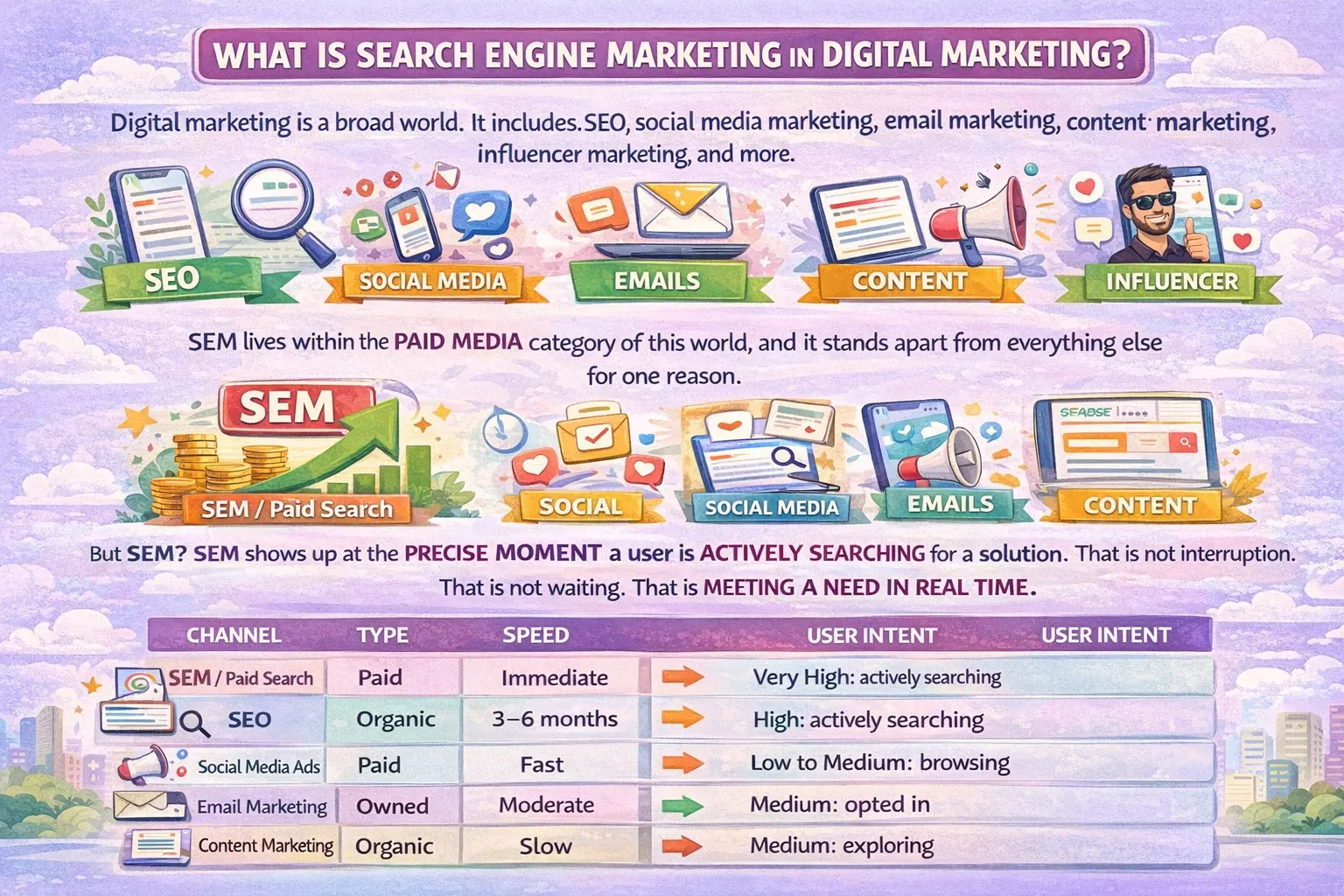
Social media ads interrupt users mid-scroll. Email waits in an inbox. Content marketing waits for Google to rank it. But SEM? SEM shows up at the precise moment a user is actively searching for a solution. That is not interruption. That is not waiting. That is meeting a need in real time.
| Channel | Type | Speed | User Intent |
|---|---|---|---|
| SEM Paid Search | Paid | Immediate | Very High: actively searching |
| SEO | Organic | 3–6 months | High: actively searching |
| Social Media Ads | Paid | Fast | Low to Medium: browsing |
| Email Marketing | Owned | Moderate | Medium: opted in |
| Content Marketing | Organic | Slow | Medium: exploring |
This intent-based targeting is why SEM consistently delivers some of the highest ROI of any digital marketing channel available today.
Let us make this real.
Imagine you run a digital marketing institute in Kolkata. A student sitting in their room types “best digital marketing course with placement in Kolkata” into Google. Within milliseconds, before that page even fully loads Google has run an auction. Your ad, set up through Google Ads search engine marketing, wins a top spot. The student clicks, lands on your admissions page, fills out an enquiry form.
That click cost you ₹40. That student enrolled in a ₹35,000 course.
That is search engine marketing. Not magic. Not luck. Precision.
Example 1: E-commerce A user searches “best running shoes under ₹3000”. A shoe brand running a Google Ads campaign appears at the top with a Shopping Ad product image, price, store name visible right on the SERP. User clicks. Buys. Brand pays ₹30 per click, earns ₹2,800 in revenue.
Example 2: Local Business A dentist in Pune runs a Google Local Search Ad targeting “dentist near me”. Their ad appears with address, phone number, and star ratings. A patient calls directly from the ad without even visiting the website.
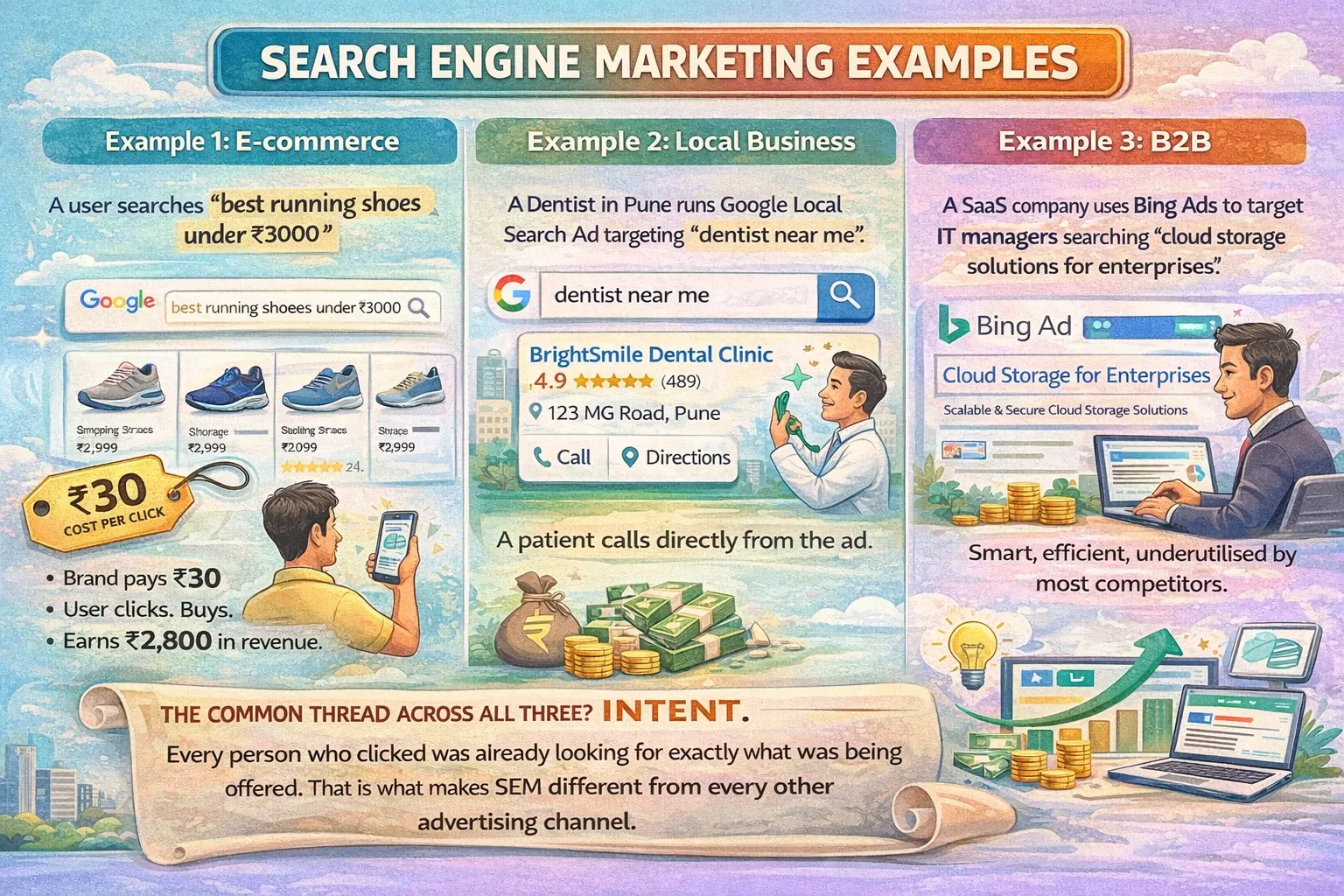
Example 3: B2B A SaaS company uses Bing Ads to target IT managers searching “cloud storage solutions for enterprises”. Bing’s professional, older user base means the cost per click (CPC) is significantly lower than Google with equally qualified leads. Smart, efficient, underutilised by most competitors.
The common thread across all three? Intent. Every person who clicked was already looking for exactly what was being offered. That is what makes SEM different from every other advertising channel.
Understanding how search engine marketing works is what separates people who get results from people who burn through budgets.
Here is the complete process, step by step:
It all starts with understanding what your audience is typing into Google. A cloud kitchen targets “order biryani online Delhi”. A coaching institute targets “best JEE preparation course online”. The goal is finding high-intent keywords the ones where the searcher is close to taking action.
You build a campaign on Google Ads or Bing Ads. You define your ad groups, write your ad copy, set your target audience, location, device, time of day, demographics and set your budget. This is where strategy meets execution.
SEM runs on a keyword bidding model. You set a maximum cost per click (CPC), the highest amount you are willing to pay when someone clicks your ad. This is the heartbeat of pay per click advertising: you pay only when someone actually clicks. Not when they see your ad. Only when they act.
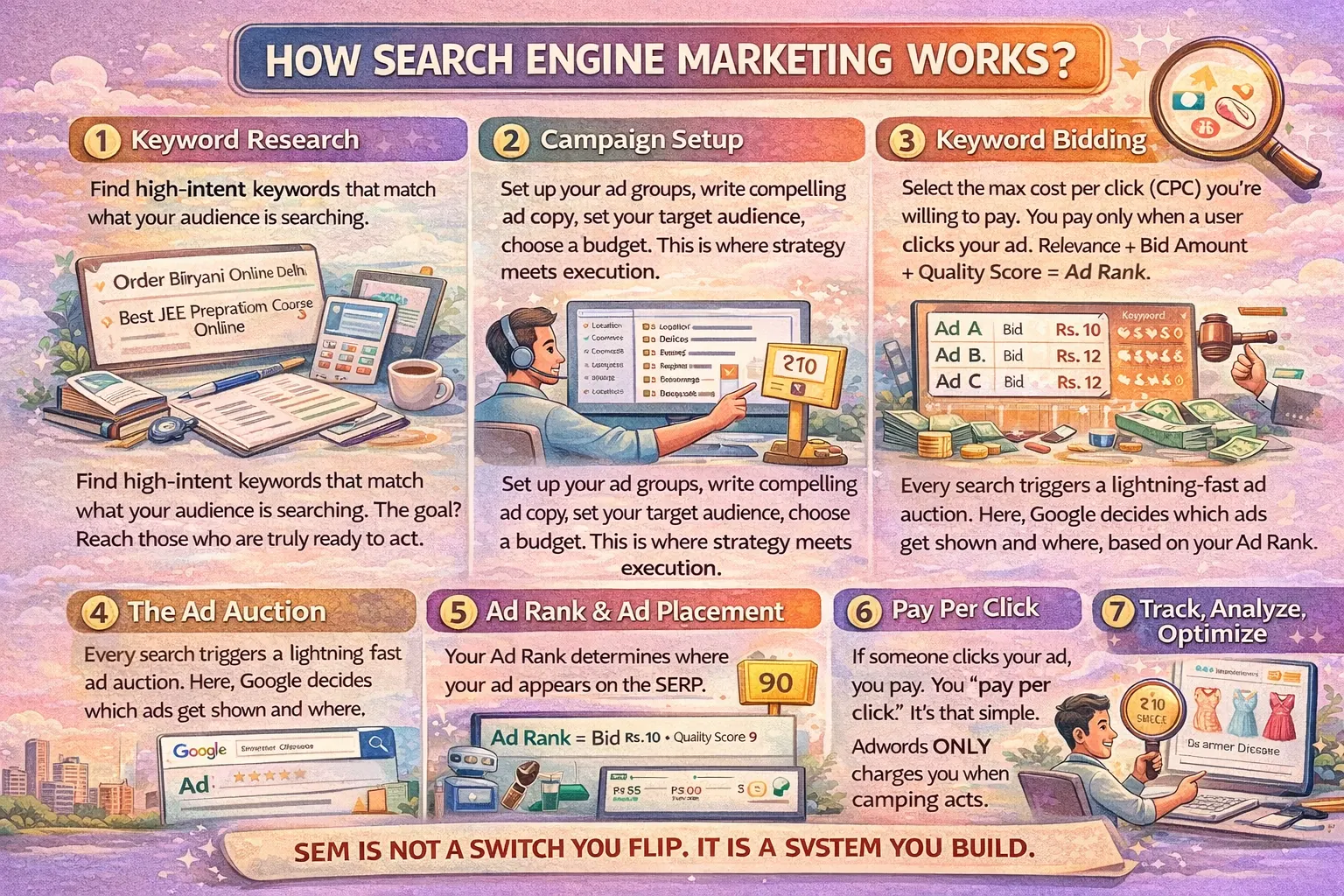
Every time someone searches, Google runs a real-time ad auction in milliseconds. It evaluates every advertiser bidding on that keyword and calculates who gets shown, and where. Two things determine the winner: your bid amount and your Quality Score, a 1 to 10 rating based on how relevant your ad is, your expected click-through rate, and your landing page experience.
The ad rank is the final score that determines your ad placement on the SERP.
Ad Rank = Bid Amount × Quality Score × Expected Impact of Ad Extensions
Here is the insight most beginners completely miss: a higher Quality Score can beat a higher bid. A competitor spending more money than you can still rank below you, if your ad is more relevant. Relevance beats budget. Always.
When someone sees your ad on the search results page and clicks it, you are charged. That is the pay per click advertising model. You pay for results, not exposure.
The click is not the finish line, it is the starting gun. After the click, you track what happens. Did they buy? Fill a form? Call? This conversion data is what makes your PPC campaigns smarter over time. SEM is not a switch you flip. It is a system you build.
Most people hear “ad auction” and picture a room full of people raising paddles. The reality is far more sophisticated, and far more fair.
Every single search on Google triggers a fresh auction. In milliseconds, Google evaluates every advertiser who has bid on that keyword and asks three questions:
These three inputs combine into the ad rank, and the highest ad rank wins the top ad placement on the SERP.
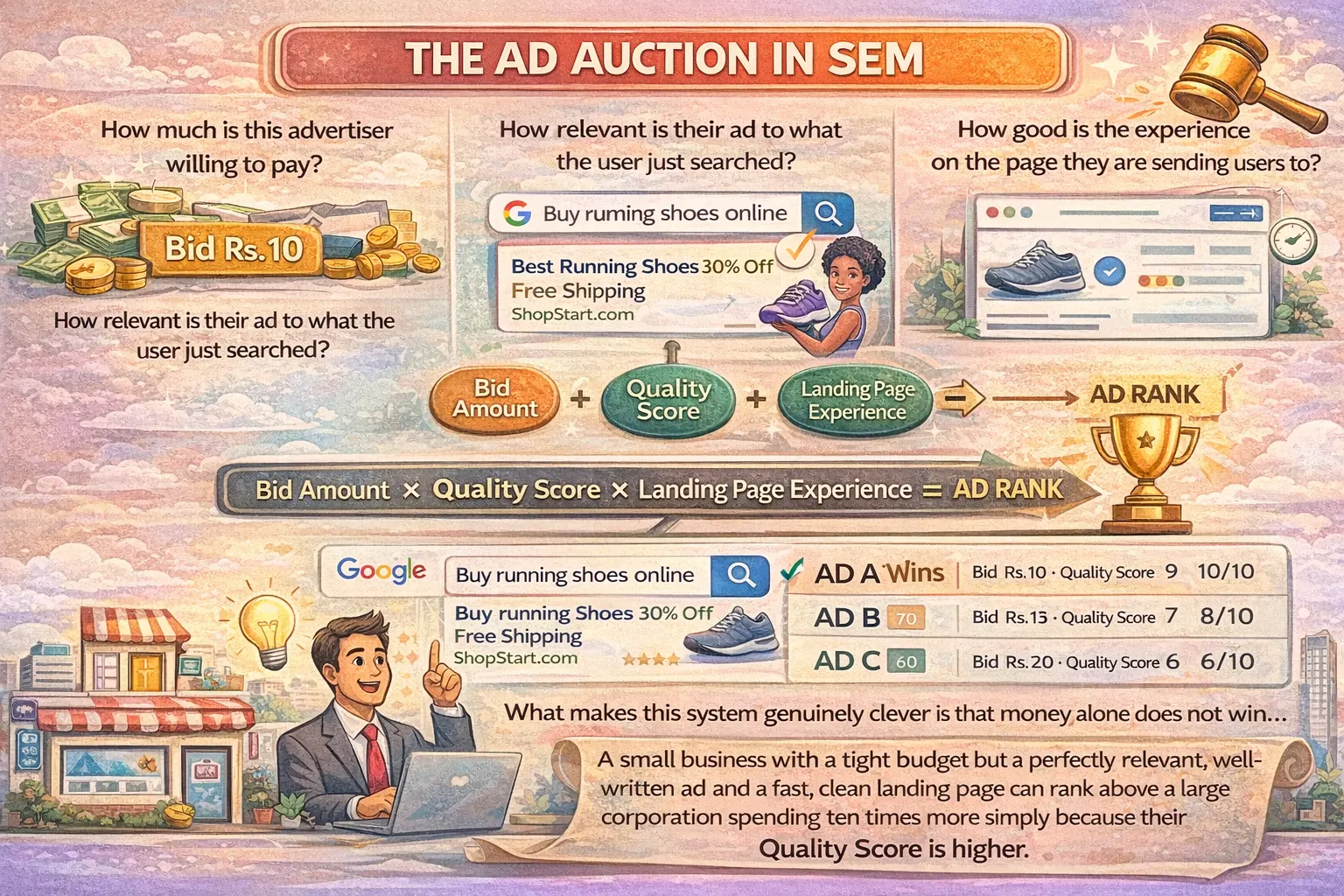
What makes this system genuinely clever is that money alone does not win. A small business with a tight budget but a perfectly relevant, well-written ad and a fast, clean landing page can rank above a large corporation spending ten times more simply because their Quality Score is higher.
That levels the playing field. And that is why understanding SEM is such a powerful skill, because the people who understand it can consistently outperform people who are just outspending them.
SEM is not one thing. It is a family of paid search strategies, each suited to a different goal:
Paid Search Ads: The Core of SEM
Text-based ads at the top or bottom of the SERP when users search targeted keywords. Managed through Google Ads and Bing Ads. This is what most people picture when they think of SEM. Best for: lead generation, immediate traffic, course enquiries, service bookings.
Shopping Ads (Product Listing Ads)
Visual ads showing product image, price, and store name directly on the SERP. When you search “wireless headphones” and see those image tiles with prices, those are Shopping Ads. Best for: e-commerce businesses driving direct product sales.
Display Advertising
Visual banner ads appearing across millions of websites and apps via the Google Display Network. Not strictly search ads, but managed within Google Ads. Best for: brand awareness and remarketing.
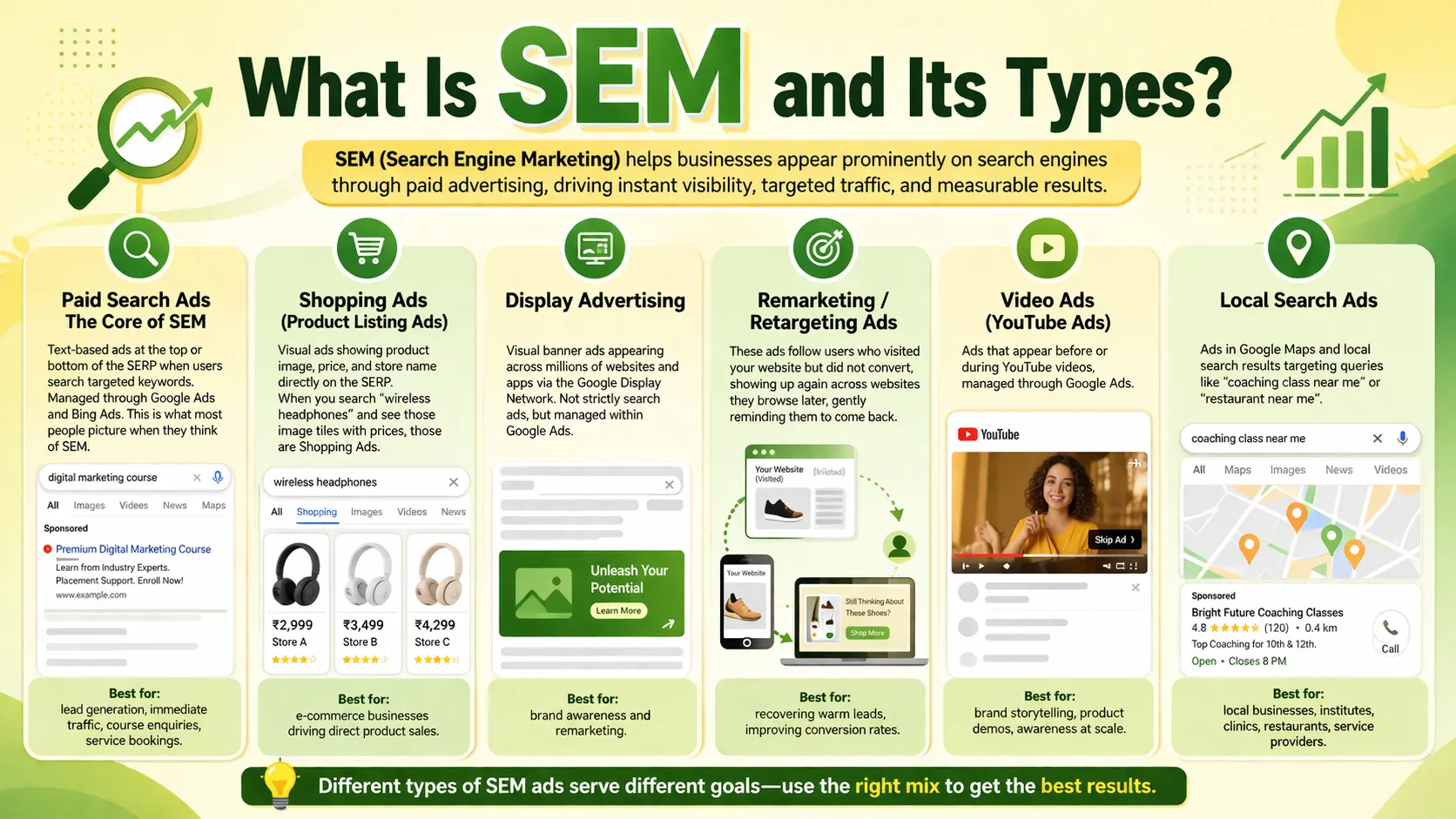
Remarketing / Retargeting Ads
These ads follow users who visited your website but did not convert, showing up again across websites they browse later, gently reminding them to come back. Best for: recovering warm leads, improving conversion rates.
Video Ads (YouTube Ads)
Ads that appear before or during YouTube videos, managed through Google Ads. Best for: brand storytelling, product demos, awareness at scale.
Local Search Ads
Ads in Google Maps and local search results targeting queries like “coaching class near me” or “restaurant near me”. Best for: local businesses institutes, clinics, restaurants, service providers.
The type of SEM you choose should be driven by one question: what action do you want the user to take?
If you want someone to enquire about your course, Paid Search Ads targeting high-intent keywords like “digital marketing course with placement” is your answer.
If you want someone to visit your store or call your clinic, Local Search Ads with call extensions will get the phone ringing.
If you want someone who almost bought but left, Remarketing Ads will bring them back.
If you want to build brand awareness among a cold audience, Display and YouTube Ads will put your brand in front of them before they even know they need you.
The most effective SEM strategies combine multiple types working together- awareness at the top of the funnel, intent-based ads in the middle, and remarketing at the bottom. That is how brands like Myntra do not just capture customers, they build them.
To run SEM well, you need to understand what it is built from:
The search terms you choose to bid on are the foundation of everything. Get these right and everything downstream improves. Get these wrong and even a big budget will produce nothing. Keywords come in types, Broad Match, Phrase Match, Exact Match, and the strategic use of Negative Keywords is what stops your budget from being silently drained by irrelevant clicks.
Quality Score Google rates every keyword-ad-landing page combination on a scale of 1 to 10. A higher Quality Score means better ad placement at a lower cost per click. Three things determine it: your expected click-through rate, your ad’s relevance to the keyword, and the experience on your landing page.
Ad Rank = Bid Amount × Quality Score × Expected Impact of Ad Extensions
This is the number that decides where your ad appears on the search results page. It is the single most important number in your campaign.
What you actually pay per click. Directly influenced by competition and your Quality Score. A better Quality Score means a lower CPC, Google literally rewards relevance with cheaper clicks.
The headline and description users see on the SERP. Great ad copy contains the target keyword in the headline, a clear value proposition in the description, and an action-driving call to action. It is also a direct input into your Quality Score, write it carelessly and your entire campaign suffers.
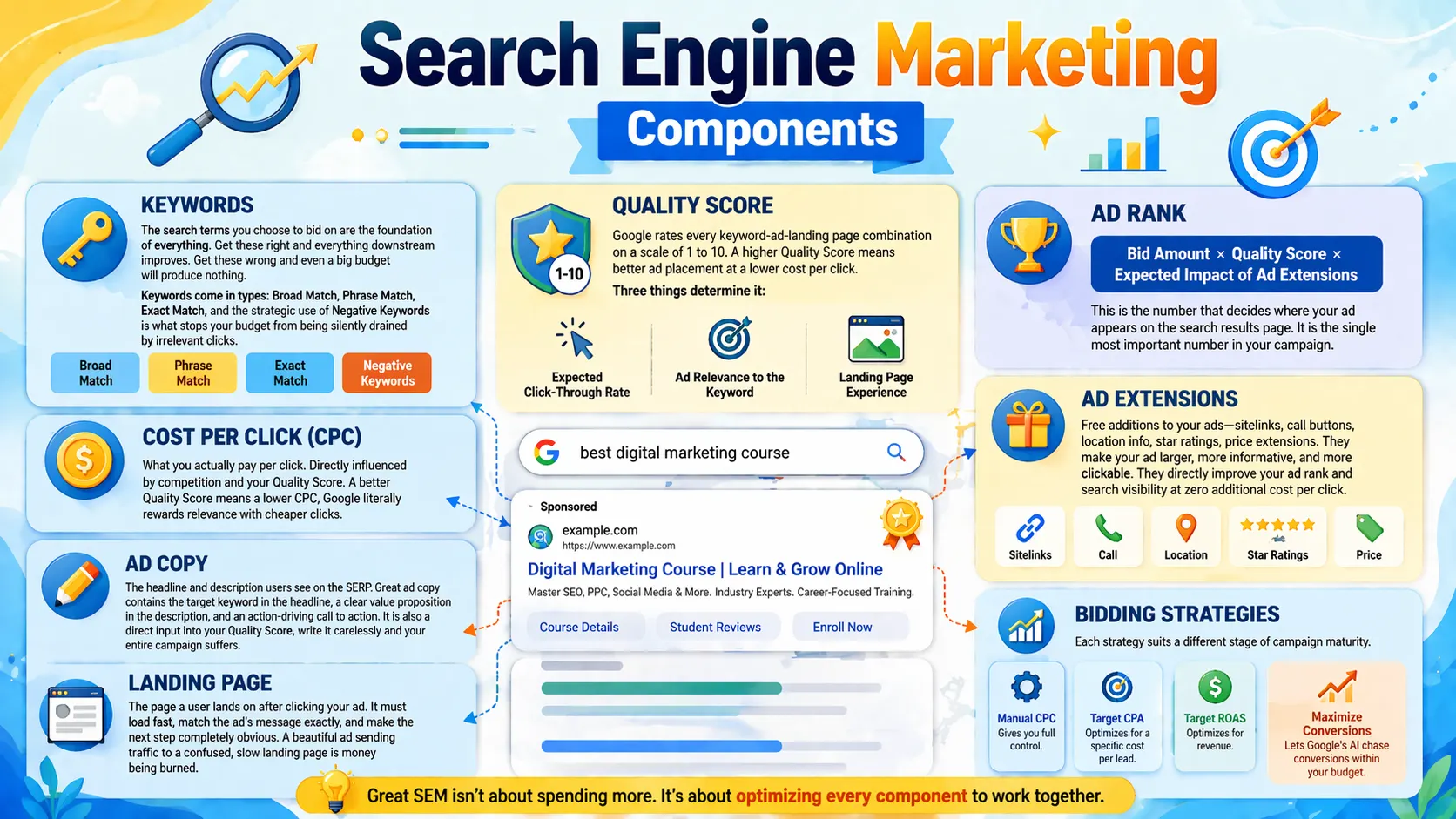
The page a user lands on after clicking your ad. It must load fast, match the ad’s message exactly, and make the next step completely obvious. A beautiful ad sending traffic to a confused, slow landing page is money being burned.
Free additions to your ads, sitelinks, call buttons, location info, star ratings, price extensions. They make your ad larger, more informative, and more clickable. They directly improve your ad rank and search visibility at zero additional cost per click.
Manual CPC gives you full control. Target CPA optimises for a specific cost per lead. Target ROAS optimises for revenue. Maximize Conversions lets Google’s AI chase conversions within your budget. Each strategy suits a different stage of campaign maturity.
This is the question every student, job seeker, and business owner eventually asks. And the honest answer is, they are not rivals. They are partners.
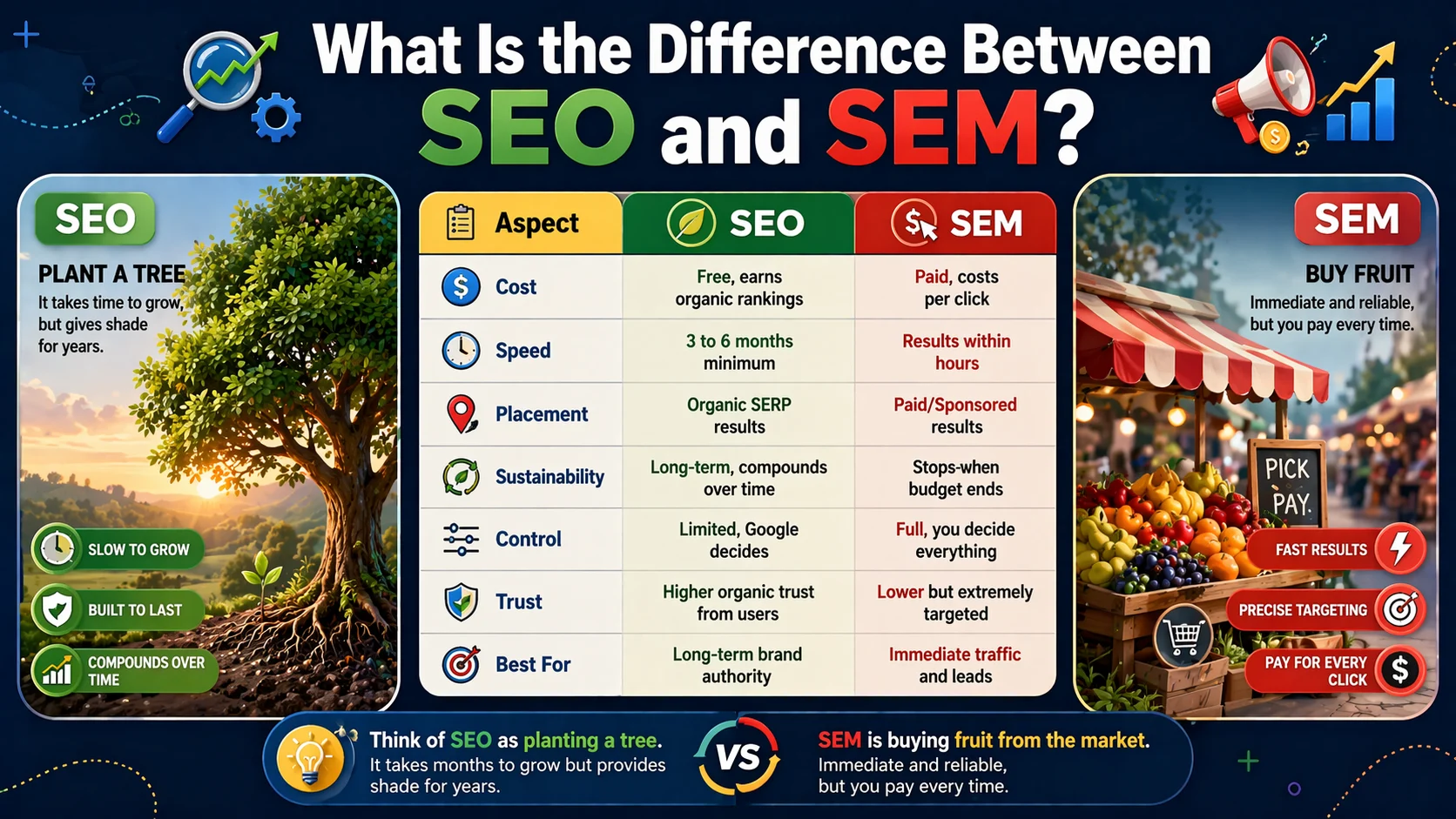
| Aspect | SEO | SEM |
|---|---|---|
| Cost | Free, earns organic rankings | Paid, costs per click |
| Speed | 3 to 6 months minimum | Results within hours |
| Placement | Organic SERP results | Paid/Sponsored results |
| Sustainability | Long-term, compounds over time | Stops when budget ends |
| Control | Limited, Google decides | Full, you decide everything |
| Trust | Higher organic trust from users | Lower but extremely targeted |
| Best For | Long-term brand authority | Immediate traffic and leads |
Think of SEO as planting a tree. It takes months to grow but provides shade for years. SEM is buying fruit from the market, immediate and reliable, but you pay every time.
Neither is universally better. SEO builds the kind of compounding authority that pays dividends for years. SEM delivers immediate, controllable, scalable results. The sharpest digital marketers and the most successful businesses, use both simultaneously. SEO builds the long game. SEM wins the short game. Together, they cover everything.
Why does SEM matter so much in 2026? Here is the honest answer:
Because your competitors are already doing it.
Every day that your business is not showing up on the SERP for high-intent keywords, a competitor is. That is not a hypothetical that is what is happening right now in every industry, every city, every niche.
Beyond that:
A new business can be invisible on organic search for six months or more while SEO builds. SEM eliminates that gap completely. Launch a campaign today, appear on Page 1 tonight.
The person searching “digital marketing course fees in Kolkata” is not casually browsing. They are ready to make a decision. SEM puts you in front of that person at that exact moment. That is not advertising. That is timing.
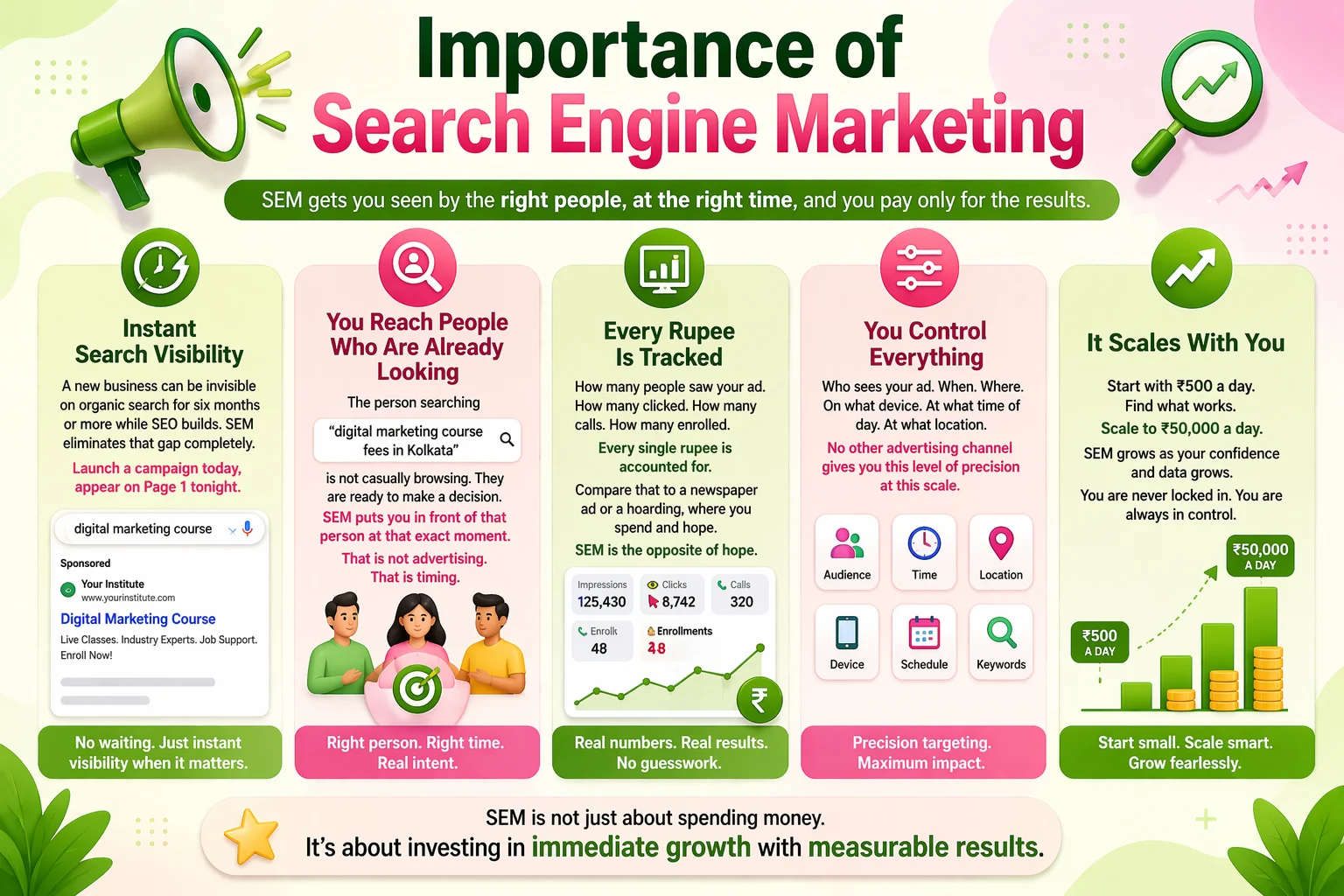
How many people saw your ad. How many clicked. How many calls. How many enrolled. Every single rupee is accounted for. Compare that to a newspaper ad or a hoarding, where you spend and hope. SEM is the opposite of hope.
Who sees your ad. When. Where. On what device. At what time of day. At what location. No other advertising channel gives you this level of precision at this scale.
Start with ₹500 a day. Find what works. Scale to ₹50,000 a day. SEM grows as your confidence and data grows. You are never locked in. You are always in control.
SEM is not just for one type of business or one type of goal. Here is where it gets used most powerfully:
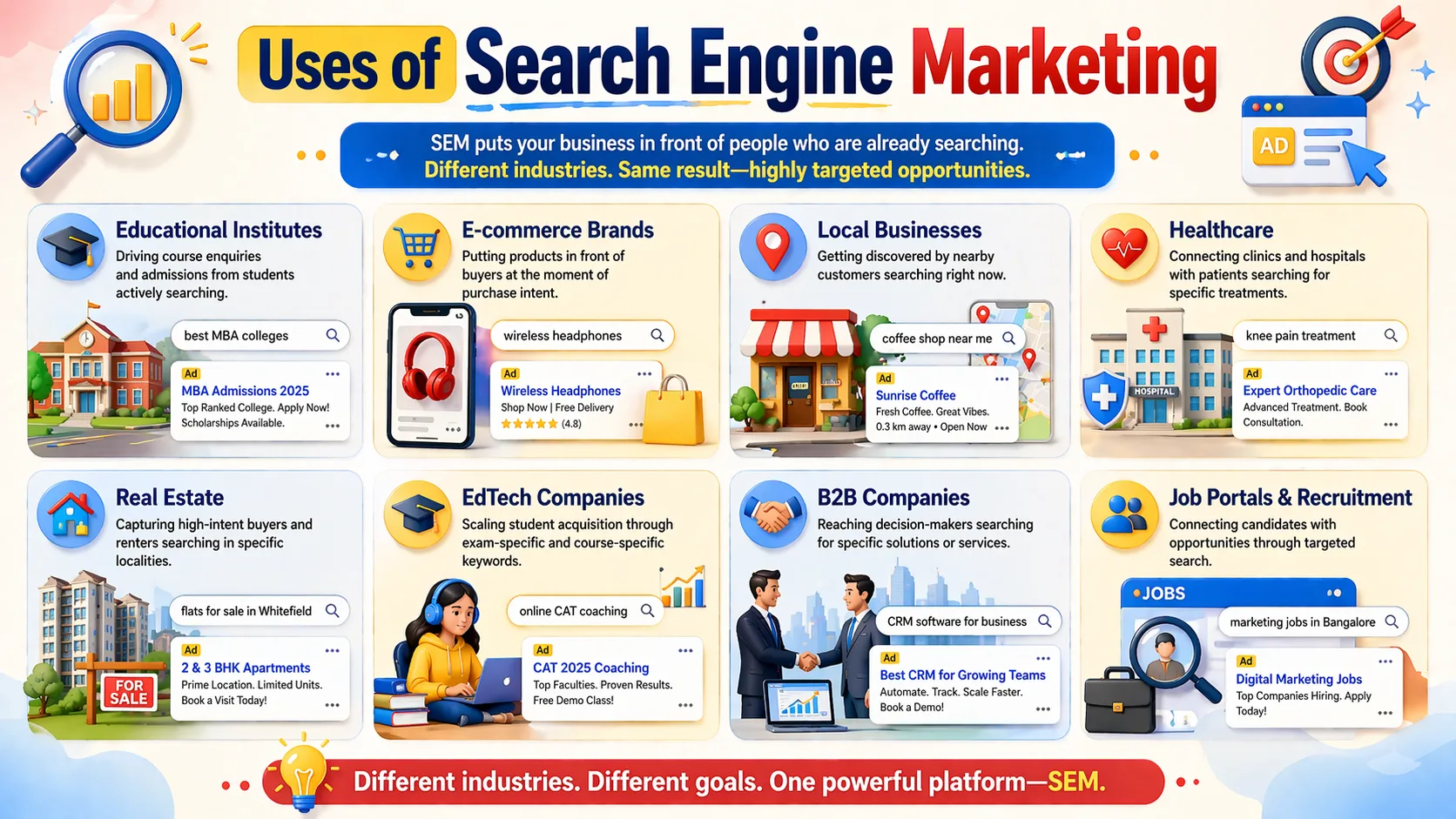
If a potential customer is searching for what you offer SEM is how you make sure they find you first.
Let us be completely honest here. SEM is powerful, but it is not perfect.
| Advantage | What It Means in Practice |
|---|---|
| Immediate results | Go live today, get traffic today |
| Fully measurable | Track every click, lead, call, and conversion |
| Precise targeting | Keyword, location, device, time, demographics |
| Flexible budget | Start small, scale as confidence builds |
| Competitive positioning | Appear above even well-established competitors |
| Retargeting | Win back visitors who left without converting |
| A/B testing | Test headlines, offers, CTAs to find what converts |
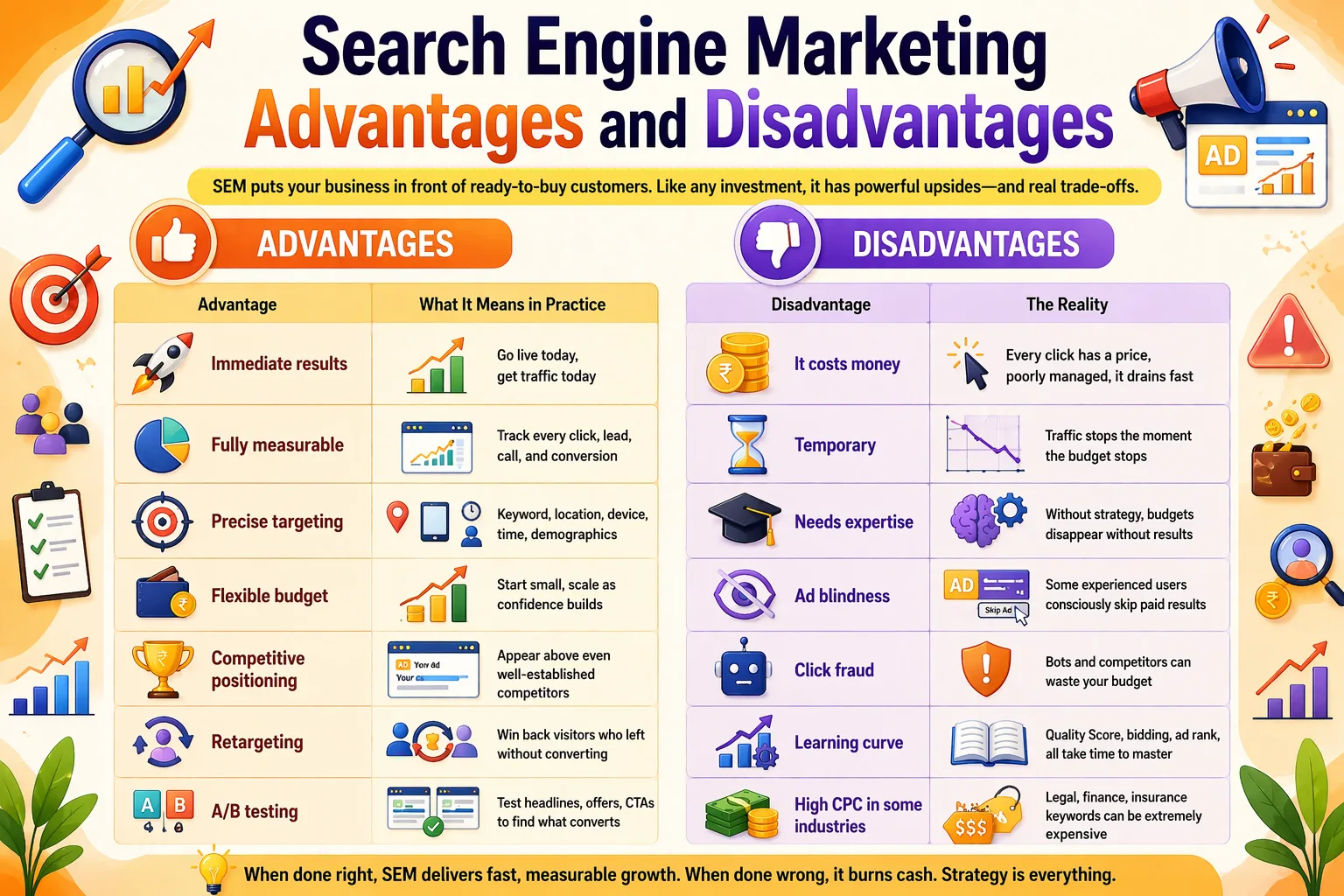
| Disadvantage | The Reality |
|---|---|
| It costs money | Every click has a price, poorly managed, it drains fast |
| Temporary | Traffic stops the moment the budget stops |
| Needs expertise | Without strategy, budgets disappear without results |
| Ad blindness | Some experienced users consciously skip paid results |
| Click fraud | Bots and competitors can waste your budget |
| Learning curve | Quality Score, bidding, ad rank, all take time to master |
| High CPC in some industries | Legal, finance, insurance keywords can be extremely expensive |
The key takeaway: SEM rewards knowledge. The more you understand it, the more efficiently it works. The less you understand it, the more expensive it gets.
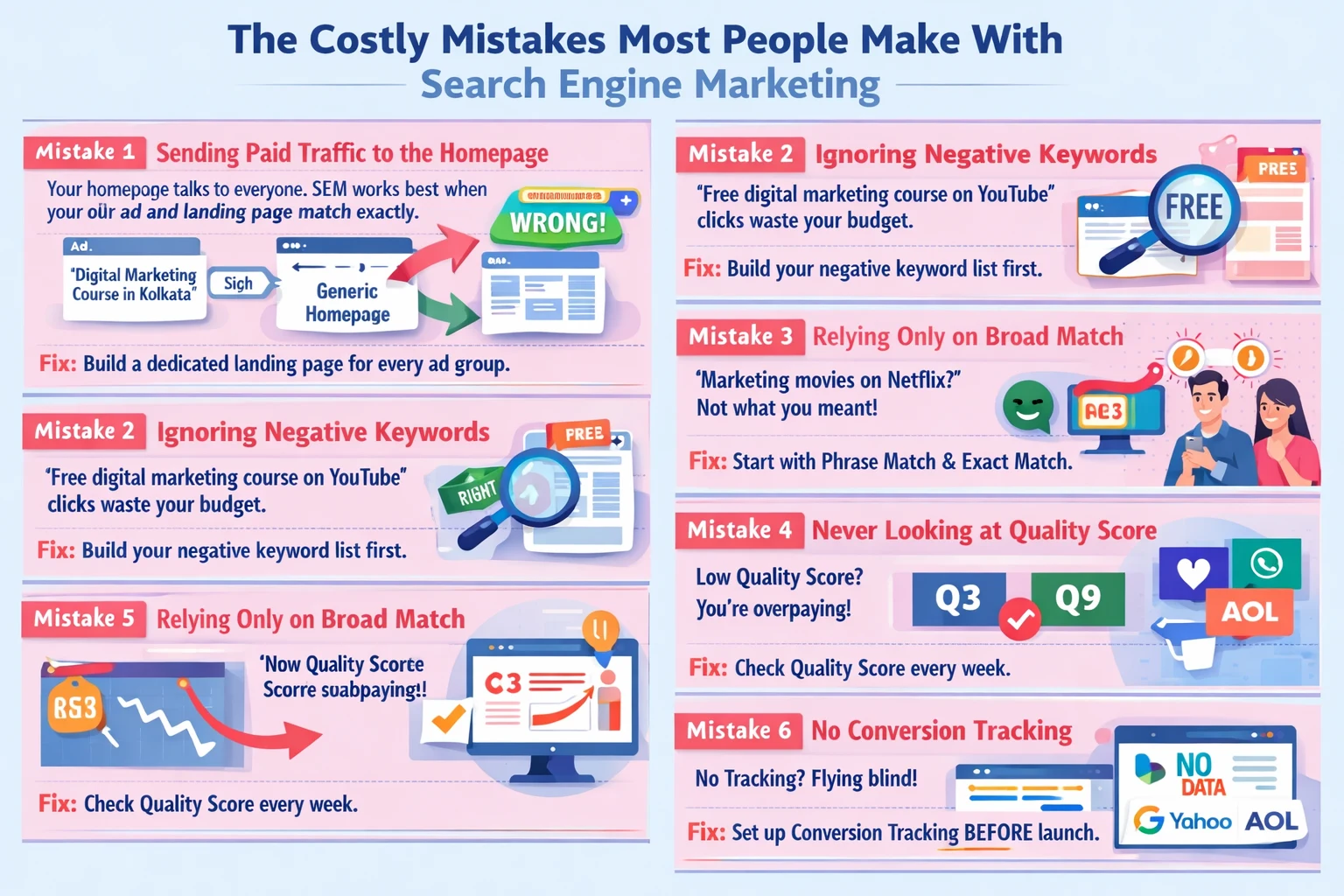
This is the section that will save you real money. Not theory, actual mistakes that happen every single day.
Your homepage talks to everyone. SEM works best when your ad and your landing page say exactly the same thing. A student who clicked “digital marketing course in Kolkata” should land on a page about that exact course, not your generic homepage. Mismatch kills Quality Score and conversions simultaneously.
Fix: Build a dedicated landing page for every ad group. Match the message exactly.
If you are running ads for “digital marketing course” and someone searches “free digital marketing course on YouTube”, and clicks your ad, you just paid for someone who had zero intention of paying you anything. This happens hundreds of times a day without a negative keyword list.
Fix: Build your negative keyword list before you spend a single rupee. Review search term reports weekly.
Broad match tells Google to show your ad for anything it considers “related”, which can mean almost anything. “Marketing course” on broad match might trigger your ad for “marketing movies on Netflix”. You pay. They leave in three seconds.
Fix: Start with Phrase Match and Exact Match. Use Broad Match only after you have real conversion data.
A Quality Score of 3 means you are paying significantly more per click than a competitor with a score of 9, for the same position. Most beginners never check this number. They just watch their budget disappear and wonder why.
Fix: Check Quality Score weekly. Improve ad relevance, landing page speed, and click-through rate consistently.
SEM is not a vending machine. You do not put money in and walk away. Competitors adjust bids. Seasons change. Audience behaviour shifts. A campaign that was profitable in January can be haemorrhaging money by March.
Fix: Weekly reviews are not optional. They are the job.
Running PPC campaigns without conversion tracking is like driving with your eyes closed. You are spending money, but you have absolutely no idea if it is working. This is the single most expensive mistake in all of SEM.
Fix: Set up Google Ads conversion tracking before your campaign goes live. Not after. Before.
Most businesses run everything on Google and completely ignore Bing Ads. But Bing reaches users on Microsoft Edge, Yahoo, and AOL; a demographic that is older, more professionally established, and often easier to convert. And because fewer advertisers compete on Bing, the cost per click (CPC) is significantly lower.
Fix: Replicate your top-performing Google campaigns on Bing Ads. You will often be surprised by the results.
A strategy is not a checklist. It is a way of thinking. Here is the framework:
What does success look like? More admissions? More product sales? More calls? More app downloads? Your goal determines your bidding strategy, your keywords, your ad copy, and your landing page. Without a clear goal, everything else is guesswork.
Use Google Keyword Planner, SEMrush, and Ahrefs. Find the keywords your audience is actually using, not the ones you think they are using. Look for high-intent, long-tail keywords with manageable competition. Build your negative keyword list at the same time.
Demographics are just the surface. What are they afraid of? What do they want? What have they tried before that did not work? The deeper you understand your audience, the better your ad copy, landing page, and targeting, and the higher your Quality Score.
Group keywords into tightly themed ad groups. Each ad group should target one specific cluster of related keywords. This improves relevance, which improves Quality Score, which improves ad rank, which reduces cost per click. Everything connects.
Your headline contains the keyword. Your description speaks to a specific fear or desire. Your call to action tells the reader exactly what to do next. Write it like a human talking to a human; not like someone filling in a template.
Fast. Relevant. Clear. One goal per page. The landing page is where clicks become leads and leads become customers. Treat it with as much care as you treat the ad.
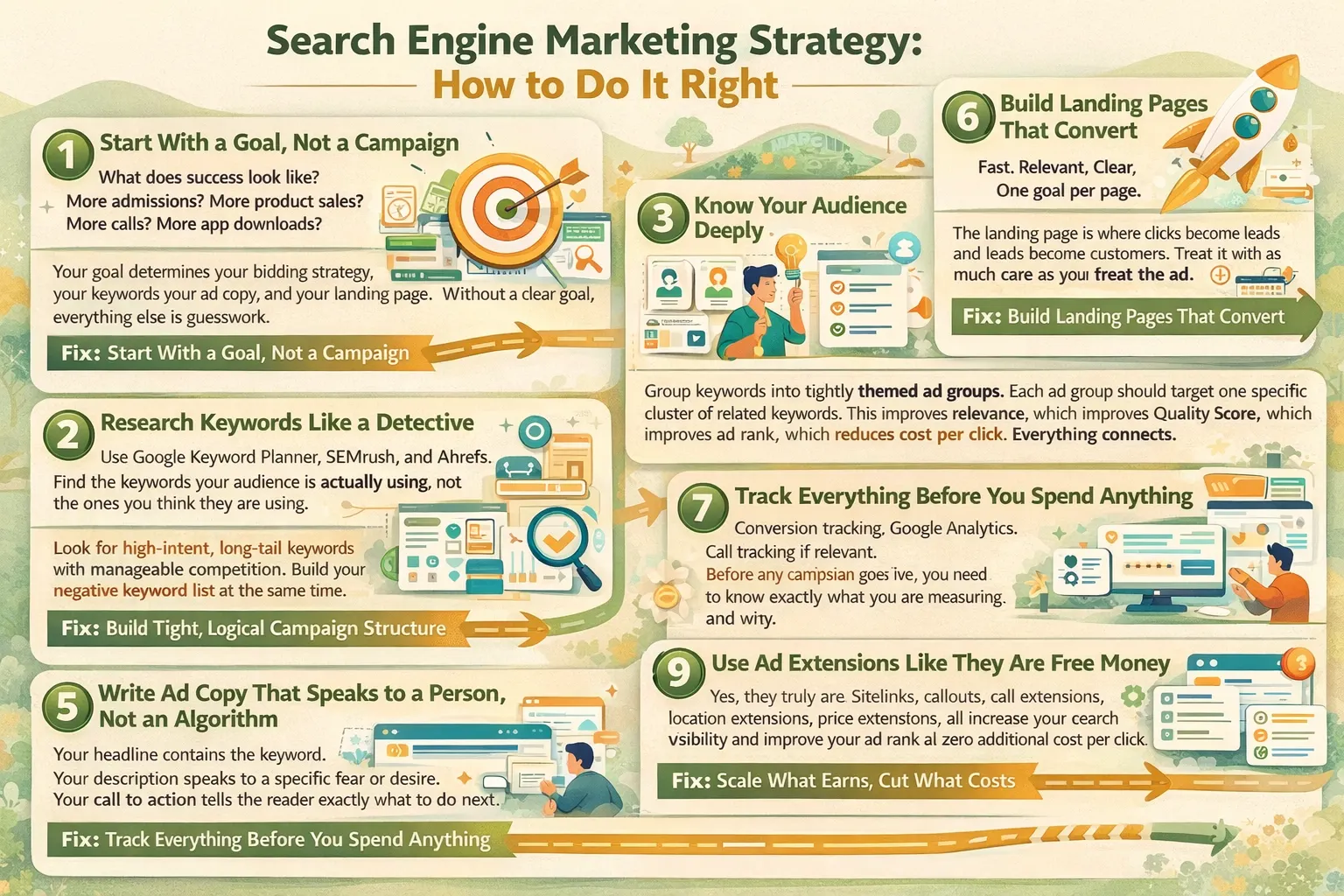
Conversion tracking. Google Analytics. Call tracking if relevant. Before any campaign goes live, you need to know exactly what you are measuring and why.
SEM rewards curiosity. Test two headlines. Test two landing pages. Test two audiences. The data will tell you what works, but only if you are paying attention and running the right experiments.
Yes, they truly are. Sitelinks, callouts, call extensions, location extensions, price extensions, all increase your search visibility and improve your ad rank at zero additional cost per click. There is no reason not to use every relevant extension.
Once you know what works, scale it. Once you know what it costs without returning, cut it. SEM is ultimately a capital allocation game. The winner is the one who learns fastest what to keep and what to kill.
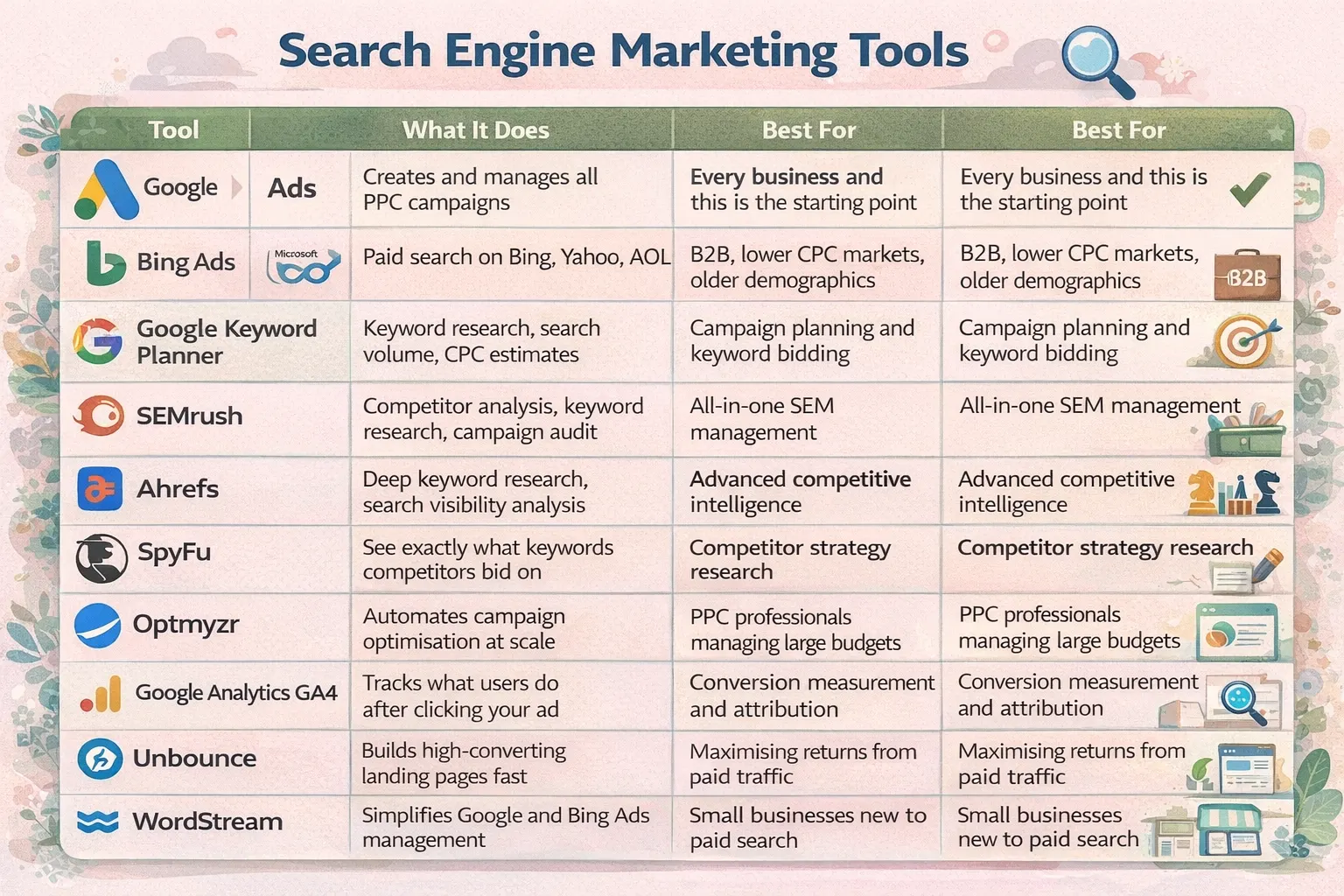
| Tool | What It Does | Best For |
|---|---|---|
| Google Ads | Creates and manages all PPC campaigns | Every business and this is the starting point |
| Bing Ads (Microsoft Advertising) | Paid search on Bing, Yahoo, AOL | B2B, lower CPC markets, older demographics |
| Google Keyword Planner | Keyword research, search volume, CPC estimates | Campaign planning and keyword bidding |
| SEMrush | Competitor analysis, keyword research, campaign audit | All-in-one SEM management |
| Ahrefs | Deep keyword research, search visibility analysis | Advanced competitive intelligence |
| SpyFu | See exactly what keywords competitors bid on | Competitor strategy research |
| Optmyzr | Automates campaign optimisation at scale | PPC professionals managing large budgets |
| Google Analytics GA4 | Tracks what users do after clicking your ad | Conversion measurement and attribution |
| Unbounce | Builds high-converting landing pages fast | Maximising returns from paid traffic |
| WordStream | Simplifies Google and Bing Ads management | Small businesses new to paid search |
Google Ads is the undisputed home of paid search engine marketing. With Google holding over 90% of global search market share, running ads here means access to the largest audience of active searchers on the planet.
Myntra itself used Google’s full suite, Search, Video Action Campaigns, and app-based solutions, to reach customers at every point of their purchase journey, from initial search to final conversion.
Businesses earn an average of $2 in revenue for every $1 spent on Google Ads, a 200% ROI. (Source: WordStream)
Key capabilities: Search Network, Display Network across 2 million+ websites, Shopping Ads, YouTube Ads, and Performance Max campaigns powered by Google AI.
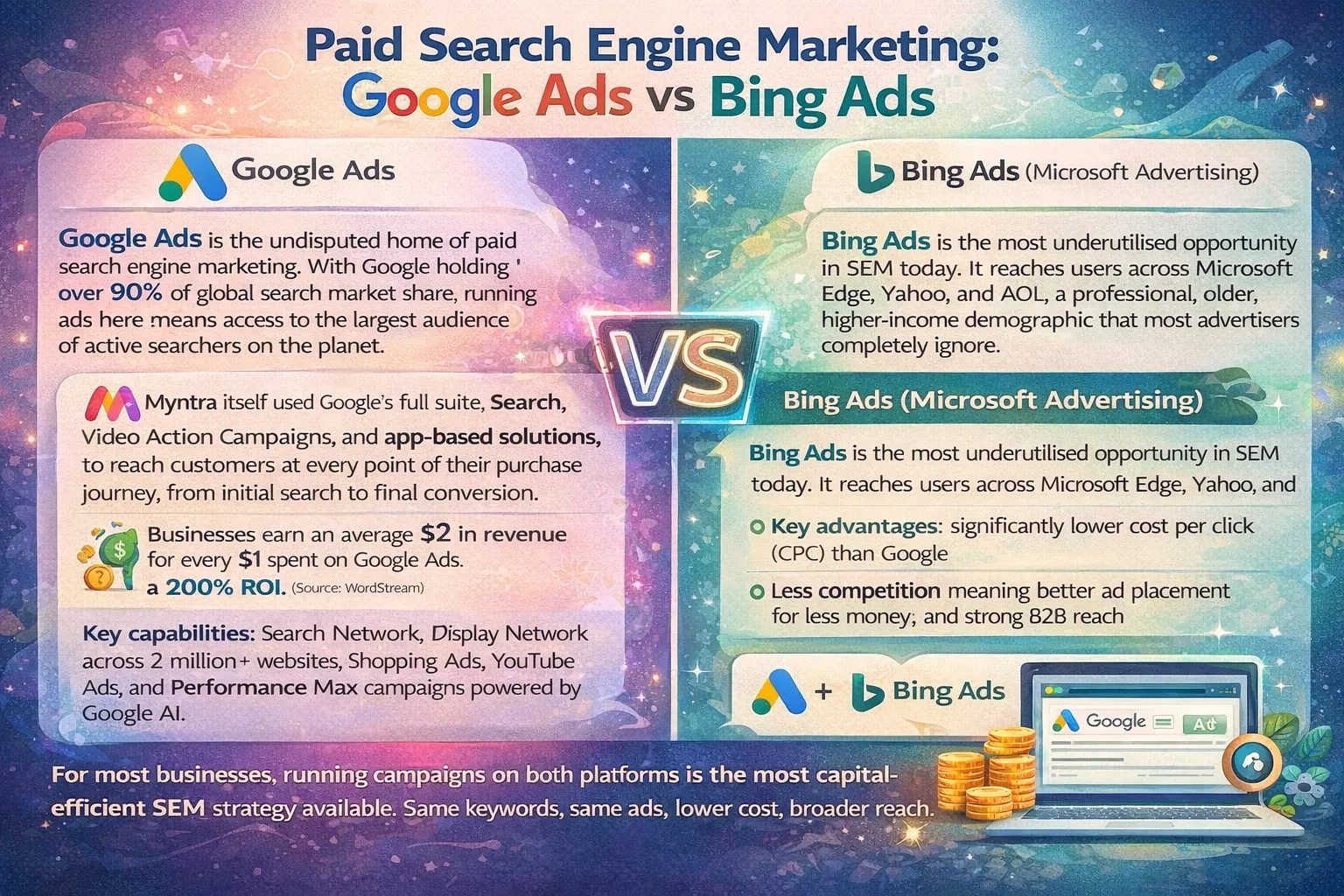
Bing Ads is the most underutilised opportunity in SEM today. It reaches users across Microsoft Edge, Yahoo, and AOL, a professional, older, higher-income demographic that most advertisers completely ignore.
Key advantages: significantly lower cost per click (CPC) than Google, less competition meaning better ad placement for less money, and strong B2B reach through Microsoft 365 integration.
For most businesses, running campaigns on both platforms is the most capital-efficient SEM strategy available. Same keywords, same ads, lower cost, broader reach.
Myntra, Winning India’s Fashion Search With 89% of fashion searches in India being generic, Myntra needed to be present for searches that did not even mention their brand name. By using Google AI-powered ad solutions across Search, video, and apps, they reached customers at scale, at the exact moment purchase intent occurred. The result was not just more clicks; it was sustainable, scalable growth in one of India’s most competitive markets.
Key Takeaway: SEM is not just about your brand keywords. It is about showing up for every relevant search your potential customer makes.
Amazon, Owning Product Search When you search “wireless headphones” on Google, Amazon’s Shopping Ads appear prominently with product images and prices. This strategy, running across millions of product keywords simultaneously drives billions in direct e-commerce revenue.
Key Takeaway: Shopping Ads combined with targeted search ads is the most effective SEM combination for e-commerce.
MakeMyTrip, Capturing Travel Intent MakeMyTrip runs precisely targeted campaigns for keywords like “cheap flights to Goa” and “hotels in Manali”, using location extensions, price extensions, and sitelinks to maximise ad rank and click-through rate on every single ad.
Key Takeaway: Ad extensions are not optional extras. They are a core part of a competitive SEM strategy.
A Local Coaching Institute, Hyperlocal SEM A small coaching institute in Bangalore runs Google Local Search Ads targeting “JEE coaching near me” and “best coaching institute in Bangalore”. Their ad appears with address, phone number, and Google ratings, driving direct calls and walk-ins from students actively looking to enrol.
Key Takeaway: Even modest budgets deliver powerful results when SEM is targeted hyperlocally with high-intent keywords.
Byju’s, EdTech Scale Through Search Byju’s built a significant part of their student acquisition engine through Google Ads, targeting keywords like “online coaching for JEE”, “NEET preparation online”, and “best learning app for kids”. By capturing students and parents at their most decisive moments, they turned search intent into enrolments at scale.
Key Takeaway: In education, the student’s search is the moment of highest intent. SEM is how you win that moment.
This is the section students and professionals have been waiting for. Let us talk about real numbers.
Digital marketing jobs in India have grown 30% in just the last two years, with 25 to 30% annual growth predicted for the next five years.
93% of Indian businesses increased their digital marketing budgets in 2025. Over 5 million digital marketing jobs are projected in India by 2027.
SEM sits at the most commercially valuable intersection of digital marketing, directly managing budgets that generate measurable revenue. That makes SEM professionals among the highest-paid specialists in the field.
What Is the Salary of SEO vs SEM in India?
| Role | Fresher (0–2 yrs) | Mid-Level (3–5 yrs) | Senior (5+ yrs) |
|---|---|---|---|
| SEM / PPC Specialist | ₹2.3L – ₹4L PA | ₹6L – ₹10L PA | ₹10L – ₹20L+ PA |
| SEO Specialist | ₹1.8L – ₹3.5L PA | ₹4L – ₹8L PA | ₹8L – ₹15L PA |
| SEO + SEM Combined | ₹2.5L – ₹4.5L PA | ₹7L – ₹12L PA | ₹12L – ₹25L PA |
| Performance Marketing Lead | ₹3L – ₹5L PA | ₹10L – ₹15L PA | ₹15L – ₹25L+ PA |
Sources: PayScale, Glassdoor, SalaryExpert, GrowAI (2025–2026)
Few related topics for your knowledge
In conclusion to our discussion of what is Search engine marketing, I simply put this by saying that it is not a tactic. It is not a shortcut and it is not something that works overnight.
It is a skill. A system. A way of thinking about how customers search, what they need at that exact moment, and how to show up for them better than anyone else.
Search engine marketing is the bridge between what your customer is looking for and what you are offering. Built correctly, with the right keywords, the right Quality Score, the right landing pages, and the right strategy; that bridge brings people to you every single day.
The businesses winning right now are the ones that built that bridge. The professionals earning the most right now are the ones who know how to build it.
Search engine marketing is a digital marketing strategy where businesses pay to appear on the SERP, the search results page, when users search for specific keywords. Through platforms like Google Ads and Bing Ads, businesses bid on keywords relevant to their audience. When someone searches and clicks their ad, the business pays a cost per click (CPC). The result is immediate search visibility in front of people who are actively looking to buy, enquire, or act.
SEO earns organic rankings on the SERP over months through content, backlinks, and technical optimisation, it is free but slow. SEM pays for ad placement on the search results page and delivers results within hours. SEO is the long game, compounding authority over time. SEM is the short game, immediate, controllable, measurable. The most effective strategies use both together.
Every time a user searches on Google, a real-time ad auction runs. Google evaluates every advertiser’s keyword bidding amount and Quality Score to calculate their ad rank. Besides this, the highest ad rank wins the best ad placement on the SERP. The advertiser only pays when someone clicks, this is the pay per click (PPC) advertising model. After the click, conversion tracking shows exactly what happened next.
The main types are paid search ads (PPC), shopping ads (product listing ads), display advertising, remarketing and retargeting ads, video ads through YouTube, and local search ads. Each serves a different goal, from immediate lead generation to brand awareness to recovering lost prospects.
Quality Score is Google’s 1 to 10 rating of how relevant and useful your keyword, ad, and landing page are to the user. A higher Quality Score improves your ad rank and directly lowers your cost per click. It is Google rewarding relevance over raw spending, which means a well-optimised campaign with a modest budget can consistently outperform a poorly managed campaign with a large one.
The core tools are Google Ads for creating and managing PPC campaigns, Google Keyword Planner for keyword research and CPC estimates, SEMrush and Ahrefs for competitive research and keyword analysis, SpyFu for understanding what competitors are bidding on, and Google Analytics GA4 for tracking conversions and campaign performance. For landing pages, Unbounce is widely used by SEM professionals.
Google Ads is the most widely used SEM platform globally. For research and competitive intelligence, SEMrush and Ahrefs are the industry standard. SpyFu is the go-to for competitor keyword bidding analysis. For campaign management at scale, Optmyzr and WordStream help PPC professionals automate and optimise efficiently.
SEM and PPC specialists generally earn more than SEO specialists at comparable experience levels as they directly manage advertising budgets tied to measurable revenue. Entry-level SEM roles in India start around ₹2.3L to ₹4L per annum. Mid-level professionals earn ₹6L to ₹10L. Senior SEM specialists and performance marketing leads in metro cities can earn ₹15L to ₹25L or more per annum.
Absolutely, and often more so than for large ones. With SEM, a small business with a ₹500 per day budget can appear above a large competitor for the same keyword, if their Quality Score and ad relevance are stronger. Furthermore, the local search ads in particular are extraordinarily effective for small businesses, connecting them directly with nearby customers who are ready to act right now.
An SEM strategy is a structured plan for using paid search advertising to achieve specific business goals. It covers keyword research and keyword bidding, audience targeting, ad copy creation, Quality Score optimisation, landing page development, budget allocation, conversion tracking, and continuous performance monitoring. A good SEM strategy is never static, it evolves with the data.
SEM is used to drive website traffic, generate leads, increase online sales, promote courses and services, build brand awareness, capture local customers, and retarget warm prospects who did not convert the first time. Moreover, it is used effectively across every industry, from education and e-commerce to healthcare, real estate, and travel. Wherever there is search intent, there is an SEM opportunity.

 }})