
Courses
Digital marketing for educational institutions is now where admissions are won or lost, and most institutes are losing before a single enquiry form is even filled out.
The seat stays empty not because the course is weak, but because the prospective student built a shortlist of three institutes on their phone last week and yours was never on it. By the time a counsellor calls, the real decision has already happened somewhere the institute was not present: a Google search, a YouTube review, a WhatsApp message to a friend, or a question typed into ChatGPT.
The competition for admissions no longer begins at the enquiry stage. It begins at the discovery stage. If an institution cannot be found, compared and trusted online, it quietly disappears from consideration before counselling ever starts. This guide shows how digital marketing for educational institutions turns that discovery stage into student leads and admissions.
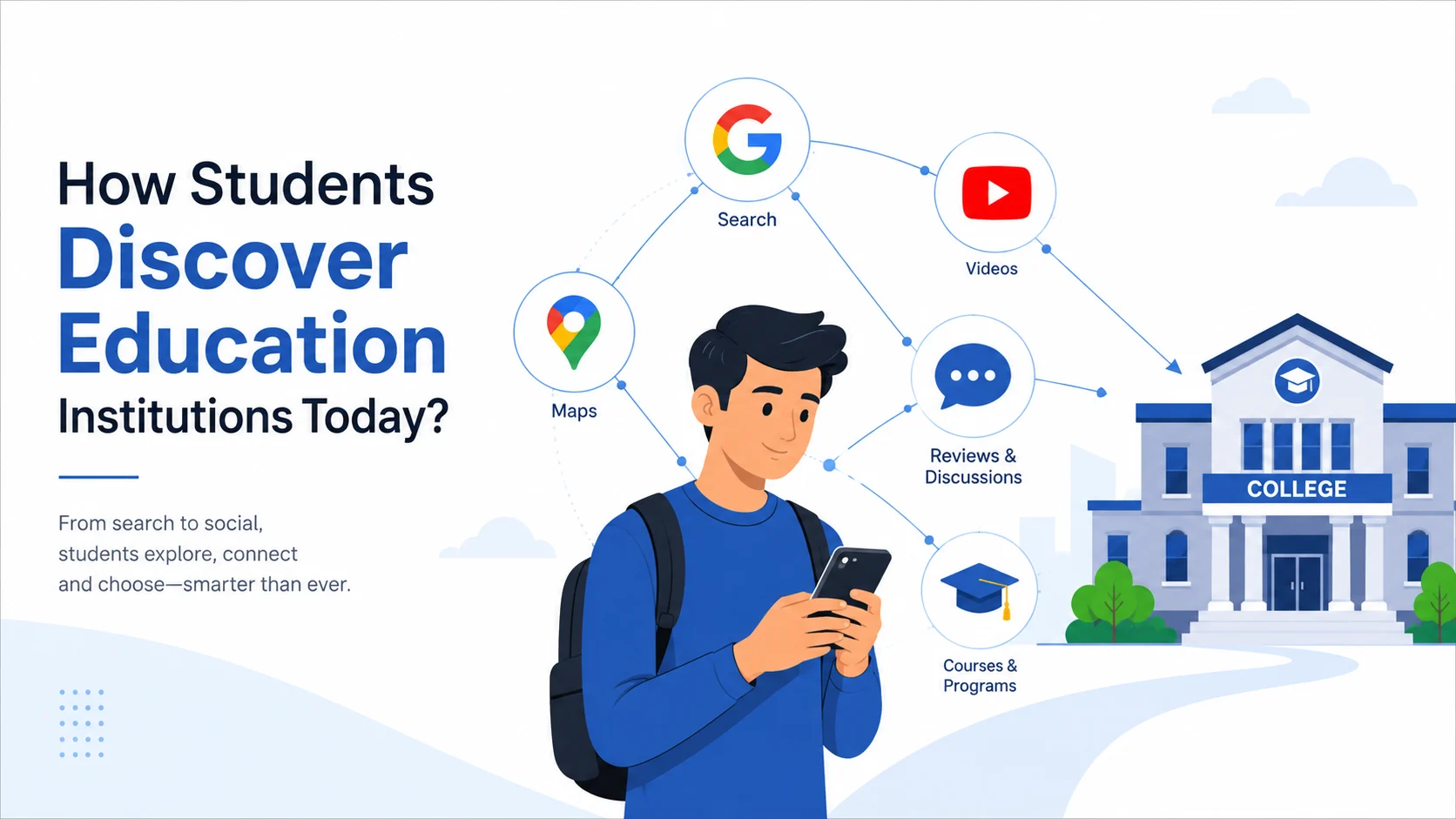
Table of Contents
Quick Answer
Digital marketing for educational institutions is the use of online channels, search engine optimisation, content, Google Business Profile, paid media, video, email and WhatsApp automation, and AI-search optimisation, to help prospective students discover, trust and choose an institution and to convert enquiries into admissions at a lower cost per admission.
Notice the end goal: not leads, but admissions at a controllable cost. Many institutes measure leads generated and celebrate a number that never reaches the register. The discipline that separates institutions that grow from those that plateau is measuring cost per admission, not just cost per lead. Whether you run a school, a college, a coaching institute or an edtech platform, education marketing follows the same logic: earn discovery, build trust, capture the enquiry, and nurture it to enrolment.
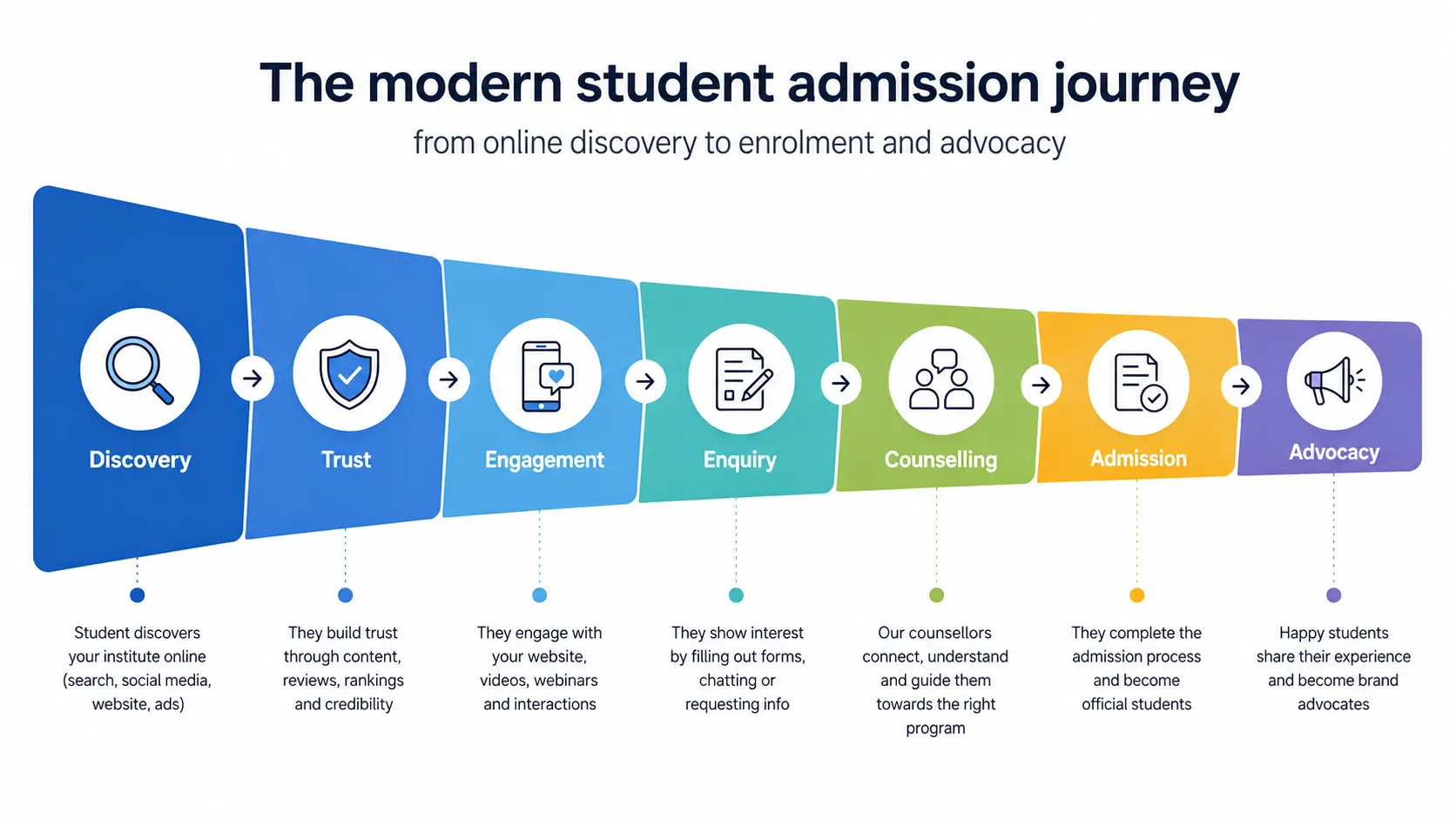
Institutes fail when they start at paid acquisition. They buy ads before they are discoverable, trusted or ready to convert, then blame the ads. Build student recruitment in this order:
Quick Answer
Very significant. India’s digital education market is projected to nearly quadruple from about US$7.5 billion in 2025 to US$29 billion by 2030 (IBEF), student enrolment has reached record highs (AISHE), and discovery has moved online, making digital marketing the most measurable and cost-efficient way to reach prospective students.
This is a large and fast-growing market. India’s edtech and digital education market was valued at roughly US$7.5 billion in 2025 and is projected to reach US$29 billion by 2030, according to an IAMAI and Grant Thornton Bharat report reported by IBEF. India is already the second-largest e-learning market in the world after the United States.
A huge, digital-first student pool. Total enrolment in higher education reached 4.50 crore in 2023-24, with the Gross Enrolment Ratio at 30, per the Ministry of Education’s All India Survey on Higher Education (AISHE) released in July 2026. These prospective students research on their phones long before they call.
Discovery has moved online, including to AI. A growing share of students now use AI tools such as ChatGPT, Gemini and Perplexity to discover and compare institutions before applying, as reported across recent Indian education marketing surveys. An institute absent from these surfaces is absent from the shortlist.
The benefit, in plain terms: compared with newspaper ads, hoardings and education fairs, digital marketing for educational institutions is measurable to the rupee, targets students with active intent, and scales on demand. Its clearest impact shows up in two numbers, cost per lead and enquiry volume, which is exactly what the proof below demonstrates.
Principles are cheap, so here is documented, named proof from India. PhysicsWallah began in 2016 as a single YouTube channel run by educator Alakh Pandey, offering free lectures to students preparing for JEE and NEET, especially in Tier 2 and Tier 3 cities.
What the Digital-First Model Delivered
The lesson for any educational institution: consistent, useful content plus a clear path from free value to enquiry can build a student-led engine that compounds, without simply spending more on ads. The rest of this guide breaks that engine into channels, each with a real institution example.
Digital marketing for educational institutions is not one activity but a system of connected channels, and it works the same way for schools, colleges, coaching institutes and edtech platforms. Below is each channel, what it does, and a real institution that used it to grow student leads.
Students research for one to four weeks before enrolling. Content marketing keeps an institute useful across that window, so that when a student is ready, it is the obvious answer. The reframe that works: stop writing “Join our course” and start writing “How to build a career in this field.” Solve the problem first.
Example: Boston University runs an on-site content hub, BU Today, publishing daily stories on student life, careers and research. As documented by Higher Education Marketing, this fresh, keyword-rich content builds trust and drives organic traffic by answering the questions prospective students are already asking.
Prospective students trust peers and teachers more than brochures. Short testimonials, day-in-the-life clips, doubt sessions and course explainers build trust, lift time on page, and surface across Google, YouTube and AI answers.
Example: PhysicsWallah is the definitive proof. Free YouTube teaching became its primary student acquisition funnel, and its cofounder credits the platform with driving both online sign-ups and offline centre leads, per Storyboard18. Video is not a vanity channel; for PhysicsWallah it was the growth engine.
Institutes that only post advertisements struggle to hold attention. A workable mix is roughly 40 per cent educational, 30 %authority (placements, faculty, alumni), 20 %community and 10% promotional. Match the platform to the audience: LinkedIn for working professionals, Instagram and Facebook for younger learners, YouTube for depth, WhatsApp for one-to-one nurture.
Real example: John Cabot University overhauled its social media approach with audience-targeted content that funnelled followers to its admissions site. Higher Education Marketing reports a 300% increase in applications coming directly from social media and a 42% overall rise in applications.
Most admission journeys begin with a search, so SEO for educational institutions is the highest-leverage, lowest-recurring-cost channel. A ranked page keeps generating enquiries for years. Target three intent levels: awareness (“career options after B.Com”), consideration (“best digital marketing courses”) and decision (“digital marketing course in Kolkata with placement”). Local SEO captures the highest-intent searches of all, such as “institute near me”, through a complete Google Business Profile for every centre, city-plus-course landing pages, authentic student reviews and local citations.
Example: Cumberland College in Montreal optimised its bilingual, region-focused website content, refocused its keyword strategy and added Google Ads. Higher Education Marketing reports organic visitors rose 27.5%, total leads jumped 95% and leads from organic search increased 386% year on year.
Paid media buys the speed and high-intent reach that SEO cannot deliver overnight. But ads do not fail at the ad; they fail after the click. The chain that decides cost per admission is ad, landing page, lead capture, response time, counselling, follow-up. Most institutes obsess over click-through rate while ignoring a slow landing page and a next-day callback.
Example: Wilfrid Laurier University runs country-specific and even city-level pay-per-click campaigns on Google and Meta to reach international prospects. Higher Education Marketing documents how this precise geo-targeting lifted lead generation from markets such as India, Bangladesh and Ghana.
Traffic is not the objective; admissions are. A high-converting institute website has a clear value proposition above the fold, transparent course information, placement proof, fast mobile load speed, easy enquiry forms and social proof near every call to action.
Example: The University of North Dakota rebuilt its website around a program-finder tool and audience-based navigation. Higher Education Marketing reports a 62% year-on-year rise in undergraduate inquiries after the refresh, while many peer institutions saw declines.
Institutes that track and attribute results consistently outperform those that guess. The goal is to tie every rupee of spend to enquiries, applications and enrolments, not just clicks.
Example: McGill University’s School of Continuing Studies set up e-commerce-style tracking to connect digital ad spend directly to applications and enrolments, per Higher Education Marketing, replacing guesswork with data-driven budget decisions.
An institute can receive hundreds of enquiries a week at peak, and manual follow-up loses the ones already paid for. Automation fixes the leak with instant responses, brochure delivery, counselling reminders and a five- to seven-message nurture sequence. Lead response time is one of the cheapest conversion levers: minutes beat hours.
Example: Michael Vincent Academy, a vocational school, implemented a CRM with marketing automation to follow up with every inquiry, score leads and send sequenced emails, per Higher Education Marketing, ensuring no prospective student fell through the cracks.
Step Into the World of Digital MarketingLearn from Digital Marketing Experts |
|
| Advanced Diploma in Digital Marketing | |
| More Learning Options for you: Diploma in Digital Marketing | Google Ads Certification Training | Certification Course |
Discovery is shifting from ten blue links to synthesised answers. Students increasingly ask an AI system a question and act on the answer without clicking a traditional result. To appear in that layer, content must be built to be understood and cited.
GEO and AEO, Defined
Practical levers that work across ChatGPT, Google AI Overviews, Gemini, Perplexity, Grok, Claude and research tools like NotebookLM:
Automation platforms like Zapier sit elsewhere in this stack: not a discovery engine, but the connective layer that pushes a new student lead into the CRM and triggers a WhatsApp or email sequence within seconds, protecting the response-time advantage.
This is how to do digital marketing for educational institutions in a way that actually produces student leads. Following the order is what separates institutes that fill seats from those that burn budget:
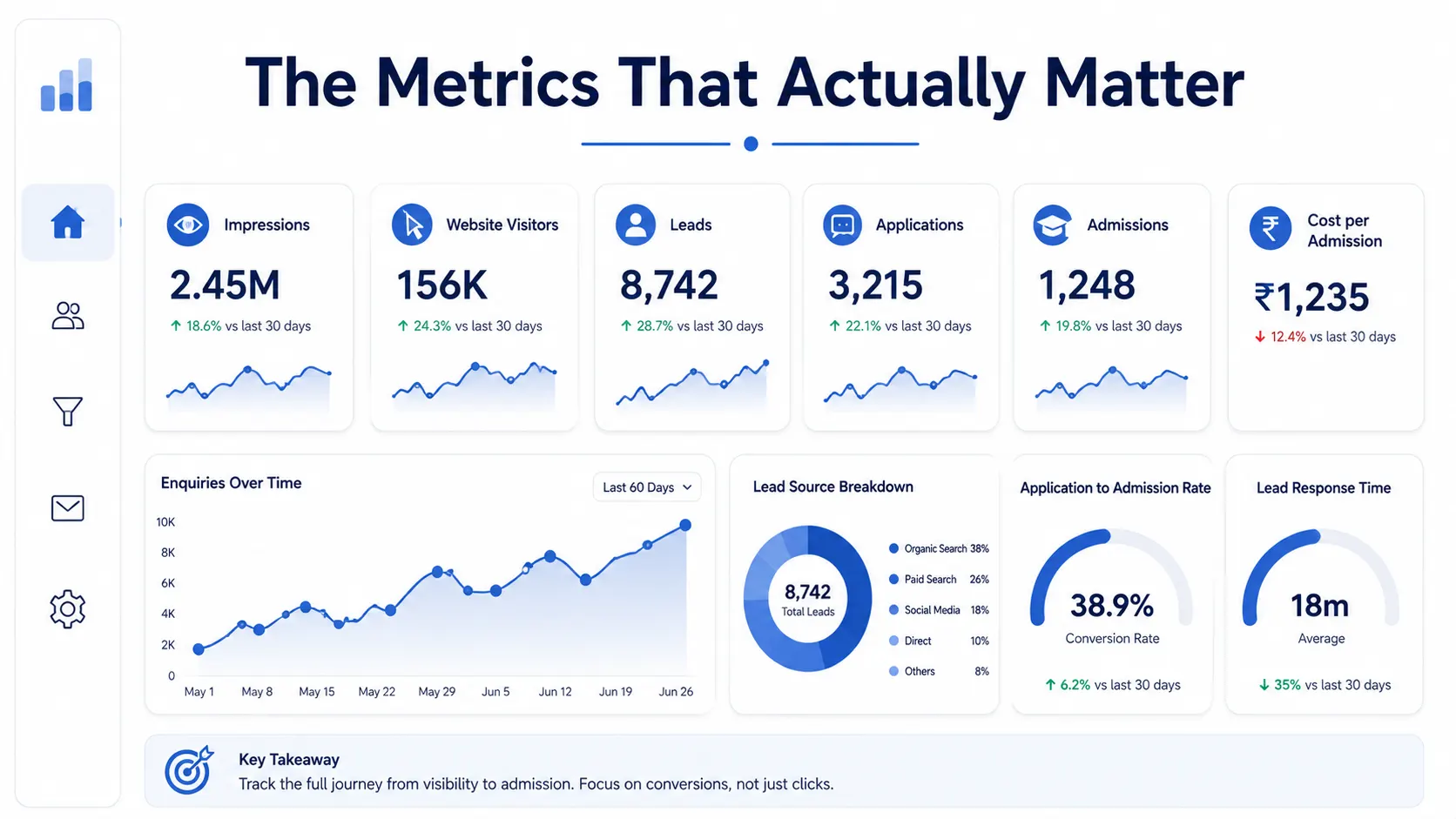
The success of digital marketing for educational institutions should be judged on outcomes, not vanity metrics. Track the chain that ends in revenue:
| Metric | Why it matters |
|---|---|
| Organic traffic to money pages | Sustainable discovery |
| Cost per lead | Acquisition efficiency |
| Lead response time | Conversion potential |
| Lead-to-enrolment rate | Counselling quality |
| Cost per admission | The number that decides ROI |
| Placement outcomes | Trust and long-term brand |
A realistic way to roll out digital marketing for educational institutions without spreading thin, in three phases:
Days 1 to 30, foundation: fix website speed and mobile experience, complete Google Business Profiles, set up conversion tracking, and rebuild top money pages for SEO.
Days 31 to 60, visibility: publish content for high-impression low-CTR queries, launch video testimonials, and start a lead-generation campaign with tight landing pages.
Days 61 to 90, scale: add WhatsApp and email automation, run conversion tests, layer remarketing, and review cost per admission by channel to reallocate budget.
Most weak results in digital marketing for educational institutions trace back to the same avoidable errors:
Every lever in this guide is now a hireable skill. SEO, performance marketing, analytics, automation, AI-search and content are in strong demand across industries, not only in education. Learning how institutions attract, convert and retain students is a direct route into a digital marketing career.
IDCM (myidcm.com) teaches this exact playbook. As a vocational training institute, IDCM offers the Advanced Diploma in Digital Marketing, Diploma in Digital Marketing and Certificate in Digital Marketing. The courses are practitioner-led and built on live objectives and real campaign data, not textbook theory. So learners can actually run these strategies, not just recognise them.
Digital marketing for educational institutions is no longer a support function. It is the main stage where admissions are decided. The institutes that win next will not be the ones that shout loudest or spend most. They will be the ones that are easy to find, easy to trust, and easy to enquire with, right when a student is deciding.
Everything here points to one idea. Stop chasing leads. Start building a system. Earn discovery through SEO and content. Prove your worth with real outcomes. Capture the enquiry the second intent appears. Then nurture it patiently to an admission.
PhysicsWallah did not buy its way to 46 million students. It built a content engine that turned attention into trust, and trust into enrolments. The same logic scales down to a single-centre institute in any city.
The market is growing. Students are already online. Discovery is shifting toward AI. The only real question is whether your institution shows up there before your competitor does. Start with the foundation. Measure cost per admission, not vanity numbers. Treat this as a long-term investment in how you are found, trusted and chosen.
Start with discoverability. Use SEO, Local SEO and a complete Google Business Profile. Build trust with content and outcome proof. Engage on social media and video. Run paid campaigns into fast landing pages. Then nurture every enquiry with WhatsApp and email automation until it converts to an admission.
Yes, significantly. India’s digital education market is projected to grow from about US$7.5 billion in 2025 to US$29 billion by 2030 (IBEF). It is also far more measurable and cost-efficient than traditional advertising. PhysicsWallah is proof of the scale possible, with roughly 95% of its 46 million students first signing up online.
There is no single best channel. The strongest results combine SEO and Local SEO for discovery, content and video for trust, performance marketing for acquisition, and automation for nurture. Judge all of it on cost per admission.
It varies with city, competition and goals, so focus on cost per admission rather than total spend. Split budget across branded and course-specific search, retargeting and content, then reallocate monthly toward the lowest cost per admission.
SEO is a long-term investment. Meaningful movement usually takes a few months and depends on competition, content quality, technical health and domain authority. Course and city money pages often move faster than broad blog content.


 }})