
Courses
SEO vs Google Ads is the first big decision every new digital marketer in India faces. Both pay well and both are in demand. Both look good on a CV, but you can only focus on one when you start out, and that choice shapes your first job, your first salary, and how fast you grow. Pick the wrong one and you waste six months. Pick the right one and you have a career.
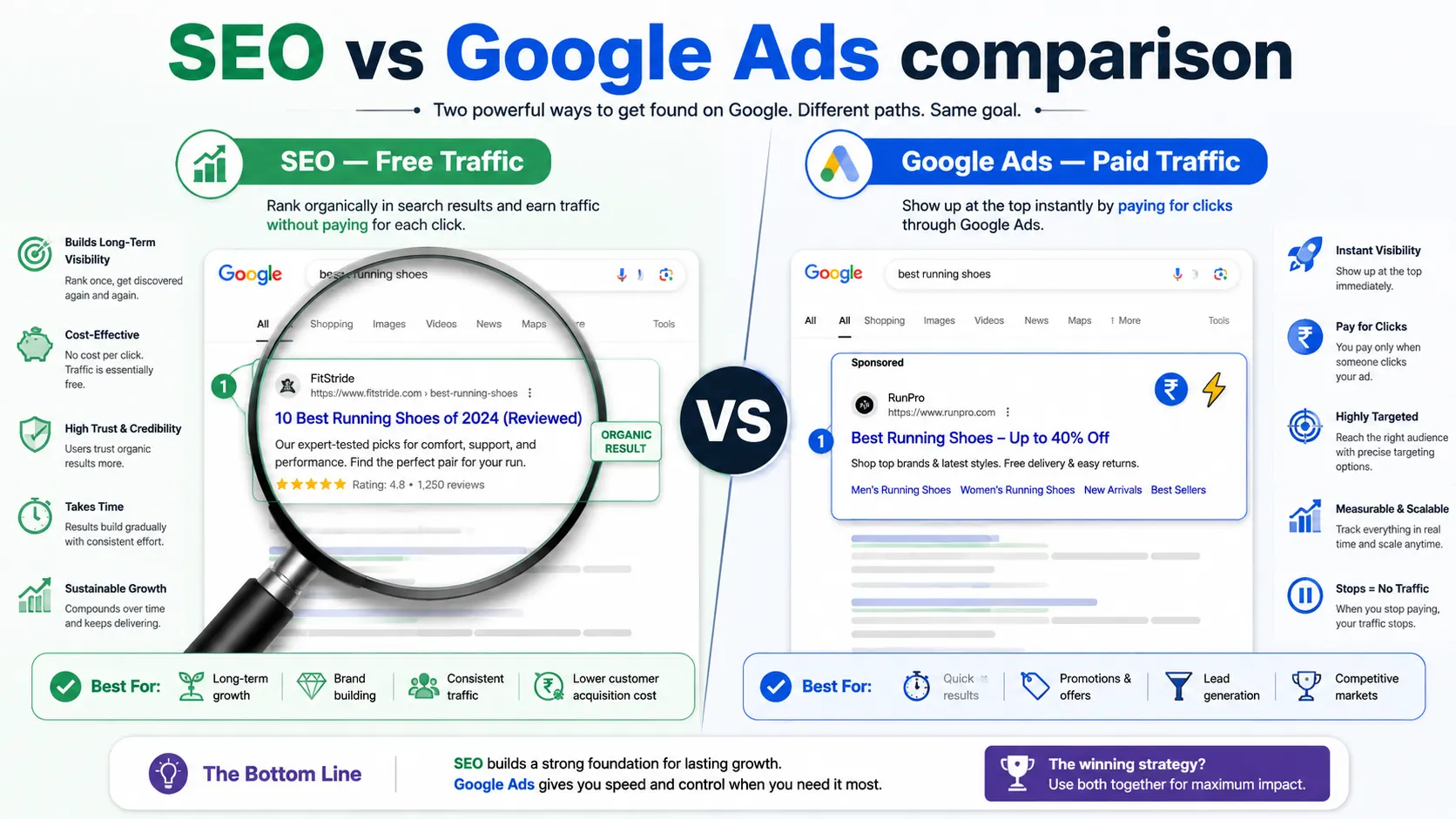
This guide gives you a comparison of SEO vs Google Ads. What each involves, how much you can earn, where the jobs are, and a clear recommendation on which to pick first. No hedging.
SEO stands for Search Engine Optimisation. Simply put, it is the work you do on a website so it shows up higher on Google when someone searches for something.
Say you run a sweet shop in Kolkata. When a customer types “best sandesh in Kolkata” on Google, you want your shop in the top five results. SEO is what makes that happen.
The work breaks into three areas. First, content on your pages using the right words, answering the right questions, structuring information so Google understands it. Second, the technical side, page speed, mobile design, how easily search engines can read your site. Third, backlinks getting other reputable sites to link to yours, which Google treats as a vote of trust.
You do not pay Google for SEO. But you do pay with time. Most SEO efforts take three to six months to show meaningful results.
If you want the broader picture, our guide on what is search engine marketing covers the full field.
Google Ads is the paid side of search. Those listings at the top of a Google results page marked with a small “Sponsored” tag, those are Google Ads.
The model is straightforward. You pick the keywords you want to show up for, twrite a short ad. You set how much you are willing to pay per click. Google runs an auction every time someone searches that keyword. If your bid and ad quality are strong, your ad appears.
You only pay when someone clicks. This is PPC or in other words pay-per-click.
The big advantage is speed. You can launch a Google Ads campaign in the morning and have website visitors by lunch. The downside is equally obvious the moment you stop paying, the traffic stops.
Google Ads goes beyond search. Display ads, YouTube ads, shopping ads, app campaigns; it is a wider field than most beginners assume. The Google Ads interview questions guide will give you a sense of how deep the field actually goes.
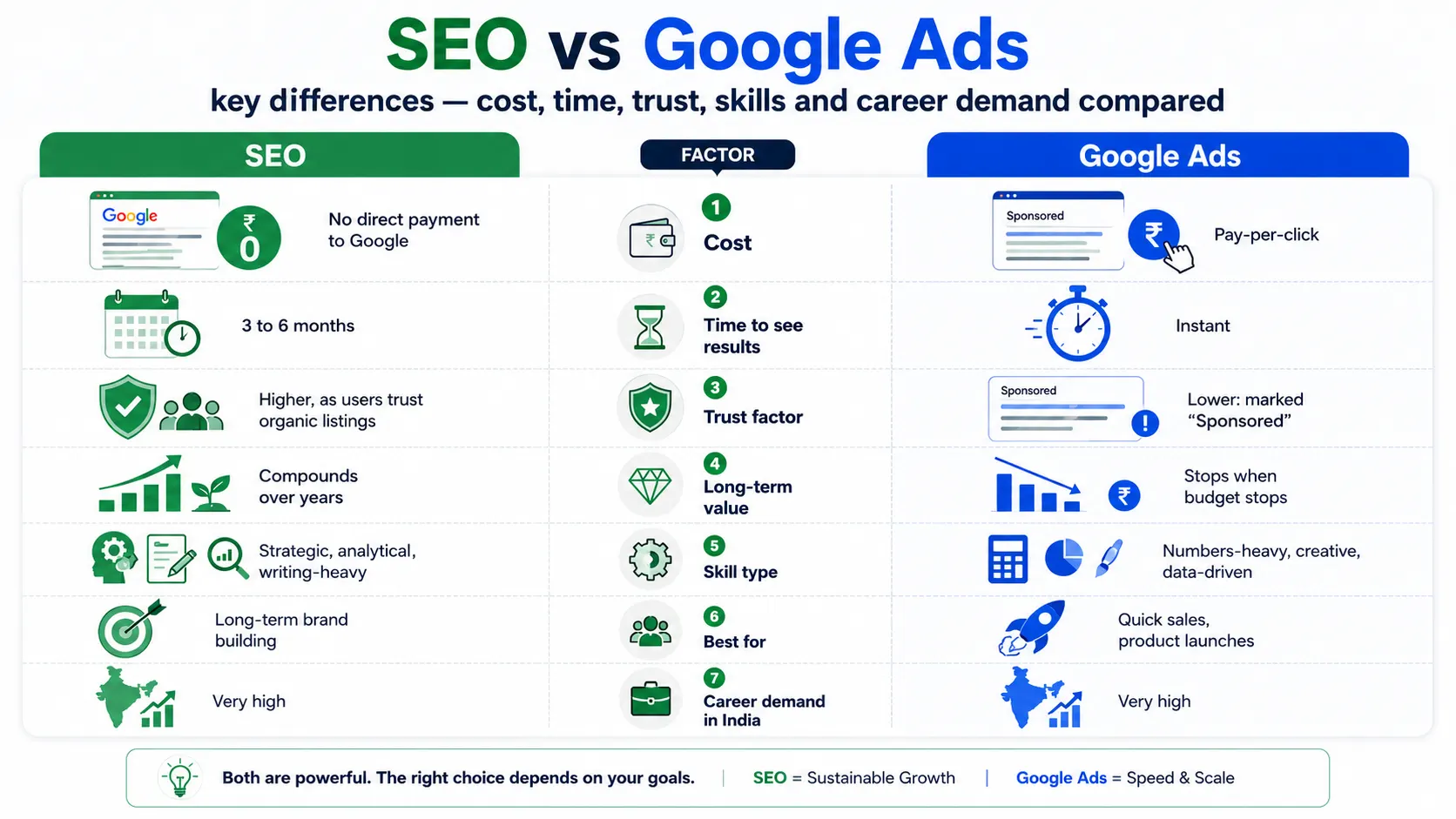
Now that the basics are clear, hence, I am going to give you is the side-by-side comparison of SEO vs Google Ads:
| Factor | SEO | Google Ads |
|---|---|---|
|
Cost |
No direct payment to Google | Pay-per-click |
|
Time to see results |
3 to 6 months |
Instant |
|
Trust factor |
Higher, as users trust organic listings |
Lower: marked “Sponsored” |
|
Long-term value |
Compounds over years |
Stops when budget stops |
|
Skill type |
Strategic, analytical, writing-heavy |
Numbers-heavy, creative, data-driven |
|
Best for |
Long-term brand building |
Quick sales, product launches |
| Career demand in India |
Very high |
Very high |
Both are useful and both have a place. The choice is not really about which one is better; it is about which one fits your goal right now.
If you want fast traffic for a new product, Google Ads makes more sense. If you want to build a brand that earns visitors for years without paying for each click, SEO is the answer.
Most serious businesses run both. They use Google Ads for the immediate sales and SEO for the long game.
Quick take: SEO is a long game. Google Ads is a sprint. The marketers who win do both.
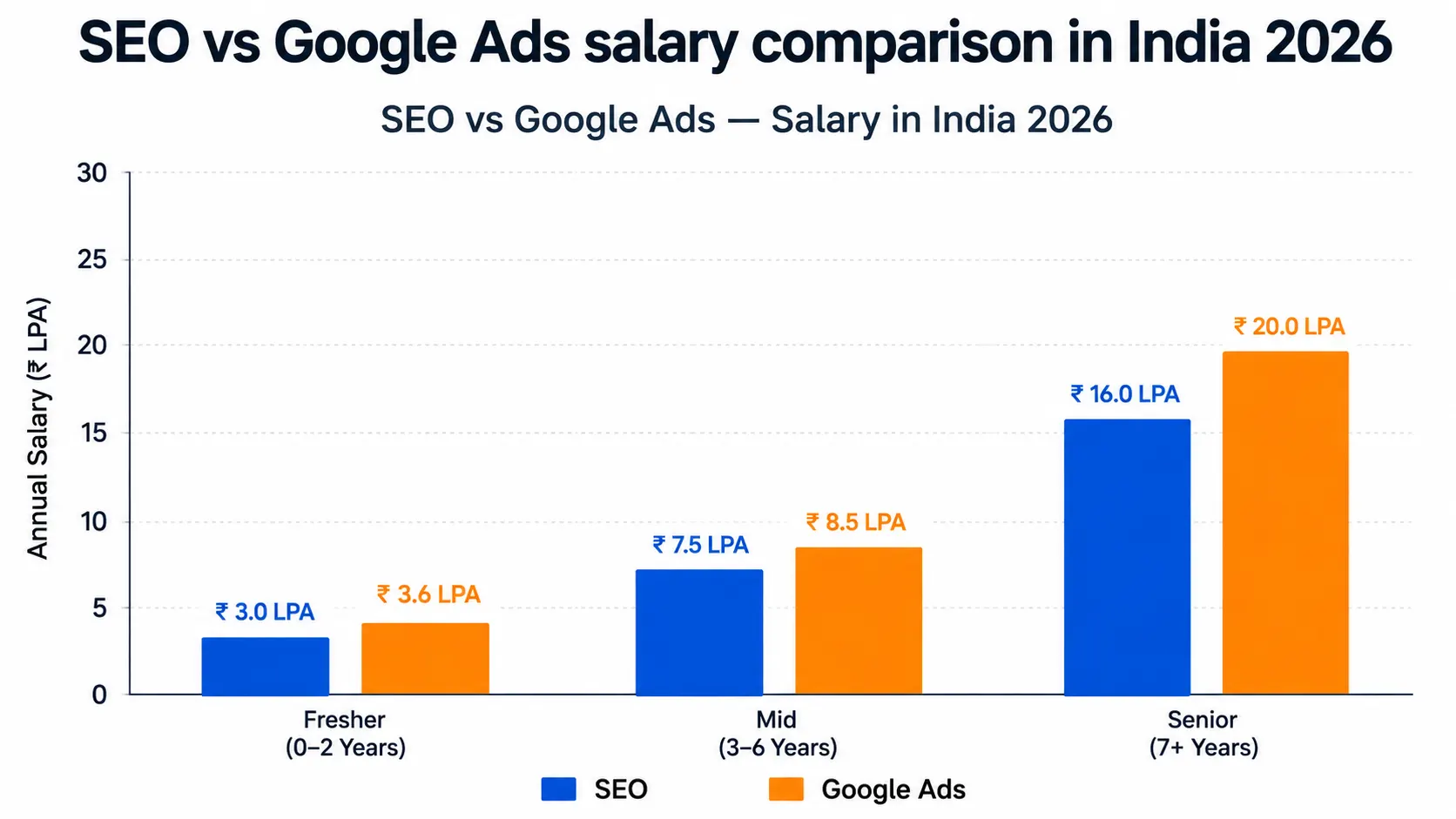
This is the section most readers came for. Here are the numbers based on industry data from AmbitionBox, Glassdoor, and active listings on Naukri as of early 2026.
| Role | Fresher (0–1 year) | Mid-level (2–4 years) | Senior (5+ years) |
|---|---|---|---|
|
SEO Executive / Specialist |
₹2.5 to ₹4 LPA | ₹5 to ₹8 LPA |
₹10 to ₹18 LPA |
|
Google Ads / PPC Specialist |
₹3 to ₹4.5 LPA | ₹6 to ₹9 LPA |
₹12 to ₹20 LPA |
Google Ads roles pay slightly more at entry and mid level. When you run paid campaigns, you are directly handling money, a PPC manager is trusted with daily ad budgets that may run into lakhs. That responsibility carries a premium.
SEO catches up at senior levels. A senior SEO manager who can drive organic traffic for a large e-commerce site or an edtech company is rare and rare always pays well.
Salaries in metro cities like Bengaluru, Mumbai, and Delhi tend to be 20 to 30 per cent higher than in Kolkata or other Tier 2 cities. But Kolkata is catching up, agencies and edtech firms here are now offering ₹6 to ₹8 LPA for mid-level talent with strong portfolios.
For a deeper look at what digital marketers earn in our city, see the digital marketing salary in Kolkata 2026 breakdown.
Step Into the World of Digital MarketingLearn from Digital Marketing Experts |
|
| Diploma in Digital Marketing | |
| More Learning Options for you: Advanced Diploma in Digital Marketing | Google Ads Certification Training | Certification Course |
SEO and Google Ads both careers are growing. But the shape of the growth is different.
SEO has been around for over two decades. The field is mature, the playbooks are well documented, and there are many practitioners. Competition for entry-level SEO jobs in India is high. But once you cross the two-year mark and develop actual expertise; technical SEO, content strategy, link building, and the demand is strong and the supply is thin.
On the contrary, Google Ads is younger as a profession. There are fewer experienced PPC specialists in India compared to SEO. Companies struggle to find people who can manage budgets responsibly and bring down cost-per-lead. This shortage means faster salary growth for skilled people.
Job listings across Naukri, LinkedIn and Indeed show a fairly even split between SEO roles and Google Ads roles. The more interesting pattern and one we see consistently at IDCM when our students apply for placements; is that a large share of job posts ask for both skills, not one.
That last point matters. It is the single most important insight in this whole comparison.
Here is the answer most blogs will not give you because they want to stay diplomatic.
Learn Google Ads first if:
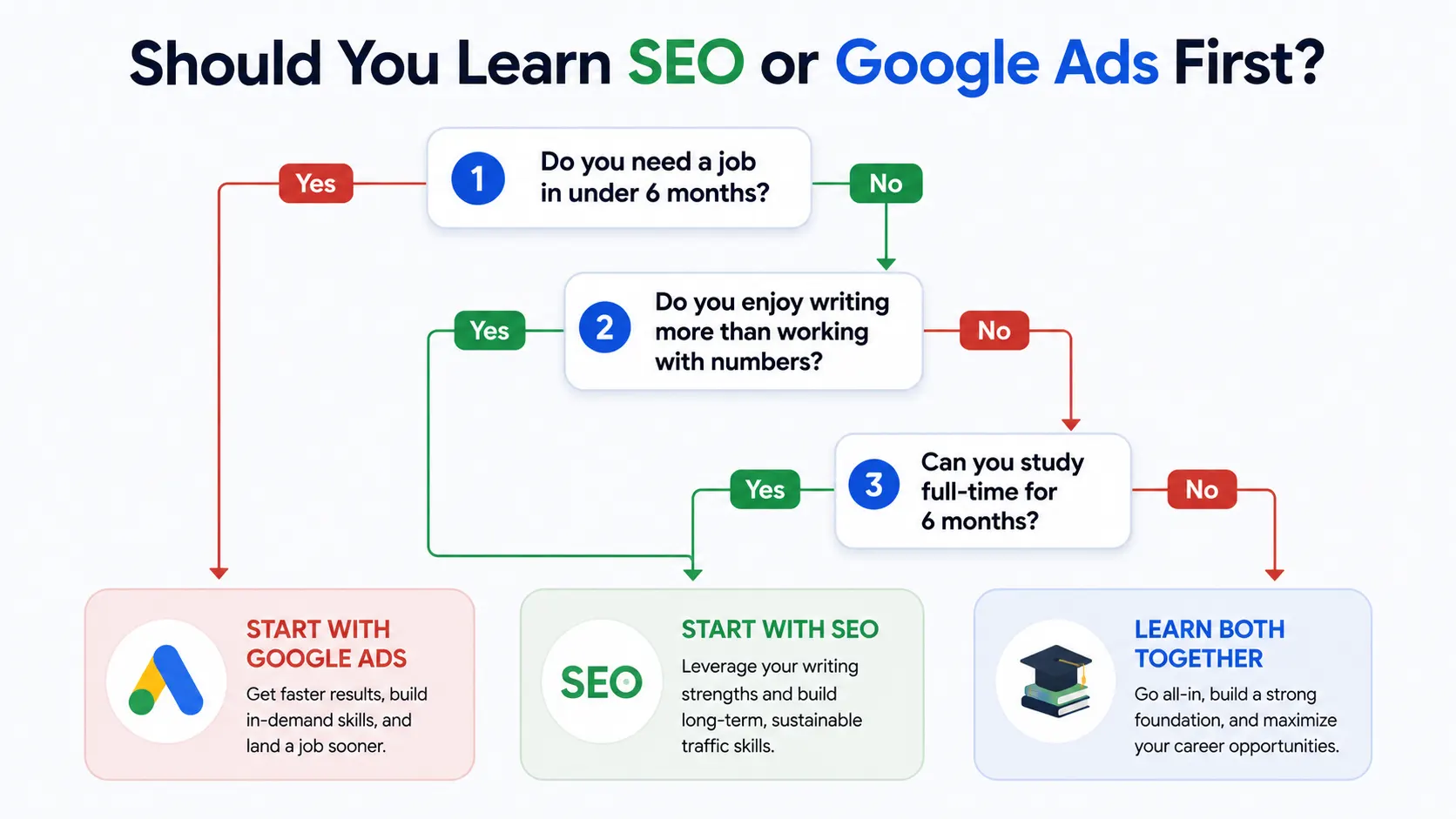
Learn SEO first if:
But here is the part nobody tells you clearly.
Standalone SEO specialists or standalone Google Ads specialists usually hit a salary ceiling around ₹10 to ₹15 LPA in India. That sounds high when you are starting out. It is not, in the bigger picture.
The marketers who cross ₹20 LPA are the ones who know both. They can audit an SEO problem in the morning and rebuild a Google Ads campaign in the afternoon. They understand how the two work together, how a high-ranking organic page lets you cut ad spend on that keyword, or how Google Ads data can guide your next round of SEO content.
This is why structured programs like the Diploma in Digital Marketing at IDCM teach both, along with 13 other modules, over six months. The goal is not to turn out a single-skill specialist. The goal is a full-stack marketer that companies hire and promote.
So if you are asking which one to learn first, my honest take is this. Start with Google Ads because it gives you faster confidence and a quicker first job. Then add SEO within the same year. Your long-term salary will thank you for it.
When you eventually sit in a marketing team meeting, this is the kind of decision you will be making.
Google Ads:
SEO:
Both:
In a working campaign the question is rarely “SEO or Google Ads.” It is “what mix of the two.”
Let me make this concrete with a pattern I see often in Kolkata.
Two competing coaching institutes. Institute A only runs Google Ads. Every month they spend ₹2 lakh on ads and generate around 200 enquiries. Decent return. But the moment they pause the ads, the leads stop overnight.
Institute B runs Google Ads too. But they have also been doing SEO for the past two years. Their blog ranks on page one for “digital marketing course in Kolkata fees” and “best digital marketing institute in Kolkata.” Roughly half their leads now come from free organic traffic. They still spend ₹2 lakh a month on ads, but total monthly enquiries are 450.
Same ad budget. More than double the leads.
That is what the integration of SEO and Google Ads looks like in practice. SEO lowers your dependence on paid traffic. Google Ads fills the gap while SEO is still maturing. Every marketing rupee goes further.
This is also why hiring managers prefer candidates who understand both sides. You see the full picture, not just one slice.
Few related topics for your knowledge
SEO vs Google Ads is not really a battle. It is a sequence.
If you are starting your career today, pick one to begin with based on your temperament and your timeline. On the other hand, if you want quick wins and you like numbers, go with Google Ads. If you have patience and you like writing, go with SEO. Either way, your first six months will go faster than you think.
But do not stop at one. The marketers earning ₹15, ₹20, ₹25 lakh a year in India today are not specialists. They are the ones who understood early that organic and paid are two sides of the same coin. They started with one, learnt the other within twelve months, and by year three became the person every digital marketing team wants to hire.
That is the path that works. That is the honest answer.
If you want to learn both under one roof, you can explore the Advanced Diploma in Digital Marketing course at IDCM. It is a structured programme with 70+ digital automation tools. You can also get 6 months of paid internship and 100% Job guarantee.
The first decision is yours. The second decision, to keep learning is what builds the career.
Q1. Is SEO better than Google Ads?
Neither is better in absolute terms. SEO is better for long-term, sustainable traffic. Google Ads is better for immediate visibility and quick sales. Most growing businesses use both together.
Q2. Can I learn SEO and Google Ads together?
Yes, and it is actually the smartest approach. Both share common ground: keyword research, audience understanding, landing page optimisation. Learning them in parallel saves time and gives you a stronger foundation. A structured 6-month diploma program is the easiest way to do this.
Q3. Which pays more SEO or Google Ads?
At fresher and mid-level, Google Ads pays slightly more, by around ₹50,000 to ₹1 lakh annually. At senior level, the gap narrows. The highest-paying roles go to marketers who know both.
Q4. How long does it take to learn SEO vs Google Ads?
Google Ads takes around 2 to 3 months to learn at a working level. SEO takes 3 to 6 months to reach similar confidence because results are slower and require patience. Both need ongoing practice once you start working.
Q5. Is Google Ads easier than SEO?
Is it easier to learn the basics? yes. Easier to master? No. Running profitable Google Ads campaigns at scale requires deep skill in bidding strategy, audience targeting, and creative testing. SEO is harder upfront but the learning curve flattens sooner.


 }})