Digital Marketing For Dentists-Stop Loosing patients Online

Digital Marketing for Dentists: Stop Losing Patients Online

Digital marketing for dentists is the difference between a clinic that fills its chairs and one that quietly loses patients before they ever call. Imagine losing those patients before the phone even rings. That is exactly what happens when a clinic’s online presence is weak, and it is happening every single day.

Imagine losing patients before they even call your clinic.

There is a dentist in your city right now who is not the best clinician in town. Their hands are not steadier than yours. Their degrees are not better. And this month, they are booking more new patients than you are.

Not because they are a better dentist. Because they are easier to find.

That is the quiet problem this guide is about. Somewhere between the moment a patient feels a sharp toothache and the moment they sit in a chair, a decision gets made, and it gets made on a phone screen, not at your reception desk. If your clinic is not part of that screen, you never even knew the patient existed. You did not lose the case. You were never in the running.

There is one channel that quietly out-earns your website and your social media combined, and most clinics in India ignore it completely. We will get to it. First, let us understand what is actually happening.

1. What does Digital Marketing for Dentists Mean?

1.1 A simple definition

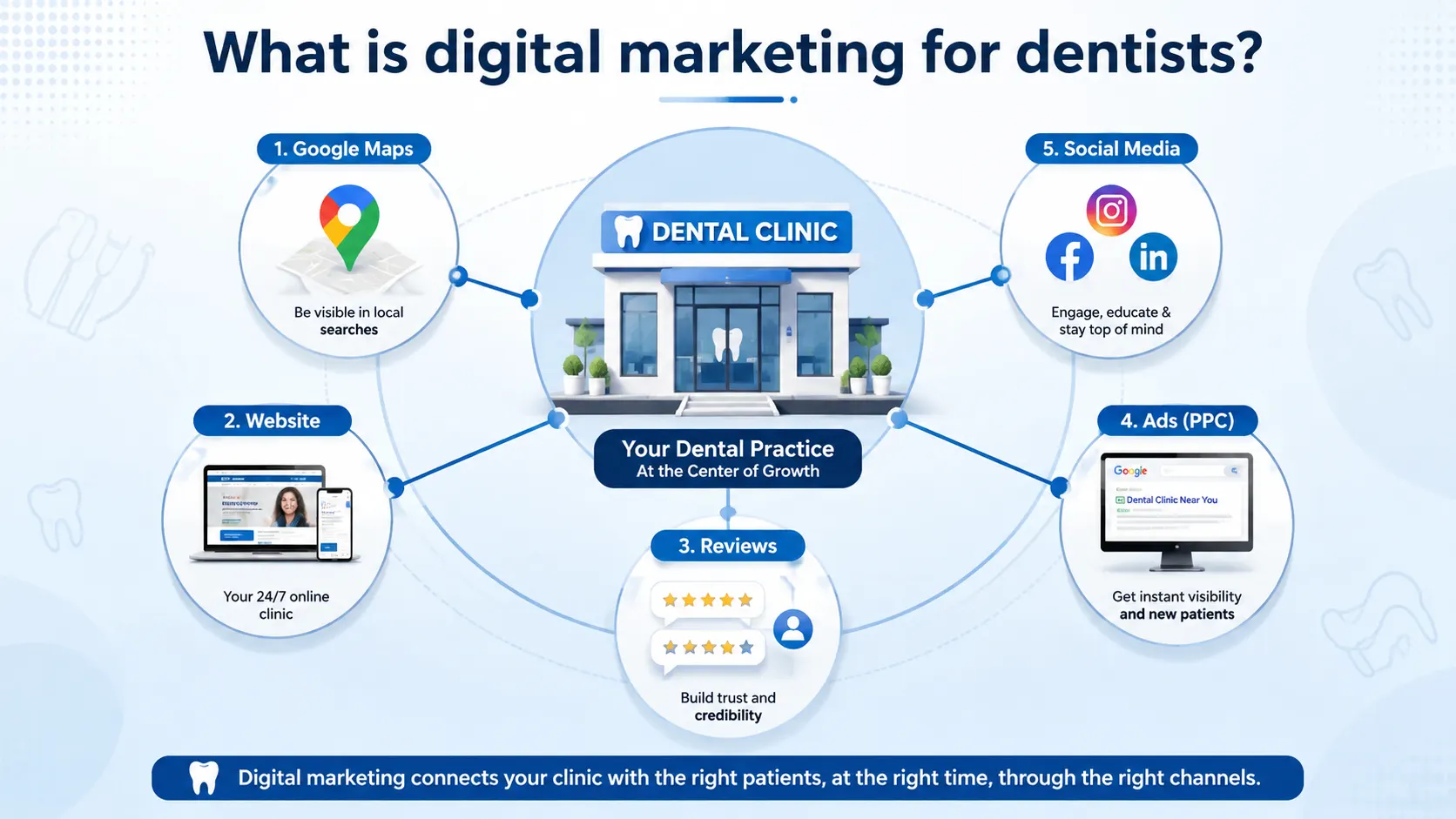
Digital marketing for dentists is the practice of using online channels, local search, your website, reviews, content, ads, social media, and messaging to help nearby patients find your clinic, trust it, and book. It replaces guesswork and word-of-mouth with a repeatable system.

Instead of waiting for referrals, digital marketing puts your clinic in front of a person at the exact second they are searching for dental care. A complete approach connects several channels, each doing one job. Local SEO and your Google Business Profile help people find you. Your website and reviews help them trust you. WhatsApp, SMS, and email follow-ups bring them back. Used together, these form one patient-acquisition system rather than a scatter of disconnected activities.

Key Takeaways

  • Patients decide before they call. A large share of health decisions now start with a search, not a referral. Your online presence is doing the first consultation for you, whether you manage it or not.
  • Local SEO is the highest-return channel for an Indian clinic. Your Google Business Profile often generates more enquiries than your website and social media put together.
  • Reviews decide both trust and ranking. A strong majority of consumers say they would choose a business that replies to reviews over one that ignores them. Never buy or incentivise reviews; it now breaks platform rules and, in some markets, the law.
  • Your website must convert, not just describe. One clear next step- book, call, or WhatsApp- turns a visitor into an appointment.
  • AI search is the new front door. Structured, question-led content gets your clinic quoted inside ChatGPT, Gemini, Perplexity, and Google’s AI answers, not just listed in blue links.
  • These are learnable skills. Everything in this digital marketing for dentists guide is a skill a person can build, which is why demand for people who understand dental and healthcare marketing is rising across India.

1.2 Why does digital marketing for dentists matter more in India? 

Let’s simply understand this. India came online through the phone, not the desktop. Cheap data and a smartphone in almost every hand mean a patient in Kolkata, Pune, or Lucknow now researches a dentist the same way they research anything else, by typing a question and comparing what comes back. When someone can read your reviews, check your qualifications, and see your clinic before calling, the clinic that answers clearly and calmly wins the appointment.

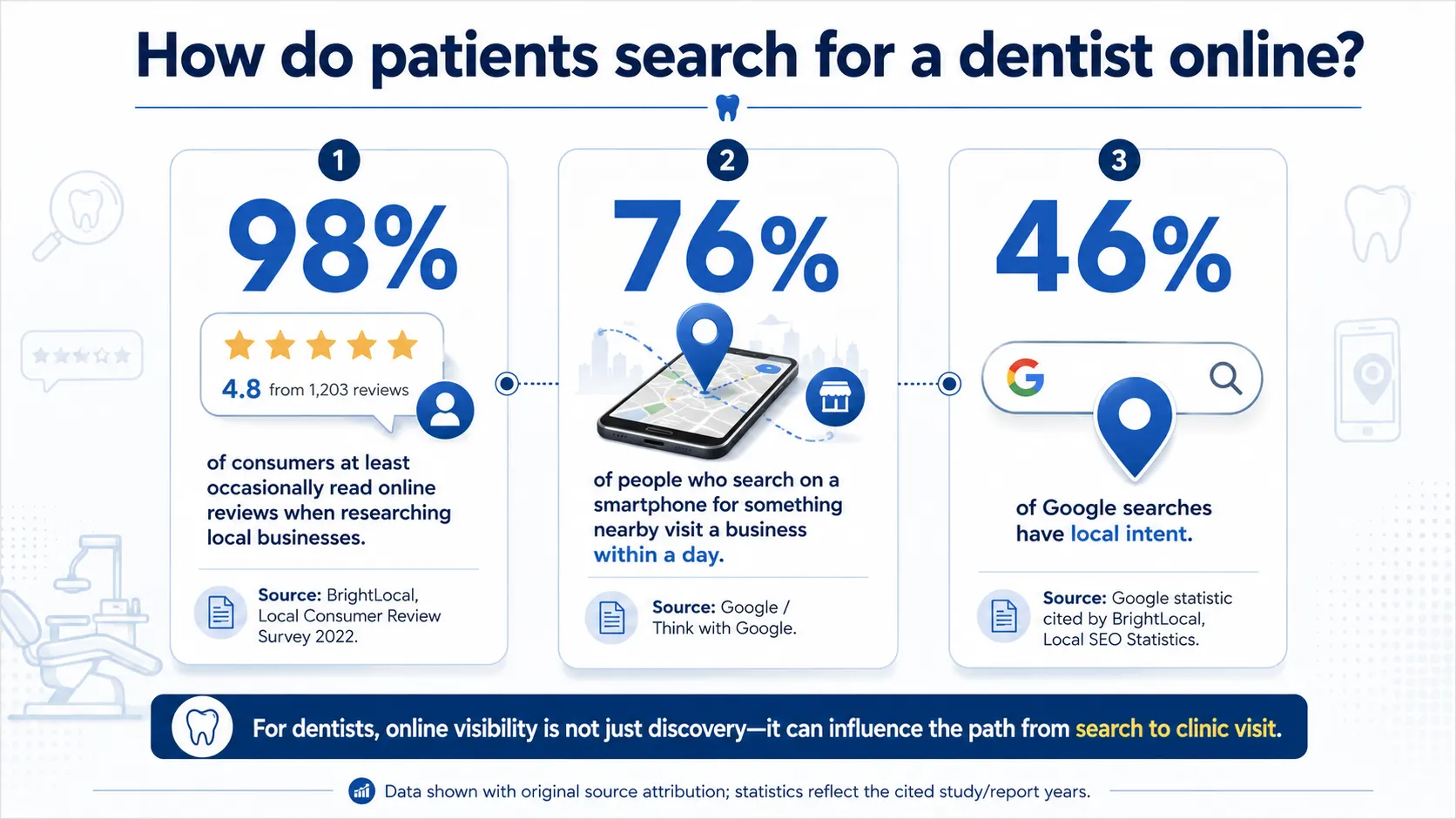
In the same way, healthcare has moved online. Patients no longer choose a dentist purely on a friend’s recommendation; they want to check for themselves first. Google has become the first consultation, and the scale is striking: Google has said publicly that about 1 in 20 of all its searches are health-related. When a person can compare your reviews, qualifications, and photos before calling, the clinic that answers their questions clearly and reassuringly wins the appointment.

1.3 How has patient behaviour changed?

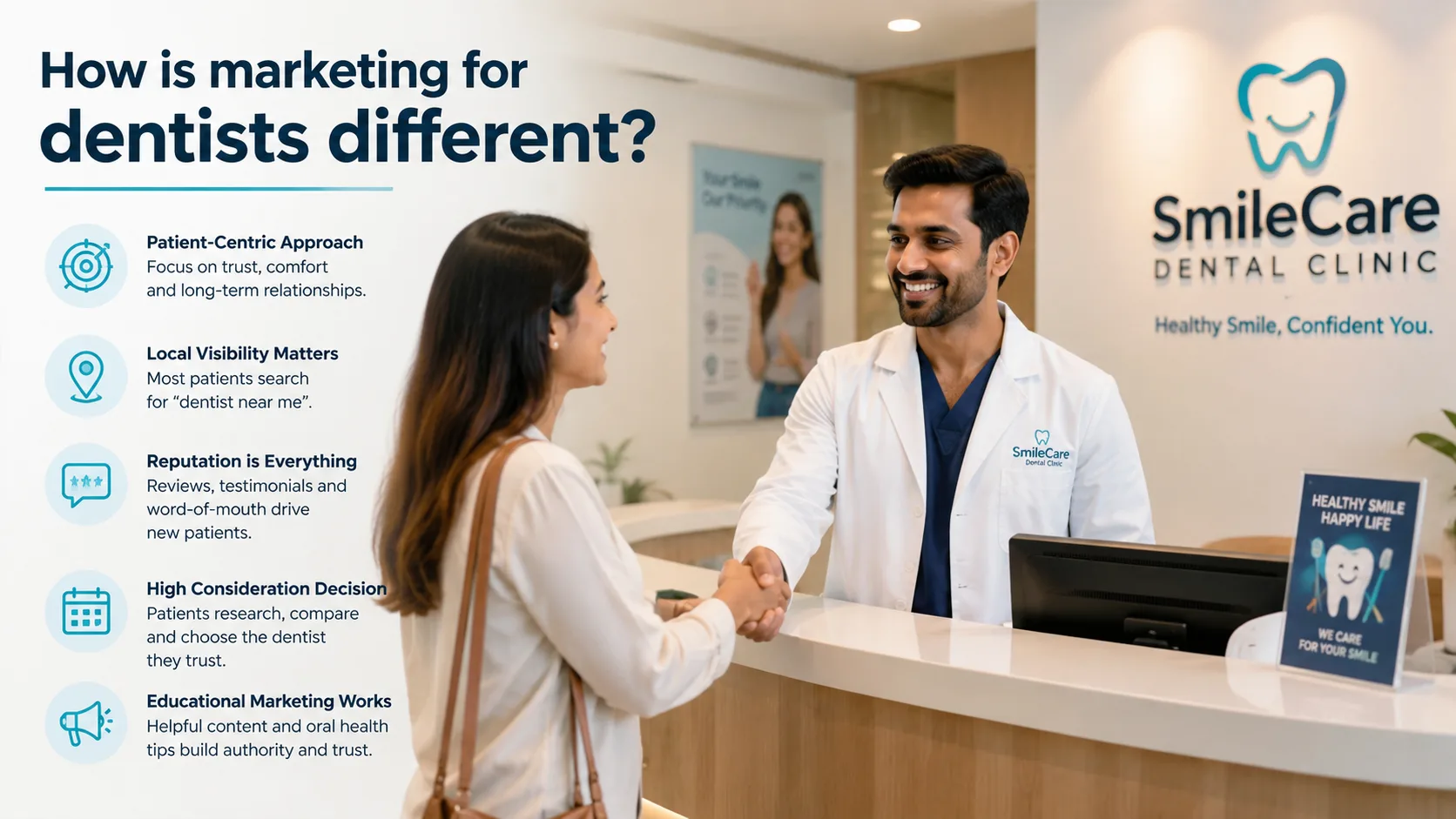
Today’s patients behave like informed consumers. Before booking, a typical patient will search Google, compare a few nearby clinics, read reviews, visit one or two websites, check the dentist’s credentials, and only then book. Every step in that sequence, except the final visit, is shaped by your digital presence. Clinics that invest in that presence simply look more trustworthy and easier to choose.

Word of mouth still matters, and satisfied patients remain your best advocates. But referrals are unpredictable; some months are busy and others quiet, while digital marketing creates a steady flow of new enquiries all year. The strongest practices combine both rather than choosing one.

2. The Patient Decision Journey

2.1 The five stages

Patients move through five stages: awareness, research, evaluation, decision, and loyalty. Each stage needs a different marketing response.

Patients' Decision Making Jouney in Dental Care

Thinking of marketing as a journey rather than a list of tactics makes it far easier to apply. The table below maps what a patient is thinking at each stage to the marketing that helps most.

Stage What the patient is thinking What helps most
Awareness “Something feels wrong with my teeth.” Educational blogs, Local SEO
Research “Which dentist should I trust?” Google reviews, website, Google Business Profile
Evaluation “Can this clinic solve my problem?” Treatment pages, case studies, FAQs
Decision “How do I book?” Online booking, click-to-call, WhatsApp
Loyalty “Will I return and recommend them?” Recall reminders, follow-ups, review requests

Clinics that support patients across the whole journey consistently outperform those that only advertise at the decision stage.

2.2 Why does a user’s trust depend on rankings?

Many dentists assume ranking on Google is only about keywords. Keywords help Google understand your content, but Google’s real goal is to recommend the most helpful and trustworthy result, which is exactly what a patient wants too. Trust is built from many small signals working together: a professional website, genuine reviews, clear treatment pages, dentist profiles with qualifications, real clinic photos, secure (HTTPS) hosting, and regularly updated content. Individually, each seems minor. Together they create confidence for both patients and search engines.

3. Local SEO and Your Google Business Profile

3.1 What does Local SEO mean for dentists?

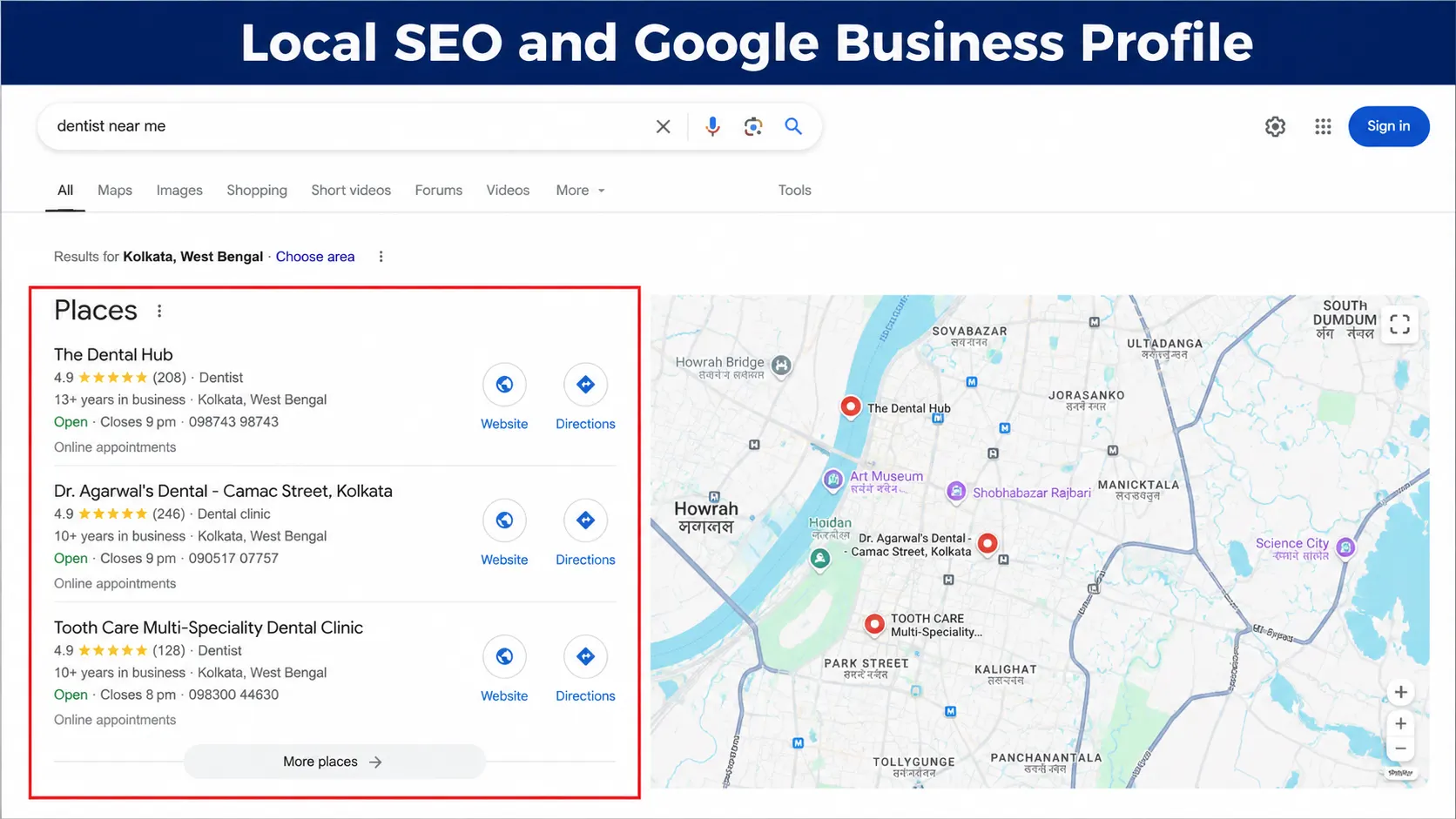
Local SEO (Search Engine Optimisation) is the work of making your clinic appear in Google Search and Google Maps when nearby patients look for dental care. It is usually the single highest-return channel for a dental practice.

When someone searches “dentist near me” or “dental implants near me”, Google often shows a “Local Pack”, the map with three clinics, before any normal results. Patients frequently call straight from that box without ever visiting a website, which is why appearing there matters so much.

Local SEO strategy for dentists

3.2 Optimising your Google Business Profile

Your Google Business Profile (GBP) is the free listing that powers your presence in the map results. Many clinics create one and never touch it again, which is a wasted opportunity. A complete, active profile helps Google understand who you are, where you are, what you offer, and whether patients trust you.

3.2.1 Profile information and services

Fill every field accurately and keep it current: clinic name, the most relevant primary category, secondary categories, address, phone, website, an online booking link, and hours including holidays. Write a natural description of your expertise and treatments without stuffing keywords. List each treatment as its own service: implants, root canal, cosmetic dentistry, aligners, whitening, crowns and bridges, children’s dentistry, gum treatment, emergency care, each with a short description.

3.2.2 Photos, posts and questions

Patients trust businesses they can see. Upload genuine photos of your reception, treatment rooms, signage, team, and equipment, and refresh them regularly so the profile looks active. Use Google Posts to share oral-health tips, seasonal campaigns, and clinic news. Answer common questions directly in the profile’s Q&A section, such as whether you accept walk-ins, offer emergency treatment, or treat children.

3.2.3 Reviews

Reviews are one of the strongest local ranking signals, and they are covered in full in Section 10. In short: encourage honest reviews from satisfied patients, thank positive reviewers, respond calmly to criticism, and never buy fake reviews.

3.3 The three local ranking factors

Google weighs hundreds of signals, but three matter most for local results. Relevance is how well your services match the search, which depends on clear service pages, correct GBP categories, and useful website content. Distance is how close you are to the searcher; you cannot move your clinic, but location-specific pages and accurate information strengthen your reach. Prominence is your reputation online, shaped by the number, quality, and freshness of reviews, website authority, trusted directory mentions, and brand searches.

3.4 The core local signals

Beyond the profile itself, a few signals repeatedly separate clinics that rank from those that do not:

  • Consistent NAP: Your Name, Address, and Phone number should be identical everywhere online: your website, GBP, Facebook, and directories. Even small differences reduce Google’s confidence.
  • Local citations: Mentions of your clinic on healthcare and local directories build local authority when they stay consistent.
  • Location pages: If you serve several areas, create a genuinely unique page for each, for example Salt Lake, Park Street, New Town, or Ballygunge, with local landmarks and area-specific FAQs. Never duplicate the same text across pages.
  • Schema markup: Structured data (explained in Section 5) helps search engines and AI tools read your clinic details accurately.
  • Mobile experience: Most local health searches happen on phones, so fast loading, tap-friendly buttons, and click-to-call are essential.

3.5 Local SEO checklist

Work through this monthly. A ✓ means the task is done and current.

Task Status
Google Business Profile fully completed
Business hours updated (including holidays)
Online booking link added
Services listed individually
High-quality clinic photos uploaded
Reviews collected regularly
NAP consistent across all platforms
Location-specific pages published
Local schema implemented
Mobile usability tested
Page speed optimised
Local citations maintained


Step Into the World of Digital Marketing

Learn from Digital Marketing Experts
Advanced Diploma in Digital Marketing
More Learning Options for you:
Diploma in Digital Marketing | Google Ads Certification Training | Certification Course

4. Your Website: Turning Visitors into Patients

4.1 What a high-converting website does?

A dental website’s main job is not to describe the clinic; it is to turn visitors into booked appointments. Every page should make the next step obvious: book, call, or message.

A beautiful website that generates no bookings is like a modern clinic with no receptionist. On every page, a visitor should immediately know what to do next, usually book an appointment, call, or send a WhatsApp message.

4.2 Five elements of a high-converting website

The best dental websites share five traits, and each addresses a specific patient worry.

  • A clear value proposition above the fold. Within seconds, the first screen should answer who you are, what treatments you offer, why patients should choose you, and how to book. A simple example: “Expert dental care for the whole family, modern technology, experienced dentists, same-day appointments,” followed by a visible “Book your appointment” button.
  • Strong trust signals. Healthcare decisions run on trust, so show dentist qualifications, years of experience, memberships, genuine Google reviews, patient testimonials, and real clinic photos.
  • Simple navigation. Keep the menu short and predictable: Home, About, Treatments, Our Dentists, Reviews, Blog, Contact. Confusing menus lose visitors.
  • Clear calls to action. Replace vague links like “Learn more” with action-led ones: “Book an appointment”, “Call now”, “Request a callback”.
  • Mobile-first design. More than half of health searches happen on phones, so large buttons, click-to-call, fast loading, and easy forms are non-negotiable.

High-converting dental website for Digital Marketing for Dentists

4.3 The pages every dental website needs

Publishing only a homepage and a contact page limits both trust and search visibility. At minimum, build a homepage (value proposition, services, reviews, booking), an about page (qualifications, experience, and philosophy, because people trust people more than logos), individual treatment pages for each major service, a reviews page that collects testimonials and patient stories in one place, and a contact page with phone, address, map, hours, a form, and WhatsApp. Each treatment page should answer what the treatment is, who needs it, the benefits, the procedure, recovery, and common questions, then invite the reader to book.

4.4 The on-site conversion journey

Think of the website as a digital receptionist guiding each visitor through five moments.

Stage Visitor action Page’s goal
Discover Lands on the website Capture attention
Explore Reads treatment information Build trust
Compare Checks experience and reviews Reduce hesitation
Decide Chooses your clinic Encourage booking
Convert Books an appointment Generate the enquiry

5. Technical SEO Foundations

5.1 What does technical SEO cover?

Technical SEO is the behind-the-scenes work- speed, security, mobile-friendliness, clean links, and structured data- that lets search engines crawl, understand, and rank your site. Great content cannot perform if the technical base is weak.

5.2 The essentials

A handful of technical basics carry most of the weight for a dental site:

  • Fast page speed. Google measures this through Core Web Vitals, three simple loading and stability scores. Aim for Largest Contentful Paint (main content loads) under 2.5 seconds, Interaction to Next Paint (response to a tap) under 200 milliseconds, and Cumulative Layout Shift (how much the page jumps around) under 0.1. These thresholds are Google’s own. Compress images, remove unnecessary scripts, and use modern formats like WebP.
  • Security (HTTPS). An SSL certificate encrypts data and reassures both patients and Google. Always use HTTPS.
  • Mobile responsiveness. Google indexes the mobile version of your site first, so it must work cleanly on every screen size.
  • Clean URLs. Short, descriptive links like /dental-implants beat messy ones like /page?id=45.
  • Optimised metadata. Every page needs a unique title, a compelling description, one H1 heading, and a logical heading order.
  • Image optimisation. Compress files, name them descriptively, and add alt text so images help both accessibility and speed.
  • Crawling basics. Keep an up-to-date XML sitemap submitted in Google Search Console, a sensible robots file, and canonical tags to avoid duplicate-content confusion.
  • Structured data (schema). Explained next, this helps search engines and AI tools read your pages.

Technical SEO for Digital Marketing for Dentists

Structured data, or “schema”, is a small piece of code that labels information on a page so machines can read it precisely, for example, marking your opening hours, address, or a list of questions and answers. For a clinic, the most useful types are Dentist or LocalBusiness (with address, hours, and location), FAQPage for question pages, and Review. Good schema improves your chances of rich results in Google and makes your details easier for AI assistants to quote.

5.3 Technical SEO audit checklist

Run this every quarter. A ✓ means the item is in place.

Technical SEO task Status
HTTPS enabled
Mobile-friendly design
Fast loading speed (Core Web Vitals passing)
XML sitemap submitted
Robots file configured
Schema markup implemented
Broken links fixed
Images optimised
Metadata unique on every page
Canonical tags added
404 errors monitored

6. Content Clusters and Topical Authority

6.1 What is a content cluster?

A content cluster is one main “pillar” page (like this guide) supported by several focused articles that all link back to it. It signals to Google that your site is a genuine authority on dental marketing, not a one-off page.

Think of it as a small library. The pillar page introduces the subject; each supporting article explores one topic in depth and links back to the pillar. This structure helps search engines see comprehensive coverage and helps readers move easily to the next relevant topic.

Digital Marketing for Dentists

Pillar Page

Local SEO for Dentists
Dental Reviews

Google Business Profile Guide
Google Maps Ranking

Website Optimisation for Dentists
Appointment Page SEO

6.2 A recommended cluster for dentists

Each supporting article below should answer one clear search intent and link back to this pillar page.

Pillar: Digital Marketing for Dentists

Supporting articles

  • Local SEO for dentists
  • Google Business Profile guide
  • Dental SEO checklist
  • Dental website best practices
  • Google Ads for dentists
  • Facebook and Instagram for dentists
  • AI in dental marketing
  • Online reputation management
  • Dental content marketing
  • Dental email marketing
  • Dental marketing budget guide
  • Dental marketing KPIs
  • Patient retention strategies

6.3 Internal linking and the hub-and-spoke model

Internal links help both readers and search engines move around your site, but they should be deliberate, not random. The simplest effective pattern is hub-and-spoke: the pillar page is the hub, and each supporting article is a spoke that links back to it.

Digital Marketing for Dentists

Hub Page

Local SEO
Google Ads
Content
Reviews
AI Marketing

Every spoke links back to the Hub

Use descriptive link text (“learn more about Local SEO for dentists”) rather than “click here”, link where it genuinely helps the reader, and revisit older articles to add links to new ones.

7. Getting Found in AI Search: GEO and AEO

7.1 What do GEO and AEO mean?

GEO (Generative Engine Optimisation) and AEO (Answer Engine Optimisation) mean structuring your content so AI tools, ChatGPT, Gemini, Perplexity, Claude, and Google’s AI answers can quote it. Traditional SEO earns a click; GEO and AEO earn a mention inside the answer itself.

Patients increasingly ask AI assistants their health questions, and those tools pull from clear, trustworthy, well-structured content. This is now a core part of digital marketing for dentists. The good news is that the work overlaps heavily with normal good SEO. There is no need to chase a separate system.

7.2 How to structure content for AI answers?

Three habits make your content easy for AI (and for readers) to use:

  • Answer directly, then expand. Open important sections with a one- or two-sentence answer before the detail, exactly like the “Quick answer” boxes in this guide. For example: “What is Local SEO for dentists? It helps a clinic appear in Google Search and Maps when nearby patients look for dental care.”
  • Use question-based headings. Headings phrased the way people actually ask, “How can dentists attract more patients online?”, match conversational and AI search closely.
  • Write in plain language. Patients search “why do my gums bleed?”, not clinical jargon. Use their words.

7.3 Featured snippets and entities

To win Google’s featured snippets (the boxed answer above normal results), answer the question in the first 40 to 60 words, use short lists for steps and tables for comparisons, and keep definitions tight. It also helps to mention related concepts naturally: Google Business Profile, Google Maps, reviews, appointment booking, patient retention, because modern search engines understand the relationships between these ideas, not just isolated keywords.

GEO and AEO for Digital Marketing for Dental Clinics

If you or your team want to build these AI-search and SEO skills properly rather than piece them together, Section 16 covers the training IDCM offers.

8. Google Ads for Dentists

8.1 When do ads make sense?

Google Ads puts your clinic at the top of results instantly, and you pay only when someone clicks. It is the fast complement to SEO, which builds slowly but lasts.

Paid search works best in specific situations: opening a new clinic, launching a treatment, expanding to a new area, competing in a crowded market, or generating enquiries while your SEO matures. It should support your organic strategy, not replace it. Patients searching “emergency dentist near me” or “dental implant specialist” are already close to booking, and ads let you meet them at that moment.

8.2 Best practices and common mistakes

Build campaigns around patient intent, with separate campaigns for each treatment (implants, cosmetic, emergency, aligners, whitening) rather than one generic clinic campaign, and send each ad to a matching treatment page, never the homepage. The most common ways clinics waste budget are sending all traffic to the homepage, bidding on broad low-intent keywords, ignoring negative keywords, running without conversion tracking, and judging success by clicks. Measure ads by appointments generated, not clicks.

9. Social Media for Dentists

For dentists, social media’s job is not to chase followers; it is to build familiarity and trust so patients feel they already know you before they book.

Social media humanises your practice. Patients want to see your clinic, your team, and how you care for people. The right platform depends on where your patients spend time.

Platform Best used for
Instagram Smile transformations, hygiene tips, short educational reels, behind-the-scenes
Facebook Community engagement, patient education, local promotions, testimonials
YouTube Longer educational videos (“what happens during a root canal?”) that also rank in Google
LinkedIn Networking, hiring, and professional credibility, useful for multi-speciality clinics

Across all of them, education beats promotion. Posts that explain tooth sensitivity, signs you may need a root canal, or children’s oral-health tips position your clinic as a trusted adviser rather than an advertiser.

10. Reviews and Online Reputation

10.1 Why reviews carry so much weight

Online reviews are the modern equivalent of a personal recommendation, and they influence both patient trust and your local ranking. How you respond matters as much as the rating.

The evidence is clear. BrightLocal’s Local Consumer Review Survey has repeatedly found that the vast majority of consumers read reviews for local businesses, and that responding matters enormously: 88% say they would use a business that replies to all its reviews, compared with just 47% for a business that never responds. Independent local-search research by Whitespark estimates that review signals make up roughly 17% of what determines the Google Local Pack, one of the largest single factors. In other words, reviews influence whether patients trust you and whether Google shows you at all.

10.2 Building a genuine review system

Rather than asking for reviews occasionally, make it a simple, repeatable habit: ask satisfied patients after successful treatment, during follow-ups, and through email, SMS, or WhatsApp, and give them a direct review link to remove friction.

One firm rule: never offer gifts, discounts, or payment in exchange for reviews. Incentivised reviews violate Google’s and Yelp’s policies, and in the United States, the Federal Trade Commission’s 2024 rule made buying or writing fake reviews illegal, with real fines attached. Regulators and platforms are cracking down hard; Google alone reported blocking hundreds of millions of policy-breaking reviews in a single year. Authentic reviews are not just safe; they carry more weight with patients and with Google.

Reviews and Online Reputation for Dental Clinics Digital Marketing

10.3 Responding to reviews

Every review deserves a thoughtful reply. For positive ones, thank the patient personally and reinforce your commitment to care. For negative ones, stay professional, avoid discussing any confidential medical detail, and invite the person to continue privately. Prospective patients often judge a clinic more by how it handles criticism than by the criticism itself.

11. Email, SMS and Patient Retention

Keeping an existing patient usually costs far less than winning a new one, so automated reminders and follow-ups are among the highest-return marketing you can do.

Simple, well-timed messages keep your clinic top of mind and bring patients back: six-month check-up reminders, appointment confirmations, oral-health tips, post-treatment care instructions, birthday greetings, and preventive-care campaigns. As the practice grows, marketing automation handles this consistently without adding admin work, supporting lead nurturing, appointment reminders, missed-call follow-ups, WhatsApp confirmations, and feedback collection through a modern patient-management or CRM system.

12. Measuring What Matters: KPIs and Budget

12.1 The KPIs to track

Website traffic is not success. Measure the numbers tied to revenue, enquiries, cost per lead, and patient value.

A KPI (Key Performance Indicator) is simply a number you track to judge whether marketing is working. Review these monthly.

KPI Why it matters
Organic traffic Shows SEO visibility
Google Business Profile views Indicates local-search performance
Phone calls Direct sign of patient interest
Appointment requests Measures real lead generation
Conversion rate Shows how well the website turns visits into enquiries
Cost per lead Tests advertising efficiency
Patient acquisition cost Measures overall marketing efficiency
Patient lifetime value Shows long-term profitability
Return on ad spend Measures paid-campaign performance

12.2 How much to invest

There is no universal budget; it depends on clinic size, competition, and goals. The ranges below are a practical starting framework for the Indian market, not a rule. Treat marketing as an investment measured by the patients it brings, not as a fixed cost.

Practice type Suggested monthly marketing budget
Solo practice ₹25,000–₹50,000
Growing practice ₹50,000–₹1,50,000
Multi-location clinic ₹1.5 lakh–₹5 lakh+

13. A Practical 90-Day Roadmap

Do not try everything at once. Build the foundation first, then visibility, then optimisation:

Phase Focus Key actions
Days 1–30 Build the foundation Optimise Google Business Profile; improve the website; fix technical SEO; set up Google Analytics and Search Console; start collecting reviews
Days 31–60 Increase visibility Publish educational content; build local citations; create treatment landing pages; launch targeted Google Ads; improve internal linking
Days 61–90 Optimise and scale Analyse performance; refine paid campaigns; expand content clusters; automate follow-ups; keep growing reviews

This phased approach builds a sustainable system without overwhelming a busy clinic.

90-day digital marketing roadmap for dentists

14. Common Mistakes to Avoid

Most clinics that struggle with digital marketing for dentists as they repeat the same avoidable errors:

  • Treating the website as a brochure. It should answer questions and drive bookings, not just describe the clinic.
  • Ignoring Local SEO. Neglecting the Google Business Profile is costly, since Maps results usually appear before normal results.
  • Publishing generic content. Patients want practical answers about treatments, costs, and recovery, not marketing jargon.
  • Buying fake reviews. It damages credibility, breaks platform rules, and is now illegal in some markets.
  • Running ads without measurement. Without conversion tracking, you cannot tell what works.
  • Ignoring existing patients. Your current patients are often your most valuable asset for retention and referrals.

15. The Future of Dental Marketing

Patient behaviour and technology keep shifting, and clinics that adapt early stay ahead. Four changes stand out. AI-powered search means more patients ask ChatGPT, Gemini, Perplexity, or Google’s AI answers directly, rewarding clear, trustworthy, well-structured content. Voice search favours natural questions like “which dentist is open now?”. Short video continues to grow as a way to explain treatments and build familiarity. And data-driven decisions, reviewing performance regularly rather than guessing, increasingly separate clinics that grow from those that stall.

16. Build These Skills at IDCM

Everything in this guide- Local SEO, Google Business Profile, content, ads, reviews, and AI search- is a learnable skill, not a mystery reserved for agencies. Whether you run a clinic, manage its marketing, or want to build a career in healthcare marketing, understanding these systems pays off directly.

At IDCM (Institute of Digital and Content Marketing), part of the ICA Edu Skills group, learners get hands-on training across the exact areas this guide covers: search engine optimisation and Local SEO, Google Ads, content marketing, AI-powered marketing, social media, performance marketing, and marketing analytics. All are included at our flagship programmes such as Advanced Diploma in Digital Marketing, or Diploma in Digital Marketing. The focus is practical, live projects, real tools, and industry-relevant assignments, so you can apply the skills to a real business rather than only reading about them. Placement assistance is available to eligible learners.

If you are a dentist or clinic manager, the practical takeaway is simple: you do not have to do all of this yourself or blindly outsource it. Learning the fundamentals lets you brief an agency well, judge results honestly, and keep control of your own patient pipeline.

17. Final Thoughts

Patients no longer choose a dentist on proximity or word of mouth alone. They compare clinics online, read reviews, explore websites, and look for trustworthy information before they decide. That shift has made digital marketing for dentists a core part of practice growth, not an optional extra.

The point is not to chase every new platform. It is to build a patient-first digital experience: a website that answers real questions, a complete Google Business Profile, content that shows genuine expertise, and a reputation that reflects real patient experiences. Treat SEO, ads, social media, content, and reviews not as separate tactics but as connected parts of one system, and the clinic becomes easier to find, easier to trust, and easier to choose.

18. Frequently Asked Questions 

What is digital marketing for dentists?

Digital marketing for dentists is the process of attracting, converting, and retaining patients through online channels such as Local SEO, Google Business Profile, websites, content marketing, paid advertising, social media, and messaging like WhatsApp.

Why is digital marketing important for dentists?

Most patients search online before choosing a clinic. Digital marketing increases visibility, builds trust, and helps a practice generate a steady stream of appointment enquiries rather than relying on unpredictable referrals.

How long does dental SEO take?

Most clinics see measurable improvement within three to six months, depending on competition, website quality, and how consistently the work is done.

Is Google Ads better than SEO for Digital Marketing for Dentists?

They do different jobs. Google Ads gives immediate visibility, while SEO builds durable, long-term traffic. Used together, they usually produce the best results.

How often should dentists publish blog content?

Two to four high-quality articles a month is a practical target. Consistency matters more than volume.

What type of content attracts dental patients?

Educational content works best: treatment guides, oral-hygiene tips, recovery advice, cost explanations, and answers to common patient questions.

How important Google reviews for Digital Marketing for Dentists?

Very. Reviews influence both local rankings and patient trust, and responding to them makes a measurable difference to whether patients choose you.

Which social media platform works best for dentists?

Instagram, Facebook, and YouTube are usually most effective because they let clinics educate patients and build familiarity through visual content.

Can AI help dentists with marketing?

Yes. AI can assist with content, campaign analysis, reminders, and chat support, but all healthcare content should be checked by a qualified professional before it is published.

How do dentists measure marketing success?

Track appointments, organic traffic, phone calls, cost per lead, conversion rate, patient acquisition cost, patient lifetime value, and return on ad spend, not website traffic alone.

How much is a single dental patient worth over their lifetime?

It depends on your treatment mix and how long patients stay, so calculate your own figure: average revenue per visit, multiplied by visits per year, multiplied by years retained. Because loyal patients return for check-ups and further treatment, keeping them usually costs far less than acquiring new ones, which is why retention marketing pays off.

Should dentists offer gifts or incentives to get 5-star reviews?

No. Offering gifts or payment for reviews breaks Google’s and Yelp’s policies and, in some markets, the law. Build a genuine review system instead: ask after successful treatment, share a direct review link by SMS or WhatsApp, and respond to every review.

How do I add JSON-LD schema to a dental clinic website?

Add a small application/ld+json code block to the page, either in the site’s head section or through an SEO plugin like Rank Math or Yoast. For clinics, use Dentist or LocalBusiness plus FAQPage, then check it with Google’s Rich Results Test.

Ayantika Banerjee

categories:

Tags:

Placed Students Story