
Courses
Every day, thousands of people sit at a desk, feel a sharp pain shoot down their lower back, and reach straight for their phone. In this situtaion, they aren’t looking for a big healthcare chain. They want a trusted local solution to the pain they feel right now. Today, roughly 77% of patients open a search engine before they book any healthcare appointment, so that phone search is the front door to your clinic; and it’s exactly why digital marketing for chiropractors starts with being found at that moment of need.
Most chiropractors are excellent at adjusting spines but far less comfortable filling an empty appointment book. Relying only on word of mouth in a digital-first market leaves real revenue on the table. If your clinic isn’t visible on the exact channels where these patients search, a competitor is capturing patients who should be yours.
This guide lays out the full system of digital marketing for chiropractors. You’ll see how it captures high-intent searches, builds clinical authority, and turns cautious clicks into long-term patients. The framework is built to transfer: the same playbook that works for a chiropractor in the US works for a clinic, gym, or coaching centre in Kolkata. More on that later, so let’s read together.
Table of Contents
Chiropractic is a regulated healthcare profession, not a spa treatment or a one-off massage. Practitioners or chiropractors focus on diagnosing and managing problems of the musculoskeletal system, especially the spine, and how those problems affect the nervous system and overall movement.

The core technique is manual therapy: hands-on spinal adjustment (also called spinal manipulation), where controlled pressure is applied to specific joints to improve alignment, ease mechanical pressure on nerves, and restore range of motion. Many chiropractors also use soft-tissue work, corrective exercises, posture guidance, and lifestyle advice as part of a treatment plan.
Patients most commonly see a chiropractor for lower back pain, neck pain, sciatica, headaches linked to tension, and sports or posture-related injuries. It’s best understood as a conservative, non-surgical, drug-free approach to musculoskeletal care, one option within the wider healthcare system rather than a replacement for medical treatment. That distinction matters for your marketing too: your content should inform and build trust, never promise to “cure,” which both misleads patients and breaks medical-advertising rules.
Key Takeaways
The patient journey is now digital from the first twinge of pain to the moment of booking. Even a patient referred by a friend checks you online before they call. That makes digital marketing for chiropractors less of a “nice to have” and more of the deciding factor in whether a searching patient lands on your table or a competitor’s. Here’s why it matters:
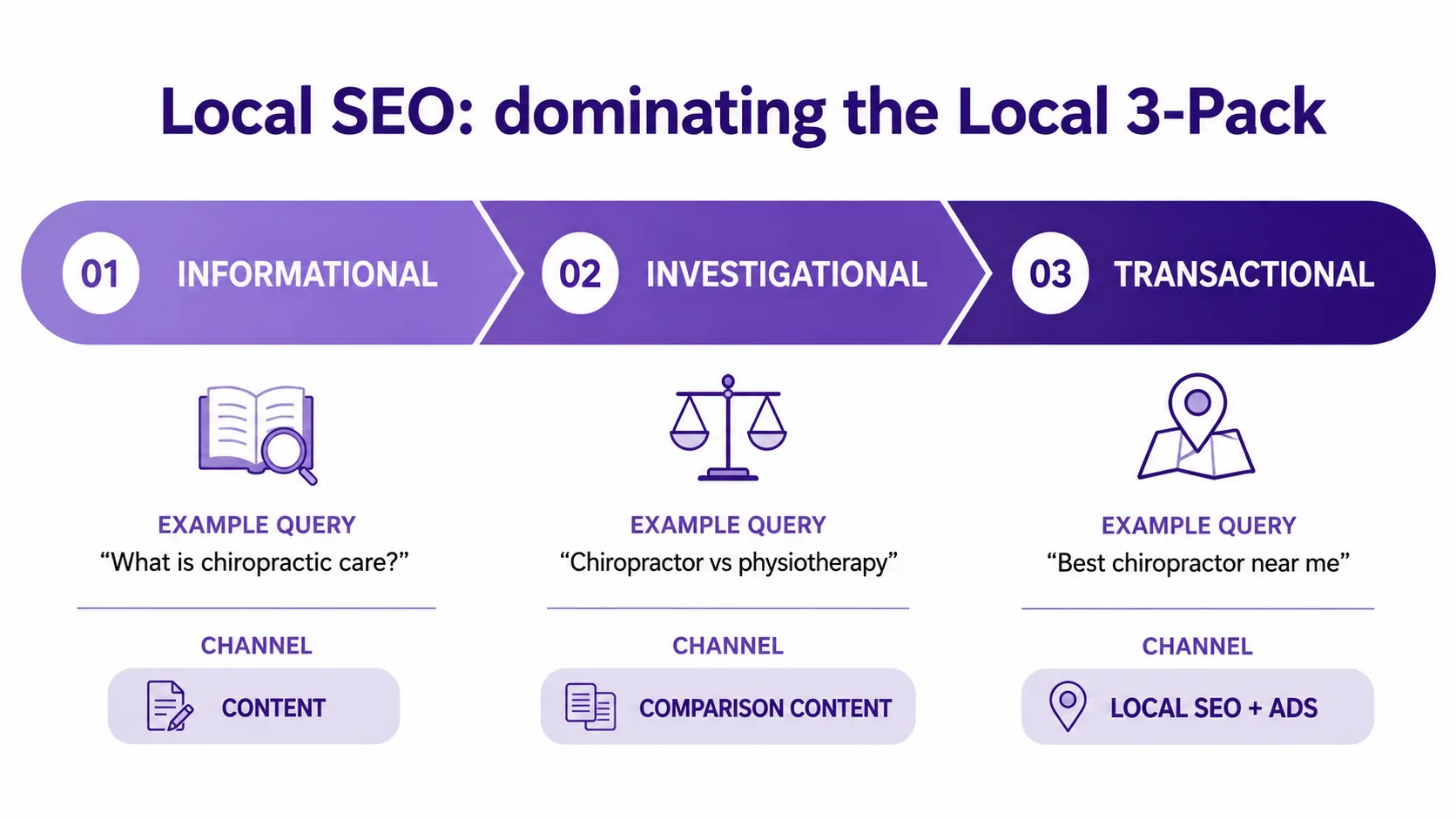
To build a presence that converts, start with how patients think. Healthcare search splits into two mental states: urgent symptomatic relief and long-term preventative wellness. Each needs a different channel, tone, and call to action.
Most high-value bookings come from acute intent, a thrown-out back, a sciatica flare, whiplash-related neck pain. These searches are urgent, local, and transactional. To capture them, your clinic must show up in instant-answer channels: Google Local Service Ads and local organic search. About 63% of medical searches now happen on a phone. Roughly 92% of patients choose a provider from the first page of Google. So mobile-first local visibility is non-negotiable.
Preventative intent is slower but valuable. These users want to fix posture or manage recurring tension. Educational content marketing reaches them early and positions your practice as the authority long before they need urgent care.
It helps to picture intent as a spectrum:
Where a patient sits on that spectrum decides the channel and the message you use to convert them.
Local SEO is the single most important part of any digital marketing for chiropractors strategy. When someone searches for a local medical service, Google shows the “Local 3-Pack”, the three map results above the standard listings. That block captures roughly 42% of clicks on local medical searches, and complete, well-maintained profiles can earn up to 7 times more clicks than incomplete ones. With nearly half of all Google searches carrying local intent, this is your prime digital real estate.
Your GBP is the digital front door of your clinic. Optimise it with this checklist:
Search engines cross-check your business details across the web. Any mismatch in your Name, Address, or Phone (NAP) weakens local visibility. Keep them identical everywhere.
| Citation directory | Authority type | What to optimise |
|---|---|---|
| Google Business Profile | Primary local engine | Exact legal NAP; verified, pinned map location |
| Yelp / local aggregators | Tier-1 aggregator | Active review monitoring; complete business history |
| Healthgrades / Practo | Medical directory | Practitioner licensing; clear service listing |
| Local Chamber of Commerce | Hyper-local trust signal | Backlink to your domain; verified physical address |
Local Business schema for chiropractors
Add structured data to your site so search engines can read your location and services precisely. Below is a clean, internally consistent Chiropractor JSON-LD example, replace the bracketed values with your real details before publishing:
{
  "@context": "https://schema.org",
  "@type": "Chiropractor",
  "name": "SpineWell Chiropractic Clinic",
  "url": "https://www.spinewell.in",
  "telephone": "+91-33-4001-2233",
  "priceRange": "\u20b9\u20b9",
  "address": {
    "@type": "PostalAddress",
    "streetAddress": "DC Block, Sector 1, Salt Lake City",
    "addressLocality": "Kolkata",
    "addressRegion": "WB",
    "postalCode": "700064",
    "addressCountry": "IN"
  },
  "geo": { "@type": "GeoCoordinates", "latitude": 22.5867, "longitude": 88.4172 },
  "areaServed": ["Kolkata", "Salt Lake", "New Town", "Howrah"],
  "openingHoursSpecification": [
    { "@type": "OpeningHoursSpecification",
      "dayOfWeek": ["Monday","Tuesday","Wednesday","Thursday","Friday"],
      "opens": "09:00", "closes": "19:00" }
  ]
}
Content Marketing is an integral part of the digital marketing for Chiropractors. Health related content sits under Google’s strict Your Money or Your Life (YMYL) framework, so it must show real Experience, Expertise, Authoritativeness, and Trustworthiness (E-E-A-T). This matters commercially, not just technically: roughly 84% of patients read online reviews and health information before choosing a provider, so weak or generic content quietly loses them.
When you write about a treatment like spinal manipulation, skip the surface-level fluff. Your reader is often in discomfort and wants a real answer. Balance clinical accuracy with plain, jargon-free language.
Take sciatica as an example. Don’t just say “try stretching.” Explain the anatomy: digital marketing for chiropractors works best when you define clinical concepts clearly. Sciatica is not a disease in itself; it’s a symptom of nerve-root compression, most often from a herniated lumbar disc pressing on the L4, L5, or S1 nerve roots. Framing it this way shifts your message from “temporary comfort” to “structural correction,” which is what patients actually want.
Always back clinical claims with credible data. If you discuss the effectiveness of non-surgical spinal decompression, cite peer-reviewed research, for example, studies published in the Journal of Manipulative and Physiological Therapeutics (JMPT). Citing named sources both reassures readers and signals to search engines and AI systems that your content is grounded, not invented.
Medical marketing must respect privacy and advertising rules. In the US that means HIPAA; in India, the equivalent duties come from the Digital Personal Data Protection Act, 2023 for patient data, plus medical-council advertising codes. Wherever you operate:
Step Into the World of Digital MarketingLearn from Digital Marketing Experts |
|
| Advanced Diploma in Digital Marketing | |
| More Learning Options for you: Diploma in Digital Marketing | Google Ads Certification Training | Certification Course |
Local SEO is your long-term asset. In digital marketing for chiropractors, Google Ads is the fastest way to get calls today, which suits a new or expanding clinic.
Focus your budget on commercial and transactional intent, and use tight match types:
Use phrase and exact match to block low-value informational queries like “how to crack your own back.” Build a strong negative-keyword list: “jobs,” “salary,” “courses,” “free,” “school”, so you’re paying only for patients, not researchers or job-seekers.
Look past clicks and impressions. Calculate the true value of a patient before you set bids. The formula is simple:
Lifetime Value (LTV) = Average Fee per Visit × Visits per Year × Retention (Years)
Worked example: if a visit averages ₹800, a patient comes 12 times a year, and stays with you for 3 years, then LTV = ₹800 × 12 × 3 = ₹28,800. Once you know a patient is worth ₹28,800, a Cost Per Acquisition of ₹600–₹1,000 is clearly profitable, and you can bid confidently on high-intent keywords.
| Advertising channel | Primary intent | Audience focus | Avg. cost per acquisition |
| Google Search Ads | High transactional | Actively searching for pain relief | ₹500 – ₹1,200 |
| Google Local Service Ads | Immediate / emergency | Local users wanting a call or booking now | ₹300 – ₹700 per lead |
| Meta Ads (FB / IG) | Informational intercept | Local users by interest (fitness, back pain) | ₹250 – ₹800 |
In healthcare, the patient’s real question is: can I trust this person with my body? Reviews are the bridge that answers it, which makes reputation one of the highest-return parts of chiropractic marketing. Most patients read reviews before booking, and one 2025 survey found that 41% of patients trust a provider more when they see the provider replying to reviews. Yet most patients won’t leave a review unless asked, so build a system.
A frictionless script you can adapt:
“Hi Anita , it’s Dr. Manish from Vitality Health Care. Great to see your mobility improving this week! If you have 30 seconds, would you share your experience on Google? It helps neighbours with similar back pain find the right care. Just tap here: https://g.page/r/vitality-healthcare/review”
Every practice eventually gets a negative review. How you respond publicly is itself a trust signal for everyone reading.
The rule: never confirm the reviewer is a patient. Doing so publicly acknowledges their medical status and can breach privacy law. Use a standardised, compliant reply written for the prospective reader:
“We take all feedback seriously, but to protect medical privacy we don’t discuss patient care in a public forum. If you are a current or past patient, please contact our Practice Director directly at [phone] so we can look into and resolve your concern.”
Most of the data above comes from the United States, where chiropractic is a large, mature market with reliable public figures. The American Chiropractic Association counts about 70,000 licensed chiropractors. The profession treats over 35 million Americans a year, and IBISWorld valued the US chiropractic industry at roughly $20.6 billion in 2024. That scale is exactly why it’s the clearest place to study digital marketing for chiropractors at full size.
But the framework does not revolve solely around chiropractic practrices, and America. It’s about how any local, service-based business earns trust and patients online. Swap “chiropractor” for a dental clinic, physiotherapy centre, diagnostic lab, gym, salon, or coaching institute, and the same channels apply. Indian patients search the same way: Google, the map pack, reviews on Google and Practo, a quick judgement of your mobile site. A clinic in Salt Lake or a coaching centre in Gariahat wins the same way a chiropractor in Texas does: a complete Google Business Profile, a fast mobile site, honest content, steady reviews, and a small, sharp local ad budget.
Building and running a system like this takes a real skill set. Handing complex, compliant, multi-channel campaigns to untrained staff usually produces broken tracking, non-compliant copy, and wasted ad spend.
A modern local healthcare funnel requires:
↳ all of which depend on properly trained specialists.
This is the gap the Institute of Digital and Content Marketing (IDCM) Kolkata, a training vertical of ICA Edu Skills, is built to close. IDCM trains students and career-switchers in the mechanics that matter. The courses like Advanced Diploma in Digital Marketing, or Diploma in Digital Markting includes hands on training of local SEO, compliant data handling over HTTPS, schema implementation, and data-driven campaign optimisation; rather than surface-level social posting. The result is job-ready digital marketers who can help local businesses across West Bengal, including clinics and healthcare brands, grow safely and profitably.
To tie your pages together, use a proven copy structure. Frank Kern’s Mass, Control, Bait framework fits local medical prospects well.
MASS. Validate the widespread pain point. Connect with the shared frustration:
“Living with chronic lower back pain or sciatica can feel isolating. You miss weekend sports, struggle to play with your kids, and rely on daily anti-inflammatories that only mask the problem. You’re not alone, thousands of professionals deal with this every day while searching for a real solution.”
CONTROL. Present the systematic solution. Position your practice as the calm, clear guide:
“Lasting relief doesn’t come from a one-off massage or a generic prescription. It comes from a precise, structured approach. We use digital structural X-rays to locate the exact source of misalignment, then apply gentle, customised spinal-decompression protocols to reduce pressure on compressed nerves and support your body’s natural recovery.”
BAIT. Offer a low-risk next step. Close with a valuable, compliant call to action (note: no absolute “cure” or “permanent fix” language):
“Don’t stay stuck in the pain cycle. Download our free guide, The Desk Worker’s Guide to Better Posture, the exact ergonomic and mobility routines you can start today. Ready to begin? Claim a $49 initial assessment, including a spinal surface scan and a recovery plan built around your goals.”

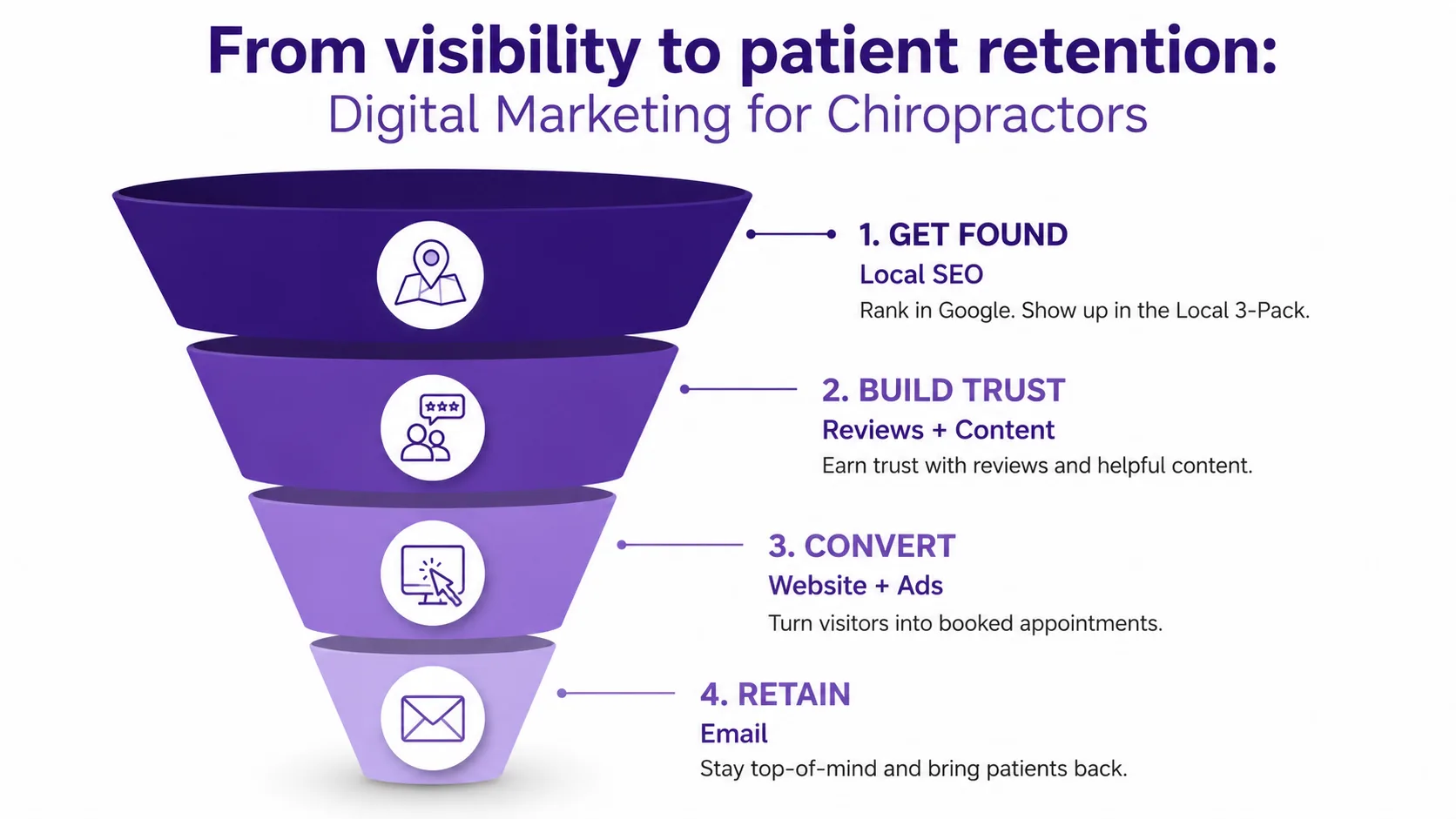
Digital marketing for chiropractors is not a collection of one-off tactics, it’s a system, and the order matters. Get found first through a complete Google Business Profile and the Local 3-Pack, earn trust with honest, compliance-safe content and a steady stream of reviews, then use paid ads to accelerate what’s already working. Skipping the foundation to chase ads is how clinics burn budget with nothing to show for it.
The single most important shift is to stop thinking like a practitioner and start thinking like the patient in pain who’s holding a phone. They search locally, they judge quickly, and they trust the clinic that looks credible, answers their question, and is easy to book. Every channel in this guide exists to meet that person at their moment of need.
And remember why this matters beyond chiropractic: the same framework, local intent, structured content, reviews, measured ad spend is how any local, service-based business grows online, whether it’s a physiotherapy centre in Salt Lake, a diagnostic lab, or a coaching institute in Gariahat. Master it once and it transfers everywhere.
Claim and fully optimise your Google Business Profile, keep your NAP (Name, Address, Phone) consistent across directories, add Chiropractor JSON-LD schema to your site, and steadily earn patient reviews that mention specific treatments like “sciatica relief” or “spinal adjustments.” Together, these push you into the Local 3-Pack, which captures a large share of local clicks.
They solve different problems. Google Ads captures high-intent patients immediately, which is ideal for a new clinic. SEO builds durable, lower-cost visibility over months. Most successful practices run both: ads for now, SEO for later.
There’s no single figure, it depends on your market, goals, and current volume. Budget as a share of revenue and fix the foundation first (Google Business Profile, website, reviews) before scaling paid ads, because paid channels only multiply the organic presence you already have.
A lot. Most patients read reviews before choosing a provider, and trust rises when they see practices responding. Earning recent reviews and replying to all of them is one of the highest-return activities available.
Protect patient privacy: never publish case studies, photos, or testimonials without written consent, run all forms over HTTPS, follow your region’s data law (HIPAA in the US, the DPDP Act, 2023 in India) and medical-advertising codes, and avoid absolute medical guarantees in your copy.
Yes, for the basics, completing your Google Business Profile, requesting reviews, and simple content. Paid ads and technical SEO have steeper learning curves; many practices handle the basics in-house and bring in trained specialists once they scale ad spend.


 }})