
Courses
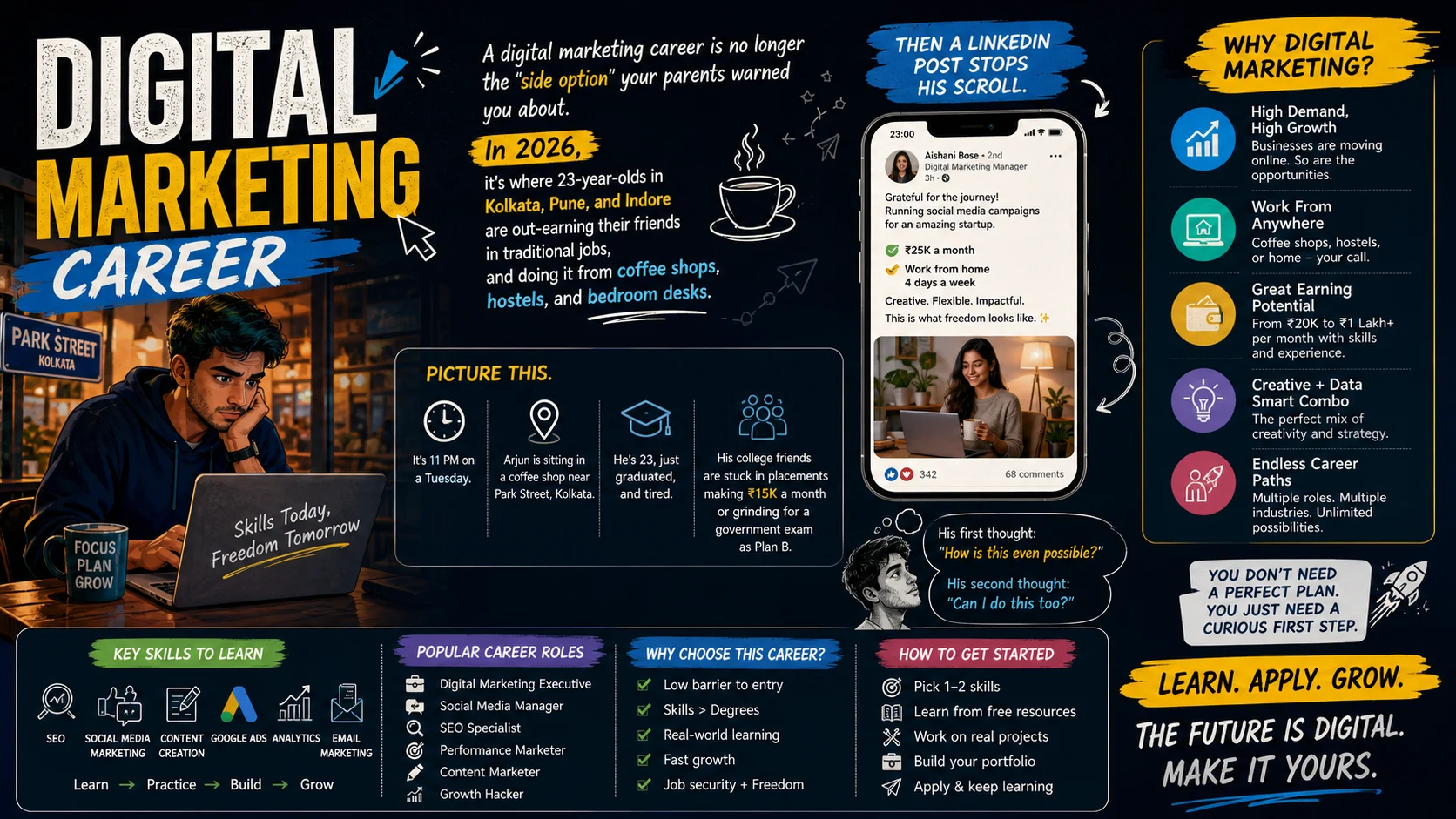
A digital marketing career is no longer the “side option” your parents warned you about. In 2026, it’s where 23-year-olds in Kolkata, Pune, and Indore are out-earning their friends in traditional jobs, and doing it from coffee shops, hostels, and bedroom desks.
Picture this. It’s 11 PM on a Tuesday. Arjun is sitting in a coffee shop near Park Street, Kolkata. He’s 23, just graduated, and tired. His college friends are stuck in placements making ₹15K a month or grinding for a government exam as Plan B.
Then a LinkedIn post stops his scroll.
A girl from his batch, someone he barely spoke to, is now running social media campaigns for a startup, earning ₹25K a month, and working from home four days a week.
His first thought: “How is this even possible?” His second thought: “Can I do this too?”
If that sounds like you, you’re in the right place.
A digital marketing career is the work of using internet channels such as search engines, social platforms, email, ads, content, analytics to drive measurable business results. Unlike traditional marketing (billboards, TV, print), every rupee you spend can be tracked, every click measured, every lead attributed.
When you build a digital marketing career, you might:
The good news: you don’t have to do all of these. Most professionals specialize in one or two areas. The honest news: you should be familiar with all of them, because they connect.
Think of it like cricket. You can be a specialist batsman, but you still need to bowl an over when the team needs you.
yes, if it fits how you work.
Let me show you what “good career” actually means using filters that matter:
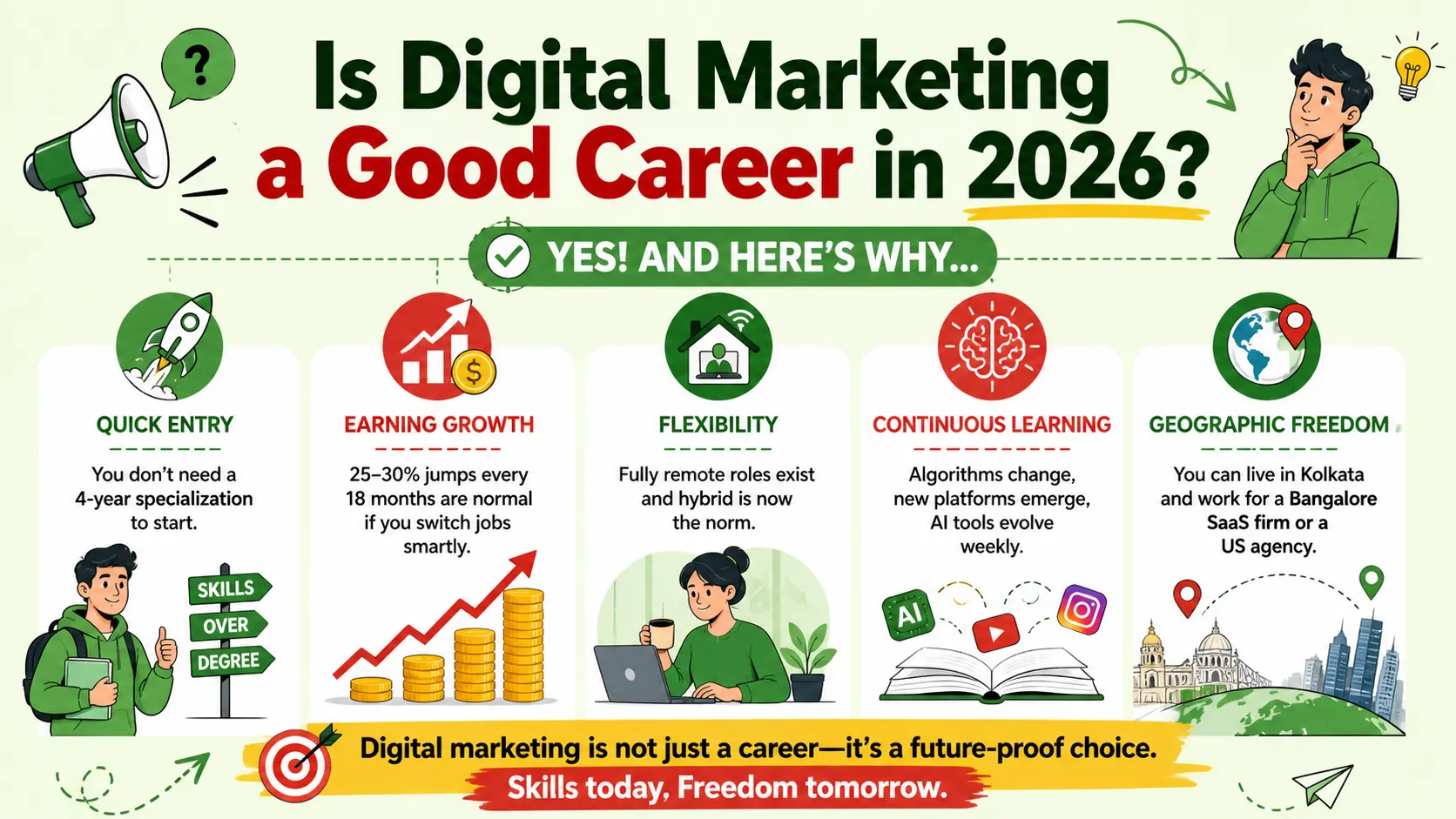
The pull factor that makes a digital marketing career different from finance, law, or engineering: you can earn while you learn.
Want to test SEO? Run it on a friend’s bakery website. See ranking move in 6 weeks. Want to test Meta Ads? Run a ₹500 campaign for a local boutique. Watch the numbers come in by tomorrow.
That feedback loop is rare in any other career.
But there’s a flip side, and I won’t sugarcoat it. The field moves fast. Google updates its algorithm. Meta changes ad targeting. ChatGPT writes ad copy in 30 seconds. If change makes you anxious, this might be tough. If change excites you, you’ll thrive.
I’ll break the digital marketing job salary in India down by experience, with Kolkata-specific numbers where it matters the most.
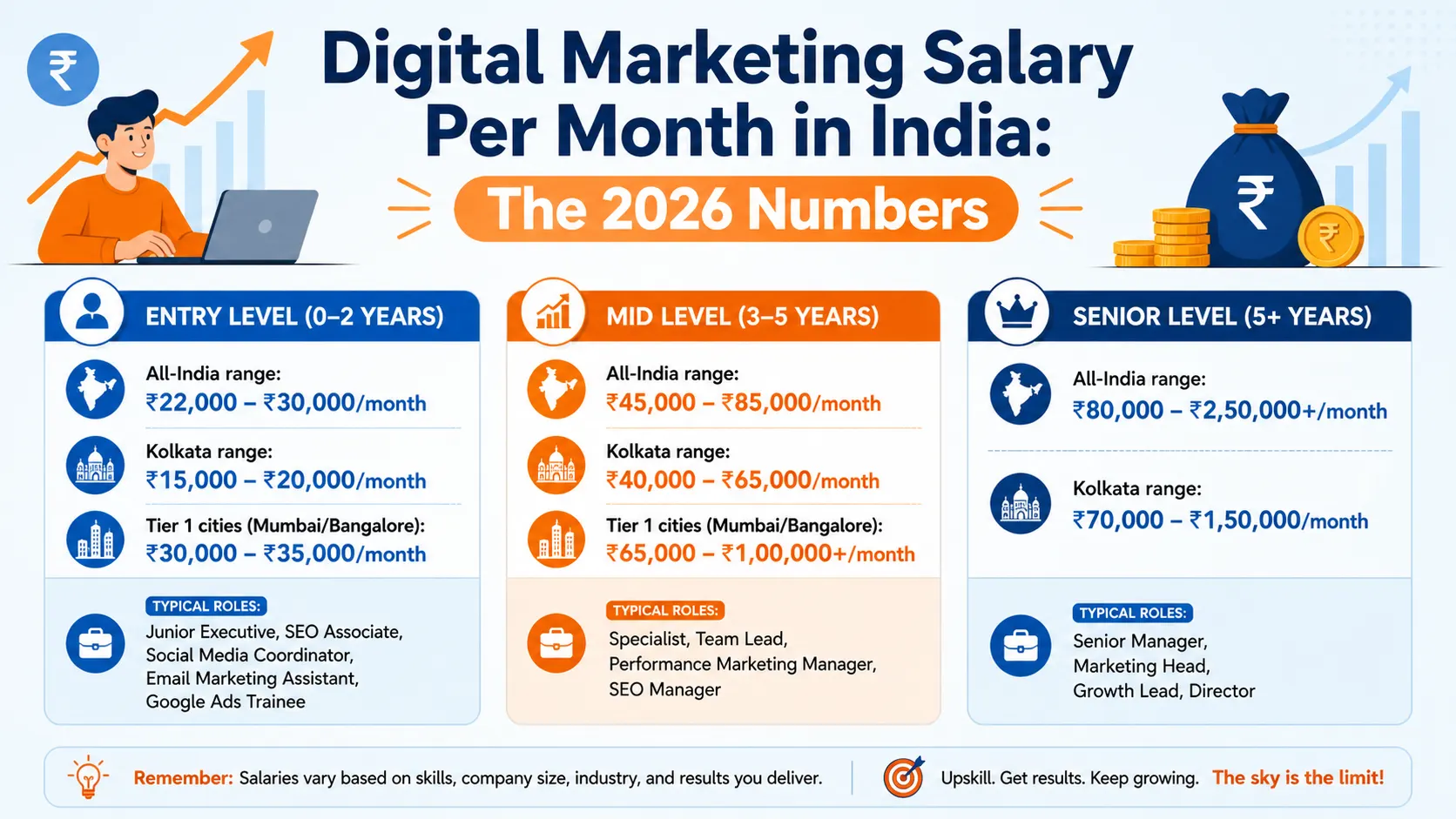
Here’s how the digital marketing job and salary picture looks in 2026, three paths I’ve seen in my experience in the industry:
Priya, Content Marketing Specialist, Kolkata. 3 years experience. ₹48,000/month at an EdTech startup. Manages content for 3 product lines, takes freelance work on weekends. Started at ₹26K. Her growth happened by switching companies twice, not by waiting for annual increments.
Rahul, Performance Marketer, Fully Remote. 2 years experience. ₹45,000/month + ₹8K performance bonus. Manages a monthly ad budget of ₹22 lakhs for a D2C brand. Learned mostly on YouTube and through paid certifications. Lives in Kolkata, works for a Mumbai company.
Nisha, Marketing Manager, Bangalore. 8 years experience. ₹75,000/month + ESOPs. Owns the go-to-market function for a SaaS company. Specializes in email marketing and conversion optimization. “Specialization is what gave me a moat,” she says.
The pattern is clear: Stay in one company → 10–15% annual hike. Switch companies smartly → 20–30% jumps. Most senior marketers held 3–4 jobs in their first 7 years.
Quick reality check: If you’re 6 months into your first job and not learning anything new, that’s a signal, not job security.
Step Into the World of Digital MarketingLearn from Digital Marketing Experts |
|
| Advanced Diploma in Digital Marketing | |
| More Learning Options for you: Diploma in Digital Marketing | Google Ads Certification Training | Certification Course |
Yes, digital marketing jobs work from home have become common especially after 2020. But “work from home” means different things in 2026.
Common in agencies, SaaS companies, freelance, and global clients. You get zero commute, work-from-anywhere flexibility, and your own hours. The trade-off: self-discipline is non-negotiable, you miss spontaneous learning that happens in offices, and pay is sometimes 10–15% lower because the talent pool is global. Best for self-motivated people with a dedicated workspace at home.
The norm in most mid-to-large Indian companies. You get office learning plus flexibility, faster promotions through visibility, and peer mentorship. The downside: commute still exists and your schedule is less predictable. Best for early-career professionals who need exposure.
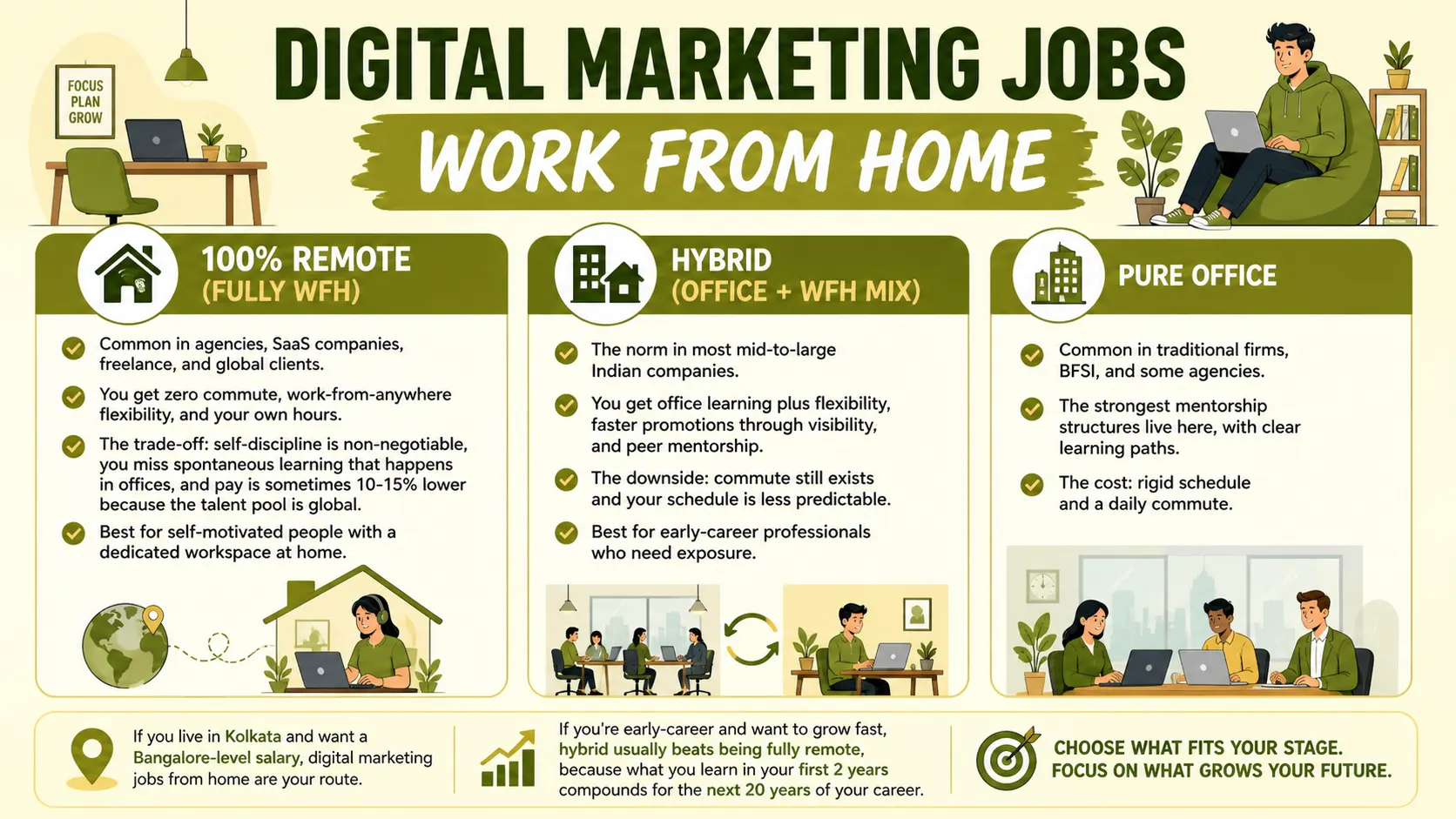
Common in traditional firms, BFSI, and some agencies. The strongest mentorship structures live here, with clear learning paths. The cost: rigid schedule and a daily commute.
If you live in Kolkata and want a Bangalore-level salary, digital marketing jobs from home are your route. If you’re early-career and want to grow fast, hybrid usually beats being fully remote, because what you learn in your first 2 years compounds for the next 20 years of your career.
If, you’ve graduated, or you’re 12th pass and figuring out a degree. Incase, you’re wondering if a digital marketing career is even open to you. Yes. It is. But you need to know what companies actually look for in freshers, because nobody expects you to be a senior marketer on Day 1.
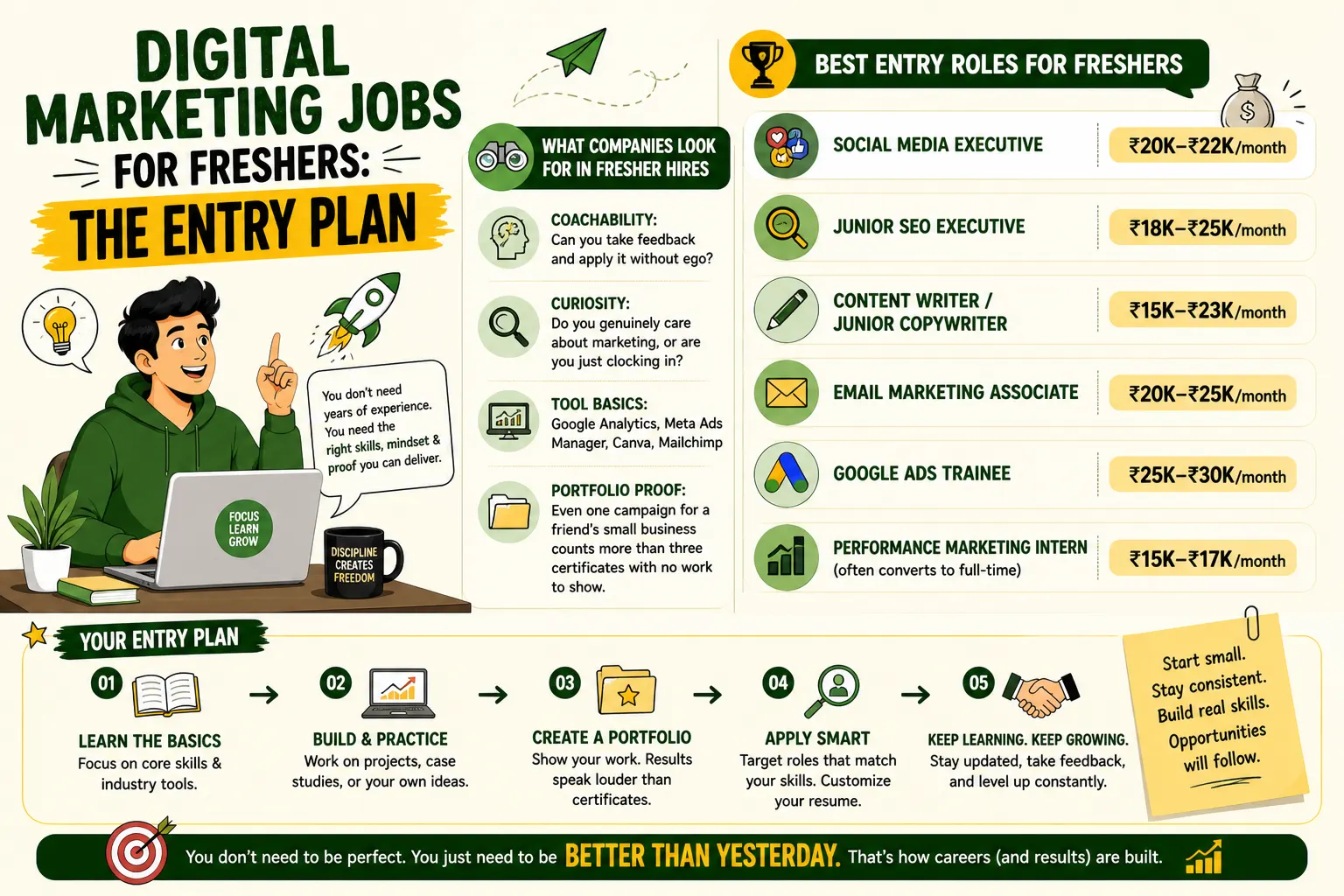
A Kolkata-specific note, the digital marketing job market here is healthier than people assume. There are 200+ active openings on LinkedIn for Kolkata-based digital marketing roles in any given month. The catch is, most of them ask for a portfolio. That’s where a structured digital marketing course earns its fee back.
The Short answer to your question ‘do I need a Digital Marketing Course?’ is: no strictly. However, from my experience I can say completeing a digital marketing course cut short your journey by 6–9 months.
Let me explain.
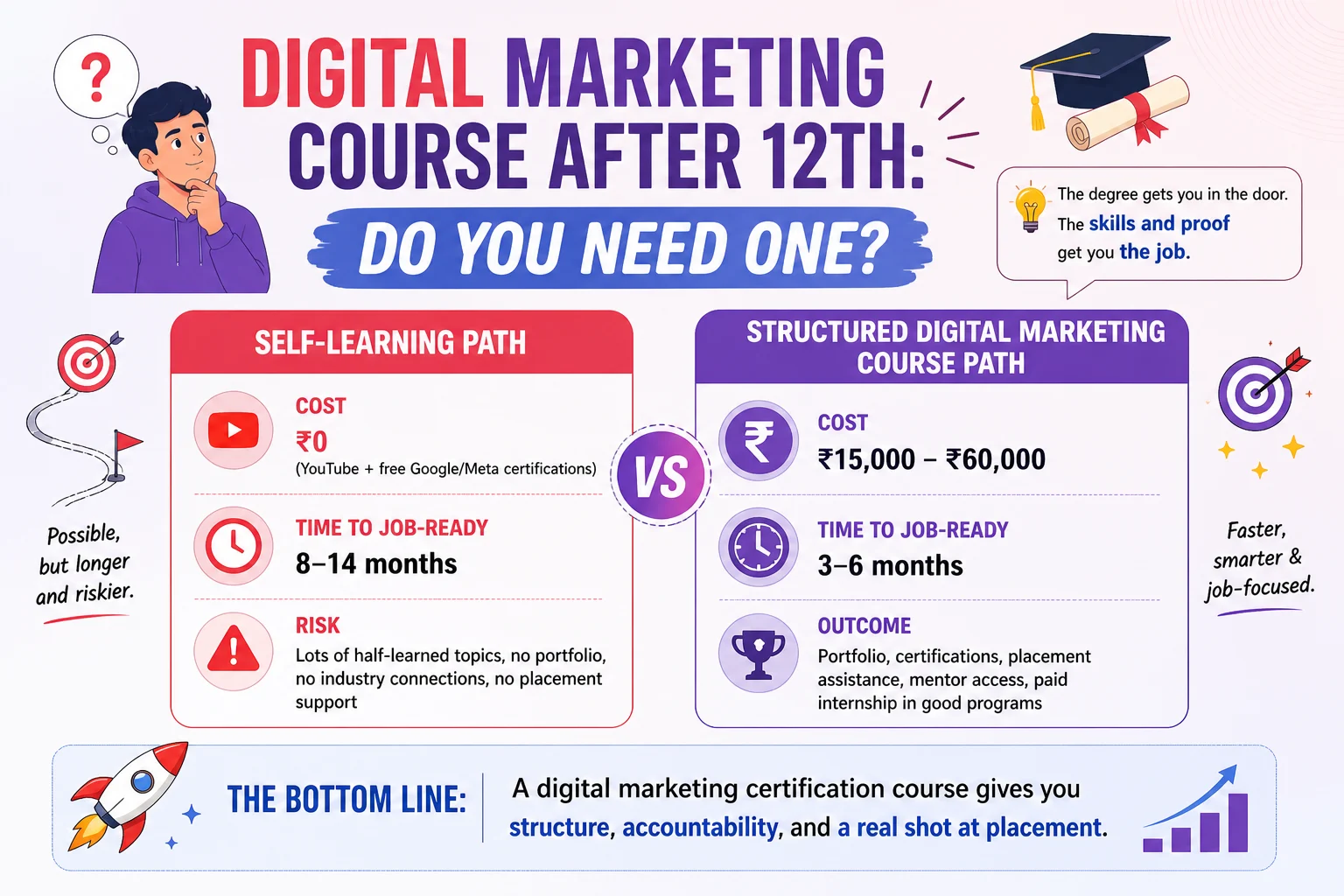
digital marketing certification course gives you structure, accountability, and a real shot at placement.
When evaluating any course (whether it’s IDCM or anyone else), the digital marketing course syllabus should cover:
If a course only teaches “theory and tools” without making you run a real campaign, walk away.
Anyone promising “complete digital marketing in 21 days” is selling videos, not skill. Real expertise takes real time.
Yes, if the placement promise is real. Ask these questions before paying:
A genuine digital marketing course with placement will answer all five with proof. If they dodge any one, that’s your signal.
If you’re typing “digital marketing course near me” into Google from Kolkata, you’ll get three buckets:
The right fit depends on whether you need just the knowledge (online courses can deliver) or the knowledge plus placement plus portfolio plus mentor (institute-led programs win).
Look for these signals before paying any fee:
That five-point filter will eliminate 80% of the noise in the top rated digital marketing courses lists you’ll find online.
Yes, sometimes. But it’s a specific kind of stress, not the soul-crushing kind.
Numbers don’t lie. If your campaign tanks, the data shows it. You can’t hide behind “the market is bad”, your manager will pull up the dashboard.
Things change fast. A Google algorithm update can shift your SEO rankings overnight. A Meta policy change can pause your campaigns.
Always-on culture. A viral comment at 11 PM doesn’t wait for office hours. A campaign breaking on a Sunday doesn’t care about your weekend.
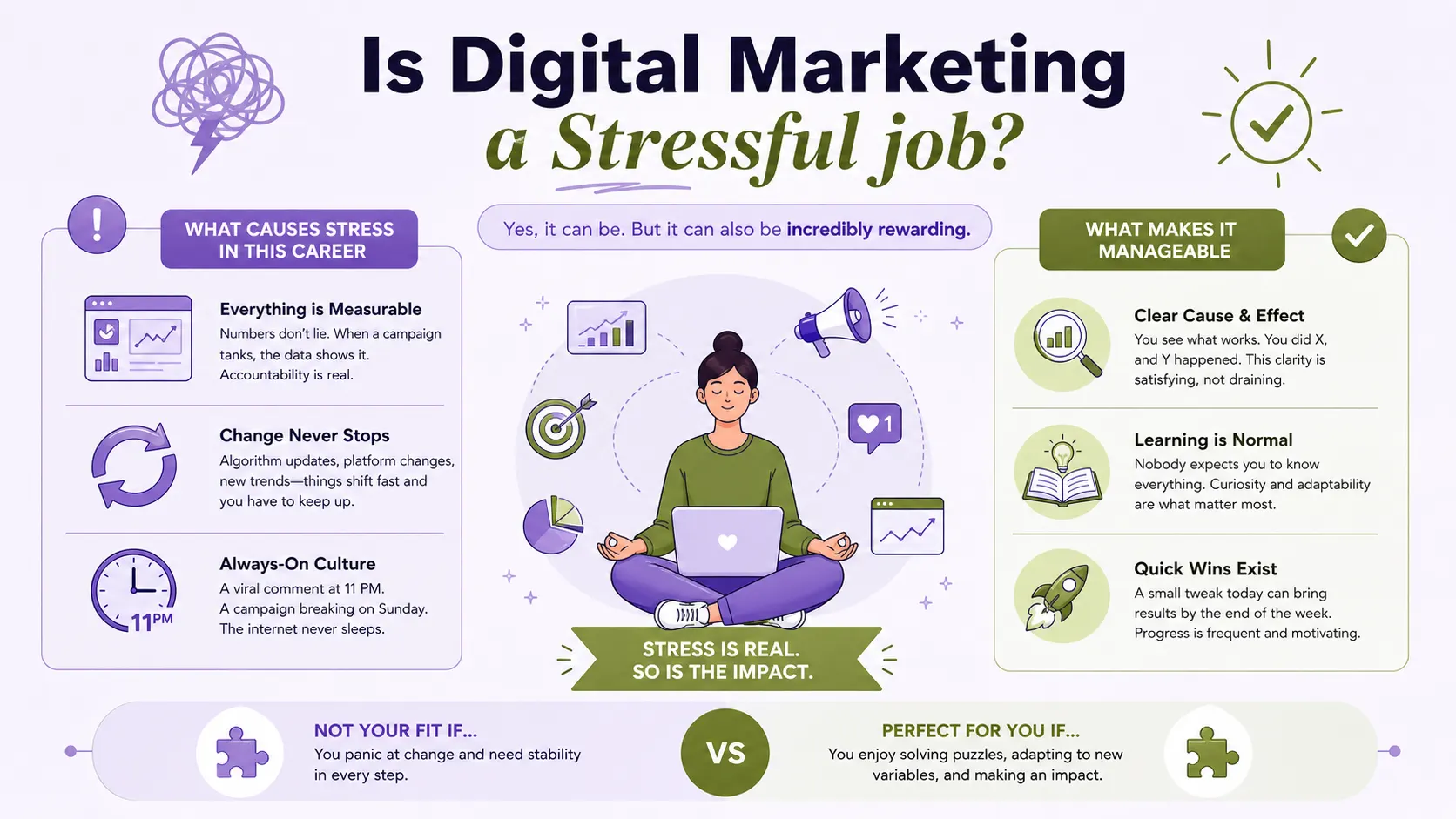
You see clear cause and effect. I did X and Y happened. That’s satisfying, not draining. Most careers don’t give you this clarity.
Learning is normalized. Nobody expects you to know everything. Saying “I’ll figure it out” is acceptable, even at senior levels.
Quick wins are common. A campaign tweak on Monday can show results by Friday. Few careers offer this rhythm.
If you’re someone who panics at change, this career will stress you out. If you’re someone who enjoys solving puzzles with new variables every quarter, you’ll love it.
It’s the biggest question in every coffee chat right now. Honest answer: no, AI won’t replace digital marketers, but digital marketers who don’t adapt will lose to those who do.
People who treat AI as a co-pilot, not a competitor. The right mental model: AI does the first draft and the heavy lifting on data, you do the strategic thinking and the creative judgment. That hybrid is where the next 10 years of high-paying digital marketing roles will live.
The marketers who’ll struggle? The ones who either fear AI or pretend they’re above using it. Both are losing strategies.
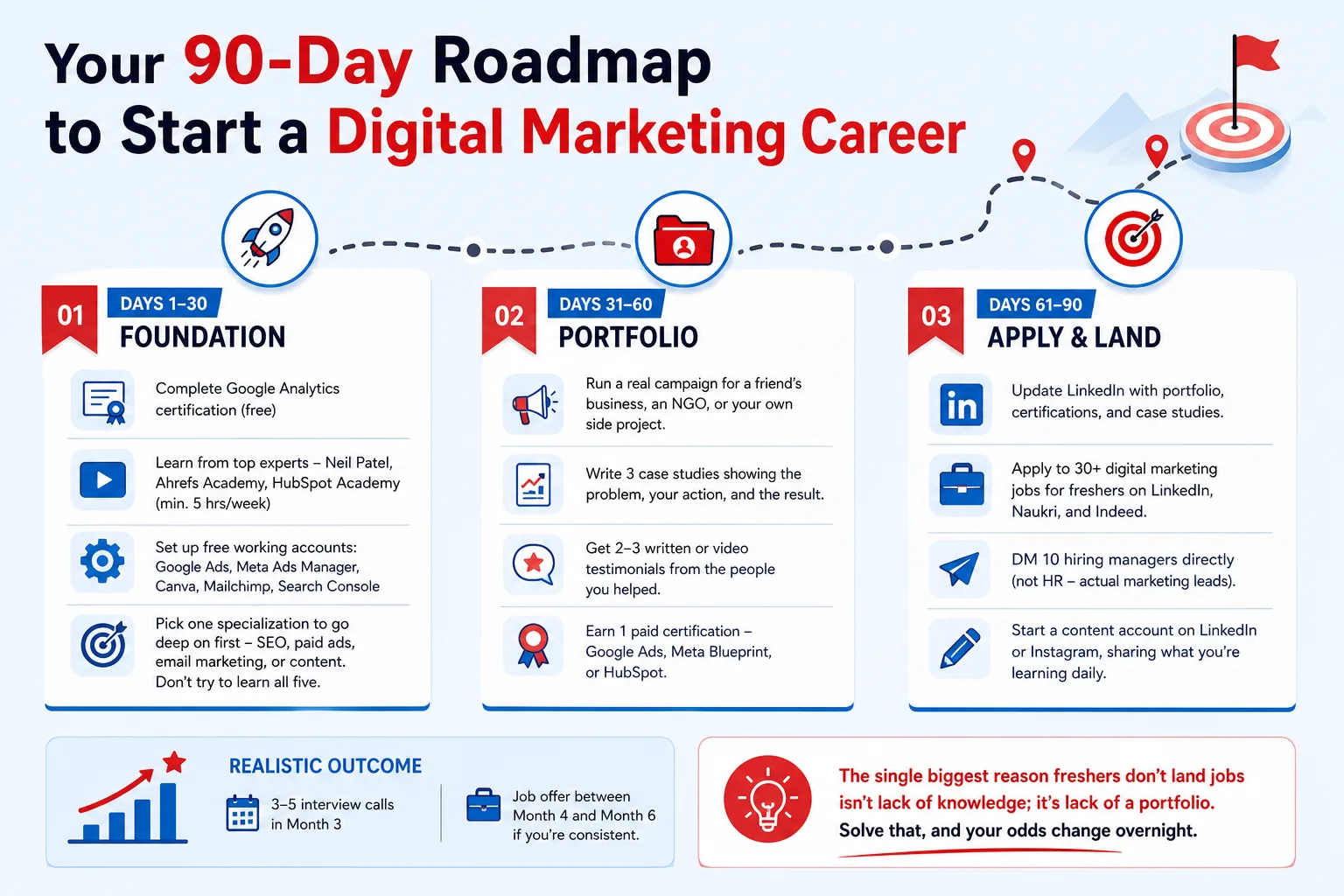
Realistic outcome: 3–5 interview calls in Month 3, a job offer between Month 4 and Month 6 if you’re consistent.
The single biggest reason freshers don’t land jobs isn’t lack of knowledge; it’s lack of a portfolio. Solve that, and your odds change overnight.
If you’re serious about a digital marketing career and want to skip the “figuring it out alone” phase, the Institute of Digital and Content Marketing (IDCM) is built for exactly this transition.
What makes IDCM different from a generic digital marketing online course:
For students searching “digital marketing course near me” in Kolkata, IDCM offers full placement assistance, paid internship integration, and a curriculum that matches what hiring managers are actually testing in 2026 interviews.
Few related topics for your knowledge
A digital marketing career does not require any fancy preparation, yet it demands competence and skill from you. If You have read this far, let me ask you the only question that matters:
What are you going to do this week?
If you have no prior commitment, you can sign up for Google Analytics. Download Canva. Watch one tutorial. Or, if you want a structured path with placement support explore the IDCM digital marketing course in Kolkata.
People who think about a digital marketing career and people who start a digital marketing career look identical on Day 1. The difference shows up on Day 30. It compounds by Day 90.
Yes. There are many roles including SEO, content writing, email marketing, analytics are skill based work and don’t require technical skills. Specialize in behind-the-scenes work and let your output speak.
Yes. A degree helps with first-screening filters in some companies, but skills and portfolio matter far more after that. Plenty of senior marketers came from non-traditional backgrounds.
Look for one that combines theory + live campaigns + Google/Meta certifications + placement support. Skip courses that only deliver pre-recorded videos with no project work or mentor access.
Digital marketing course duration varies, 8–12 weeks for intensive programs, 4–6 months for comprehensive certification courses with internship and placement support.
For the entry level jobs you can expect ₹15,000 – ₹18,000/month. However, with years of experience and proven results, this moves to ₹35,000 – ₹50,000/month.
Yes, in the digital marketing career fully remote and hybrid options are widely available, especially in agencies, SaaS companies, and freelance work.
You can start right after 12th. Many institutes offer a digital marketing course after 12th specifically designed for early starters. Starting earlier gives you a clear portfolio advantage by the time you graduate.
A solid digital marketing course syllabus covers: SEO, Google Ads, Meta Ads, Email Marketing, Content Marketing, Social Media Marketing, Digital Marketing Analytics, and a capstone live project.
Yes, but typically after 1–2 years of in-house experience. Freelancers without a track record struggle to charge well or land repeat clients.
A social media marketing course is a specialization within digital marketing. A full digital marketing certification course covers all channels including search, social, email, content, analytics and thus giving you broader career flexibility.

 }})