
Courses
Digital marketing skills aren’t what they were three years ago.
When I started my role as a SEO content writer in 2024, the job was straightforward: write content, hit keyword targets, chase traffic. Success meant volume, more words, more posts, more impressions. My days used to look like this: open Google Docs, write 3,000 words, optimize for keywords and check the box.
But that world doesn’t exist anymore.
Today, working across performance marketing, content strategy, and AI-assisted planning, I realize the entire industry has evolved. We’re no longer hiring people who “can write.” We’re hiring strategists who understand conversions, data, psychology, and how AI changes everything.
And here’s what shocked me: The digital marketers earning ₹60,000–₹80,000+ per month aren’t the ones who mastered 2024’s playbook. They’re the ones who adapted to a completely different skill set.
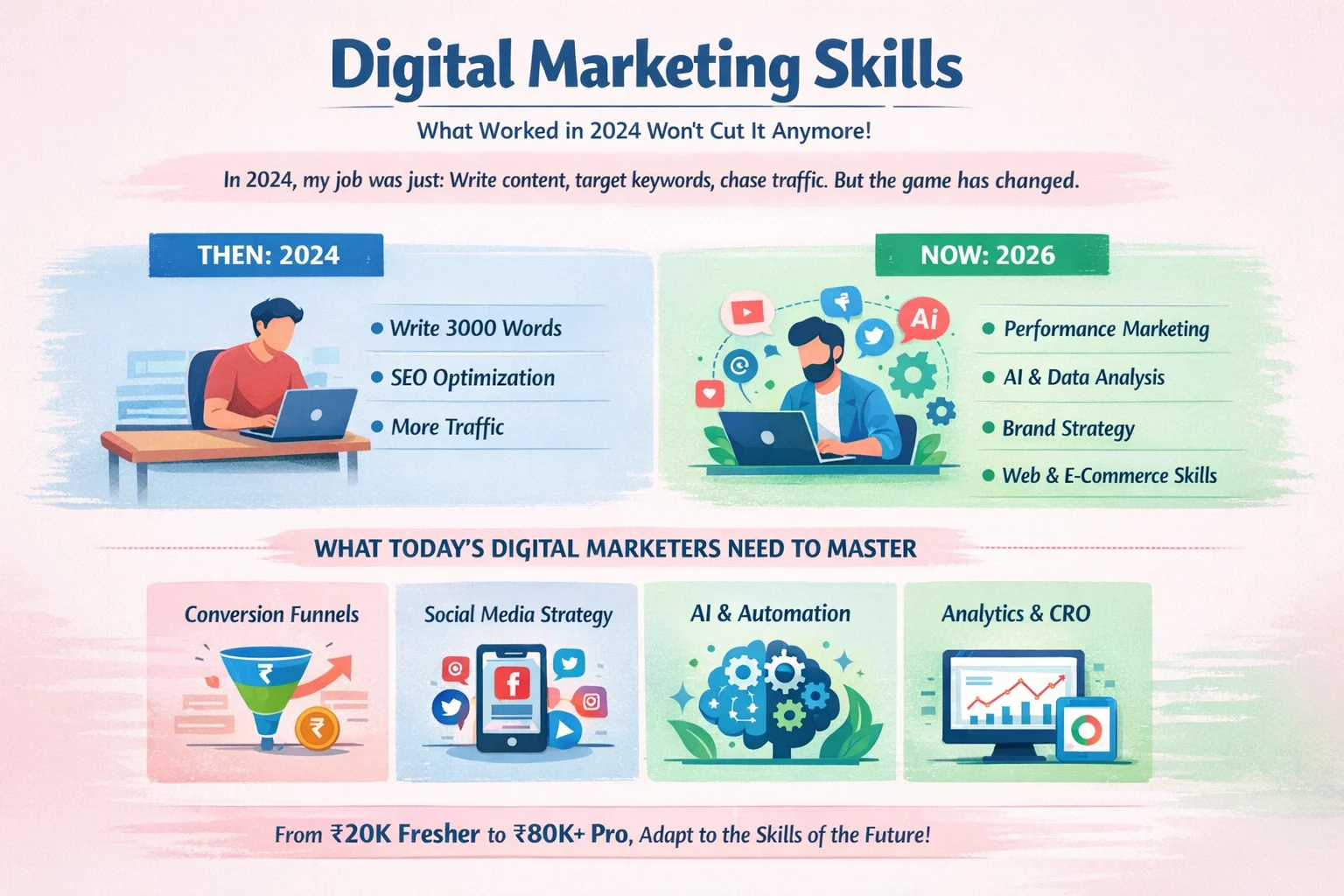
They don’t just know Google Ads, they understand performance marketing across channels. They don’t just post on social media, they build brand positioning. They don’t just write but understand web development, analytics, E-commerce strategy, AI fundamentals. They think like strategists, not executors.
If you’re looking to enter a digital marketing career in 2026, you need to know what’s actually in-demand across all domains of digital marketing. This guide shows you exactly that, and maps the realistic path from ₹20K fresher to ₹80K+ professional.
Today, Digital Marketing Isn’t One Thing Anymore
The biggest mistake? Thinking “digital marketing skills” means one thing.
In 2026, digital marketing spans six distinct but interconnected domains. A marketer earning ₹100K+ understands all of them at least at an intermediate level.
According to LinkedIn’s 2026 Talent Report on Marketing Skills, the fastest-growing skills aren’t single-channel expertise. They’re foundational skills like performance analysis, AI literacy, and strategic thinking that apply across all channels.
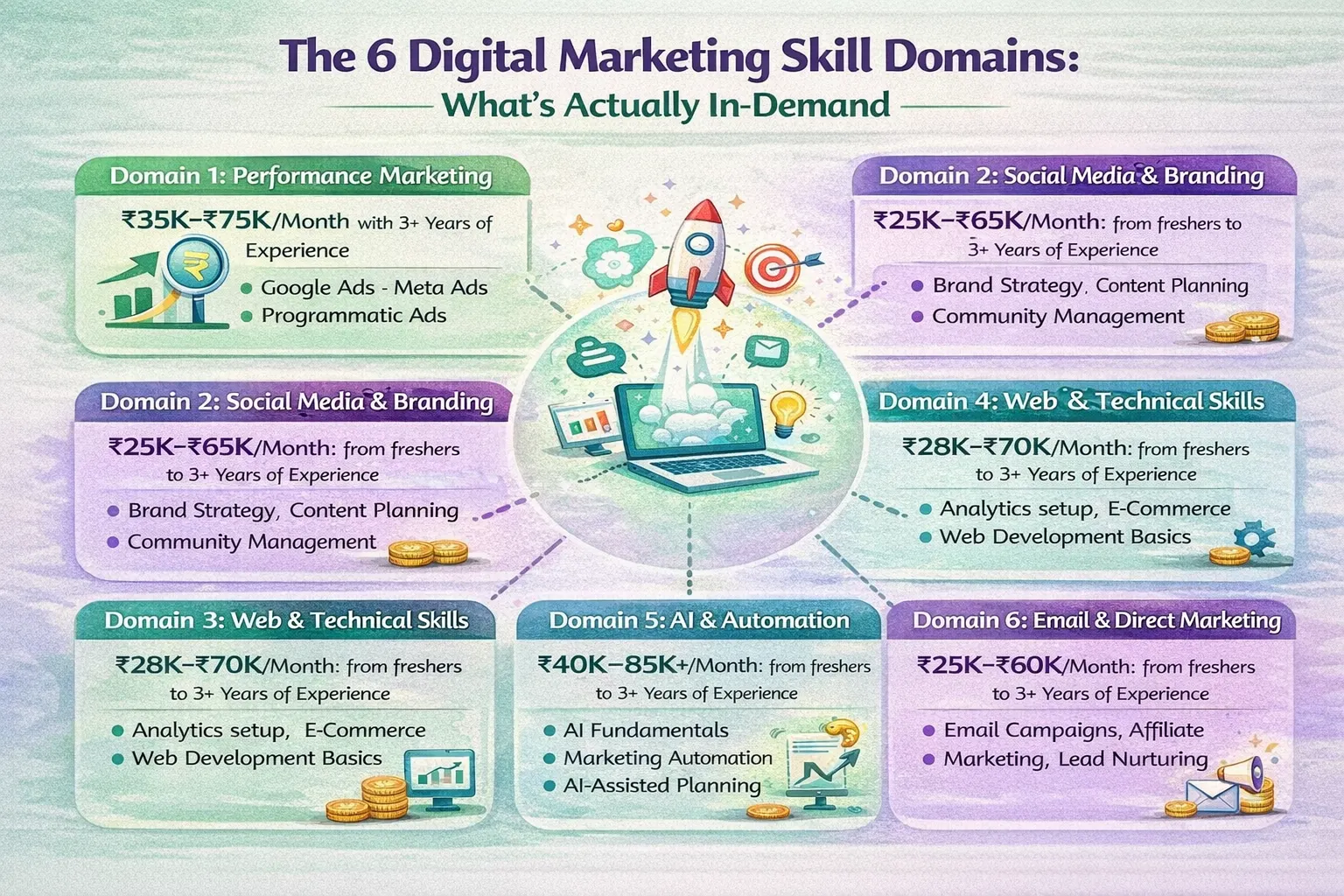
Here are the six domains where companies are actively hiring:
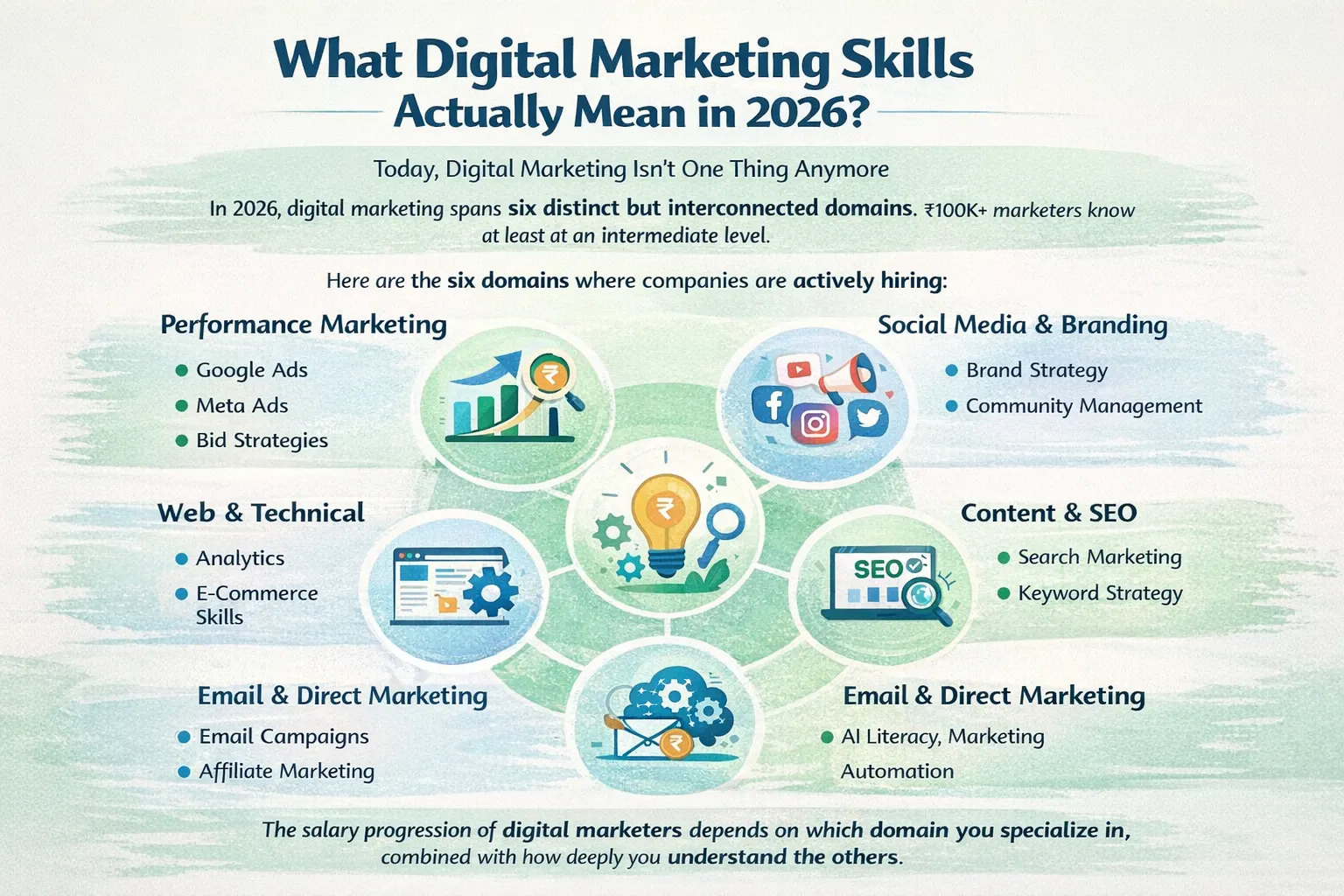
The salary progression of digital marketing skills isn’t linear. It depends on which domain you specialize in, combined with how deeply you understand the others.
The skill definition has fundamentally shifted.
| Dimension | 2024 Reality | 2026 Reality | 2028+ Direction |
|---|---|---|---|
| Job Scope | “Can you write and optimize?” | “Can you think strategically across channels?” | “Can you lead a strategy using AI and data?” |
| Core Expectation | Content volume matters | Strategic thinking matters more | Data-driven decision-making is table stakes |
| AI Role | Not yet mainstream | Baseline expectation (AI literacy ranked #2 skill) | AI integration required for all roles |
| Brand Positioning | “Nice to have” | Essential (now a separate skill track) | Core to every strategy |
| Entry-Level Salary | ₹15K–₹20K | ₹17K–₹25K (verified Indeed data) | ₹22K–₹30K (projected) |
| Specialist Salary | ₹30K–₹50K | ₹40K–₹70K (skill-dependent) | ₹60K–₹100K+ (projected) |
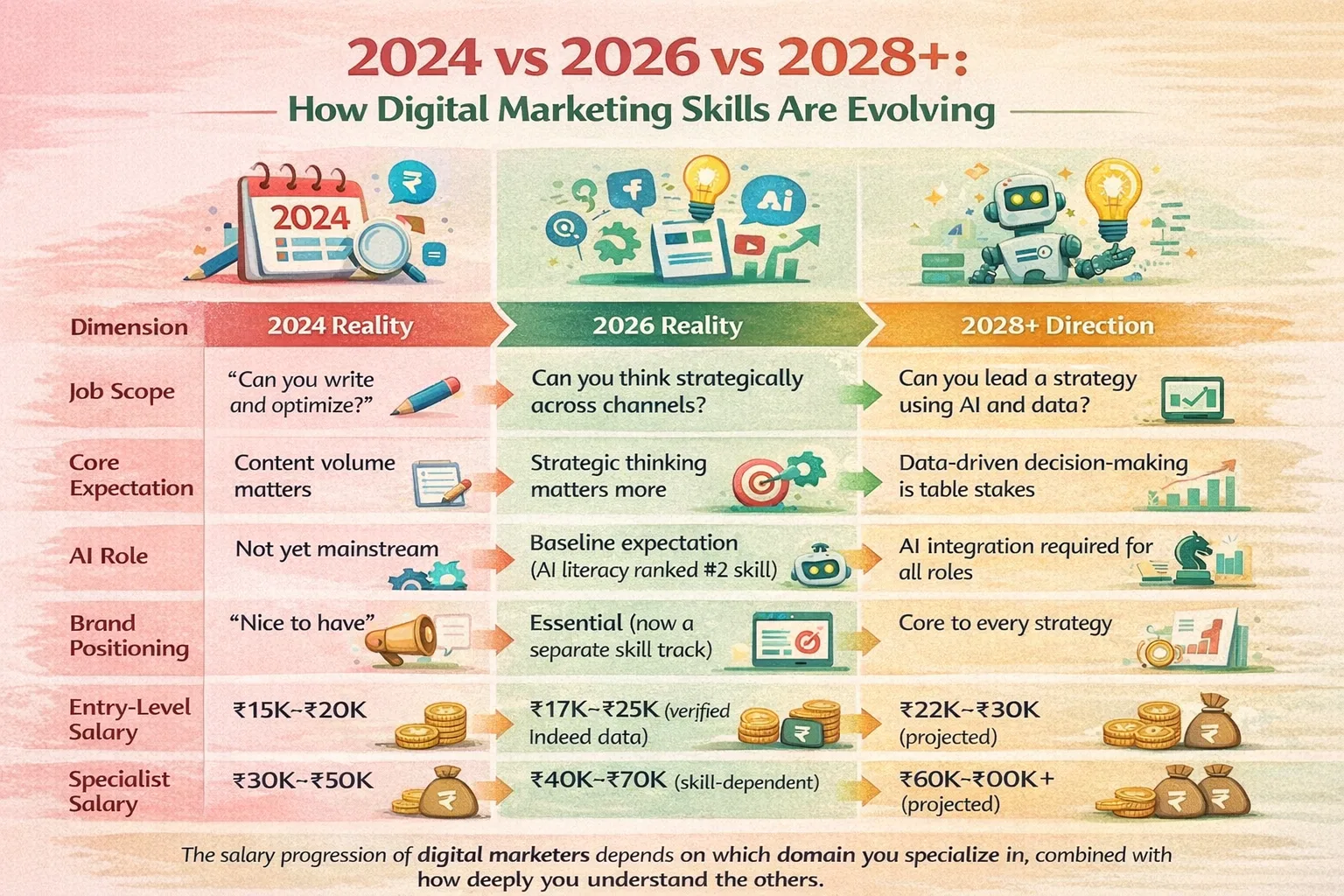
The key insight: The companies in 2026 aren’t just hiring the “digital marketers”. They’re hiring specialists in specific domains who understand the full ecosystem.
What it is: One of the highest-paid digital marketing skills is getting measurable results through paid advertising across Google, Meta, and programmatic platforms.
This is where direct ROI lives. Companies know exactly what they spend and what they get back. That measurability makes performance marketing highly valued.
Step Into the World of Digital MarketingLearn from Digital Marketing Experts |
|
| Advanced Diploma in Digital Marketing | |
| More Learning Options for you: Diploma in Digital Marketing | Google Ads Certification Training | Certification Course |
Every rupee spent generates measurable returns. A marketer who reduces cost-per-acquisition by 30% directly impacts the bottom line.
What it is: Building brand presence, positioning, and community across social platforms while creating visual identity.
This domain was historically underpaid. In 2026, that’s changing as companies realize brand differentiation drives long-term value.
According to LinkedIn’s 2026 Skills Report, “creative problem-solving” and soft skills are among the fastest-growing in marketing. Social media and branding live at that intersection.
What it is: Creating content that ranks on search engines and getting found organically.
This domain has the widest salary range because it includes tactical execution (writers at ₹25K) and strategic roles (content directors at ₹80K+).
Execution is easy to teach. Strategy is hard. A content creator who becomes a strategist, who understands business context, audience psychology, ROI measurement earns 3x more.
What it is: Understanding how websites work, optimizing them for conversions, tracking performance, and managing E-commerce.
Marketers who understand web development basics are increasingly valuable; they communicate better with engineers and make smarter decisions.
When a marketer says “Our site is slow, conversions dropped,” they understand the technical root cause, not just the symptom.
What it is: Using artificial intelligence to automate tasks, predict outcomes, and make smarter decisions.
This is the newest domain, and it’s where future salary growth will be. According to LinkedIn’s 2026 Report, AI literacy is now ranked the #2 fastest-growing marketing skill (down from #1 in 2025, not because it’s declining, but because it’s becoming baseline expectation).
Companies are desperate for marketers who understand AI. It’s not optional anymore, it’s a competitive advantage.
What it is: Reaching customers directly via email, affiliate partnerships, and direct response.
Email remains one of the highest ROI channels. Despite being “old school,” email marketing specialists are in steady demand.
Email converts better than social. Companies accept that email will never be “cool,” but it works.
Here’s the strategic insight: The most in-demand digital marketers aren’t specialized in one domain. They’re competent across all six while going deep in 1–2.
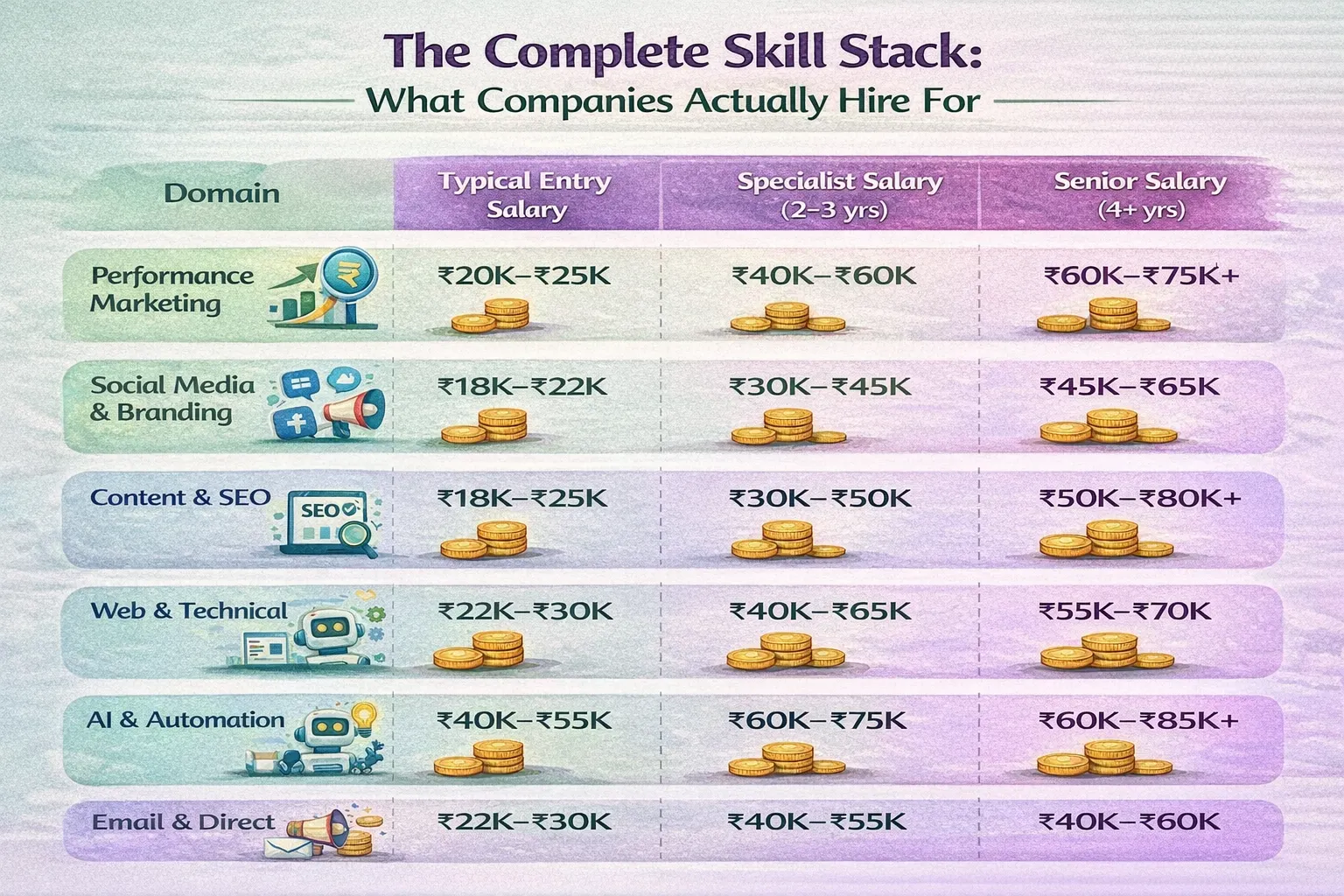
| Domain | Typical Entry Salary | Specialist Salary (2–3 yrs) | Senior Salary (4+ yrs) |
|---|---|---|---|
| Performance Marketing | ₹20K–₹25K | ₹40K–₹60K | ₹60K–₹75K+ |
| Social Media & Branding | ₹18K–₹22K | ₹30K–₹45K | ₹45K–₹65K |
| Content & SEO | ₹18K–₹25K | ₹30K–₹50K | ₹50K–₹80K+ |
| Web & Technical | ₹22K–₹30K | ₹40K–₹65K | ₹55K–₹70K |
| AI & Automation | ₹40K–₹55K | ₹60K–₹75K | ₹60K–₹85K+ |
| Email & Direct | ₹22K–₹30K | ₹40K–₹55K | ₹40K–₹60K |
Let me be honest about salary expectations. Too many promises out there suggest ₹50K+ for freshers. That’s not real.
Insights from Indeed, Naukri, JobHai (Kolkata):
Average entry salary in Kolkata: ₹19,079/month (Indeed salary data)
What changes: You stop executing and start optimizing. You understand business context. You make strategic decisions.
Salary jumps to: ₹35K–₹70K/month
Salary range: ₹60K–₹150K+/month
At this level, you’re leading strategy, teams, or specializing deeply in high-demand domains.
Kolkata’s digital marketing job market is growing fast. But the salary picture is very different from other metros.
According to Indeed’s salary data for Kolkata, the average digital marketer earns ₹19,079/month. But this number hides a massive range:
The difference between the bottom 50% and top 25% isn’t experience alone. It’s specialization + strategic thinking.
Fresher (0–6 months):
Intermediate (1–3 years):
Senior (3–5 years):
Leadership (5+ years):
Performance Marketing Specialist: ₹40K–₹75K/month
SEO/Content Strategist: ₹35K–₹80K+/month
Social Media Manager: ₹30K–₹65K/month
Email Marketing Manager: ₹35K–₹60K/month
Analytics/Web Technical: ₹38K–₹70K/month
AI/Automation Specialist: ₹40K–₹85K+/month
Kolkata’s digital marketing salaries are 15–25% lower than Bangalore/Mumbai for similar roles. But here’s the opportunity:
Don’t go deep yet. Build baseline understanding in all six domains.
Time: 10–15 hours/week
Goal: Understand how domains connect, not expertise in any one
Pick the domain that excites you most. Go deep for 8 weeks.
Time: 15–20 hours/week
Goal: Become truly skilled in one area while maintaining breadth in others
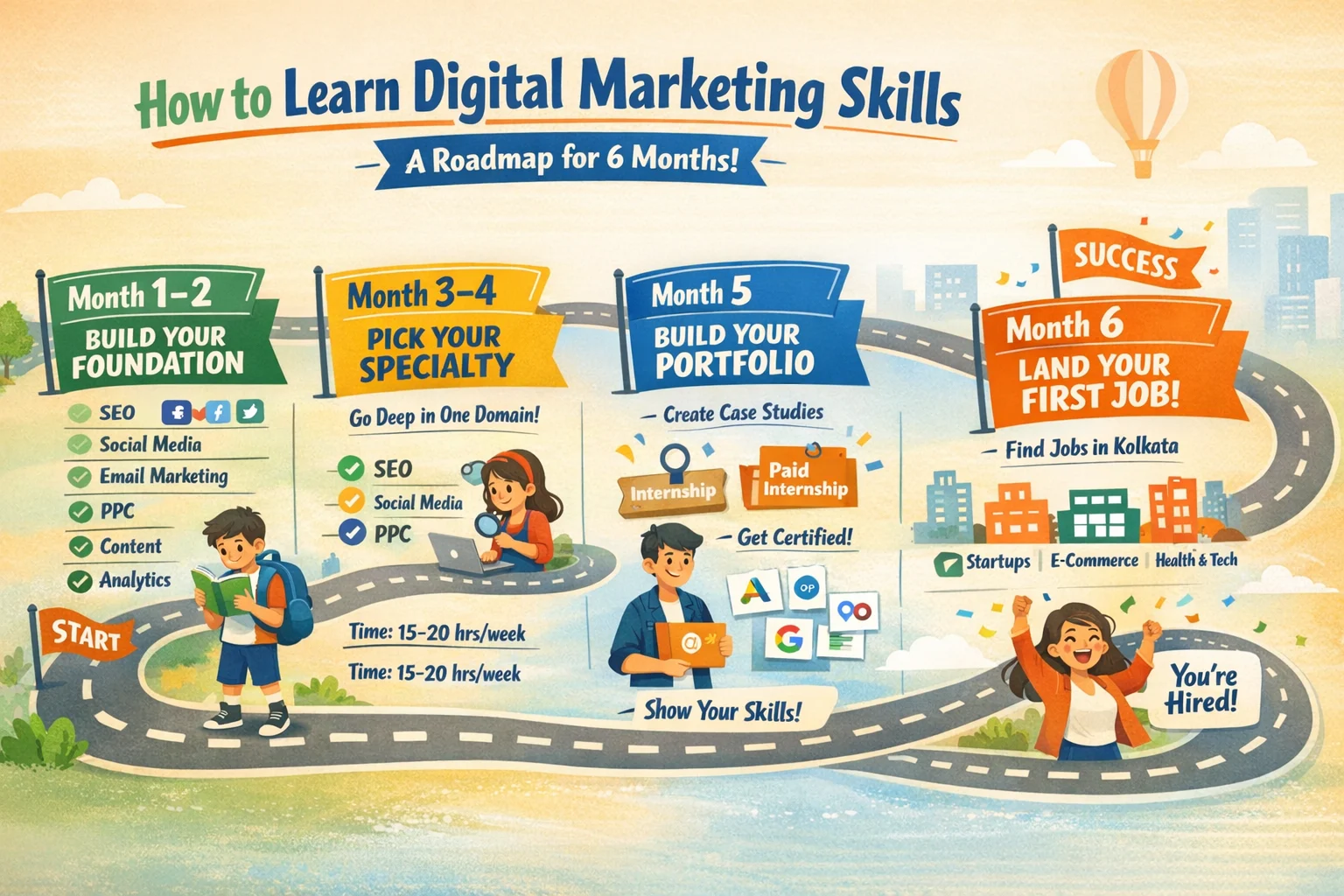
Create 2–3 case studies showing real work (even simulated campaigns count). Furthermore, opting for paid internship opportunities will help you to gain experience, while you can get monetary benefits.
Earn certifications: Google Ads, Google Analytics, Meta Blueprint, HubSpot Academy
Time: 15–20 hours/week
Companies actively hiring in Kolkata:
Expected salary: ₹17K–₹25K/month
Year 1: Executor of basic digital marketing skills. You run campaigns, post content, send emails. Salary: ₹20K–₹25K.
Year 2: Optimizer of digital marketing skills. You see patterns, improve results, understand why things work. Salary: ₹35K–₹50K.
Year 3: Strategist. You think in business outcomes, lead initiatives, anticipate shifts. Salary: ₹55K–₹85K.
Year 4+: Irreplaceable. Expertise + strategic thinking + leadership. Salary: ₹80K–₹100K+.
The difference between ₹25K and ₹100K isn’t the tools. It’s the thinking level.
Here’s the trajectory:
Now to 6 months: Learn foundations, build case studies, get certified → ₹17K–₹25K fresher role
6 months to 18 months: Master one domain, prove impact → ₹40K–₹50K specialist role
18 months to 3 years: Develop strategic thinking, understand business context → ₹60K–₹70K strategist role
3+ years: Combine expertise + leadership + business acumen → ₹80K+ leadership role
The difference between ₹25K and ₹80K isn’t the tools. It’s the thinking level.
Digital marketing jobs are real. The Career growth is real. The salaries are real, however, it will not manifest immediately.
There’s no shortcut from ₹0 to ₹80K in 6 months. What there IS is a clear path: Learn → Get hired → Prove value over 3 years → Earn ₹50K–₹70K+ → Keep growing.
The question isn’t “Can I learn digital marketing skills?”
The question is: “Am I ready to invest 6 months learning, then 2–5 years growing, to earn ₹80K+per month for the next decade?”
If yes, then don’t wait and start today.
These essential digital marketing skills require understanding six core skill domains: performance marketing (Google Ads, Meta Ads), social media & branding, content & SEO, web & technical skills, AI & automation, and email & direct marketing. You don’t need expertise in all six immediately, but competency across all six with deep specialization in 1–2 is the market standard in 2026.
Why this matters: Companies no longer hire “digital marketers.” They hire specialists who understand the full ecosystem. A performance marketer who also understands social strategy and analytics is worth ₹60K+. One who only knows ads is worth ₹30K.
Getting started: Begin with understanding all six domains at a foundational level (Month 1–2), then specialize in one (Month 3–4).
The five foundational digital marketing skills are: (1) understanding Google Ads basics, (2) Google Analytics fundamentals, (3) basic social media strategy, (4) content creation, and (5) email marketing setup. These aren’t the only skills you’ll need, but they form the foundation for everything else.
Why start here: These five teach you the core concepts of advertising, data analysis, audience engagement, content, and direct communication. Master these and everything else becomes easier.
Timeline: 4–6 weeks of consistent learning (10 hours/week) should give you basic competency in all five.
Performance marketing (Google Ads, Meta Ads optimization, programmatic advertising) and AI-assisted marketing command the highest salaries. Specialists in these domains earn ₹40K–₹75K+ per month. Content & SEO specialists earn ₹30K–₹80K+ (wider range due to skill variance). The highest earners (₹80K–₹150K+) combine expertise in 2–3 domains with strategic leadership ability.
Why the difference: Performance marketing directly impacts revenue (measurable ROI), so companies pay premium. AI skills are scarce, driving premium salaries. Strategic thinking across domains is rare, making it the most valuable.
Salary boost strategy: Specializing in one domain gets you to ₹50K. Understanding multiple domains gets you to ₹80K+.
Yes, if you build real case studies and get certified. There are 564+ digital marketing job openings in Kolkata alone (verified on major job boards). The issue isn’t jobs; it’s that most learners don’t complete projects or get certifications. Companies are actively hiring right now.
The realistic timeline: Months 1–6 = learning & skill-building. Weeks 1–3 of Month 6 = job search. Most people find roles within 3 weeks if they have case studies and certifications.
What increases your chances: Real projects (not just courses), 2–3 certifications, a clear specialization, and honest case studies showing real results.
No, AI will not replace digital marketers. AI will replace lazy execution. But strategic thinking, client relationships, and business acumen are irreplaceable. Marketers who use AI as a tool will earn more than ever. Those who compete with AI will struggle.
What’s actually happening: AI handles routine tasks (basic copywriting, data analysis, bid optimization). This means marketers who relied on execution skills are under pressure. Marketers who focus on strategy, insights, and business impact are thriving.
Future-proofing: Learn to use AI tools (ChatGPT, Claude, etc.). Get comfortable with AI as a collaborator, not a threat.
No, it is not hard, however, it is different. You don’t need a math degree or programming skills. You need logical thinking (A affects B), curiosity (why did this fail?), and willingness to test and iterate. The hardest part is staying consistent. Most people learn for 2 weeks, see no results, and quit.
Reality check: Digital marketing takes 6–12 weeks to show real results. If you’re expecting immediate impact, you’ll be disappointed. If you’re willing to learn and iterate, you’ll succeed.
What helps: Real projects (not just courses), mentorship, and accountability partners.
Start by learning the foundations (all 6 domains at basic level), pick one to specialize in, build 2–3 case studies, get certified, then apply to entry-level roles (Digital Marketing Executive, Social Media Coordinator, Email Marketing Associate). Entry salary is ₹17K–₹25K, but growth is fast for those who prove value.
Month-by-month: Month 1–2 = foundation learning. Month 3–4 = deep specialization. Month 5 = portfolio + certification. Month 6 = job search.
First job tips: Apply to 5–10 roles per week. Customize your resume for each. Have your case studies ready to show.
Digital marketing spans six types: performance marketing (paid ads), social media marketing, content & SEO, web & technical marketing, AI & automation marketing, and email & direct marketing. Most companies need skills across all six types, but specialize in 1–2 for depth.
How they work together: Performance marketing drives immediate sales. Social & branding builds long-term value. Content & SEO brings qualified traffic. Web & technical maximizes conversions. AI & automation scales everything. Email keeps customers engaged.
Career implication: Learning all six makes you valuable. Mastering one makes you hire-able.
Practice on real projects (your own business, a friend’s business, paid internship works, or freelance clients). Take on progressively harder challenges. Get feedback from experienced marketers. Most importantly, measure everything and learn from results.
Continuous learning path: Month 1–3 = foundational courses. Month 3–6 = real projects. Month 6+ = advanced specialization in your chosen domain.
What accelerates growth: Mentorship from someone 5 years ahead of you. Access to real data (not simulated). Clear KPIs (not vanity metrics).
Yes, for three reasons: (1) high demand (564+ openings in Kolkata alone), (2) good career growth (₹20K fresher to ₹100K+ senior), (3) location-independent work potential. The market is actively hiring and salaries are growing.
The catch: It’s not passive income or a side hustle. It requires continuous learning because the field evolves every 12–18 months. But if you’re willing to stay current, it’s an excellent career.
Best for: Analytical people who like solving problems, testing ideas, and seeing measurable results.
Digital marketing requires understanding of psychology (why people buy), business/economics (profit margins, customer lifetime value), data (statistics, analytics), copywriting (persuasion), and technology (how platforms and algorithms work). You don’t need formal education in any of these, but curiosity about all of them helps.
Good to have: Basic statistics, writing ability, business mindset, technical curiosity.
Not required: Coding, advanced math, design skills, or formal marketing degree.
(1) Curiosity, always asking “why did this work?” (2) Adaptability, skills change every 18 months, and you must keep learning. (3) Data literacy, you make decisions based on numbers, not gut feeling. (4) Communication, you explain complex ideas simply. (5) Persistence, campaigns fail, and you learn and iterate.
The differentiator: Most people have 1–2 of these. People who earn ₹80K+ have all five.

 }})