
Courses
Let’s be honest with each other for a second.
You’ve probably Googled “digital marketing freelance jobs” not just out of curiosity, but because something about your current situation isn’t sitting right. Maybe you’re a fresh graduate staring at a job market that feels competitive and slow. Maybe you’re a working professional thinking, “There has to be more than this 9-to-6 routine.” Or maybe you’re still in college, wondering if you can actually start earning before you even have a degree in hand.
The answer to all three questions? Yes it is possible and digital marketing freelance jobs might just be the most realistic, skill-based, and secure way to get there.
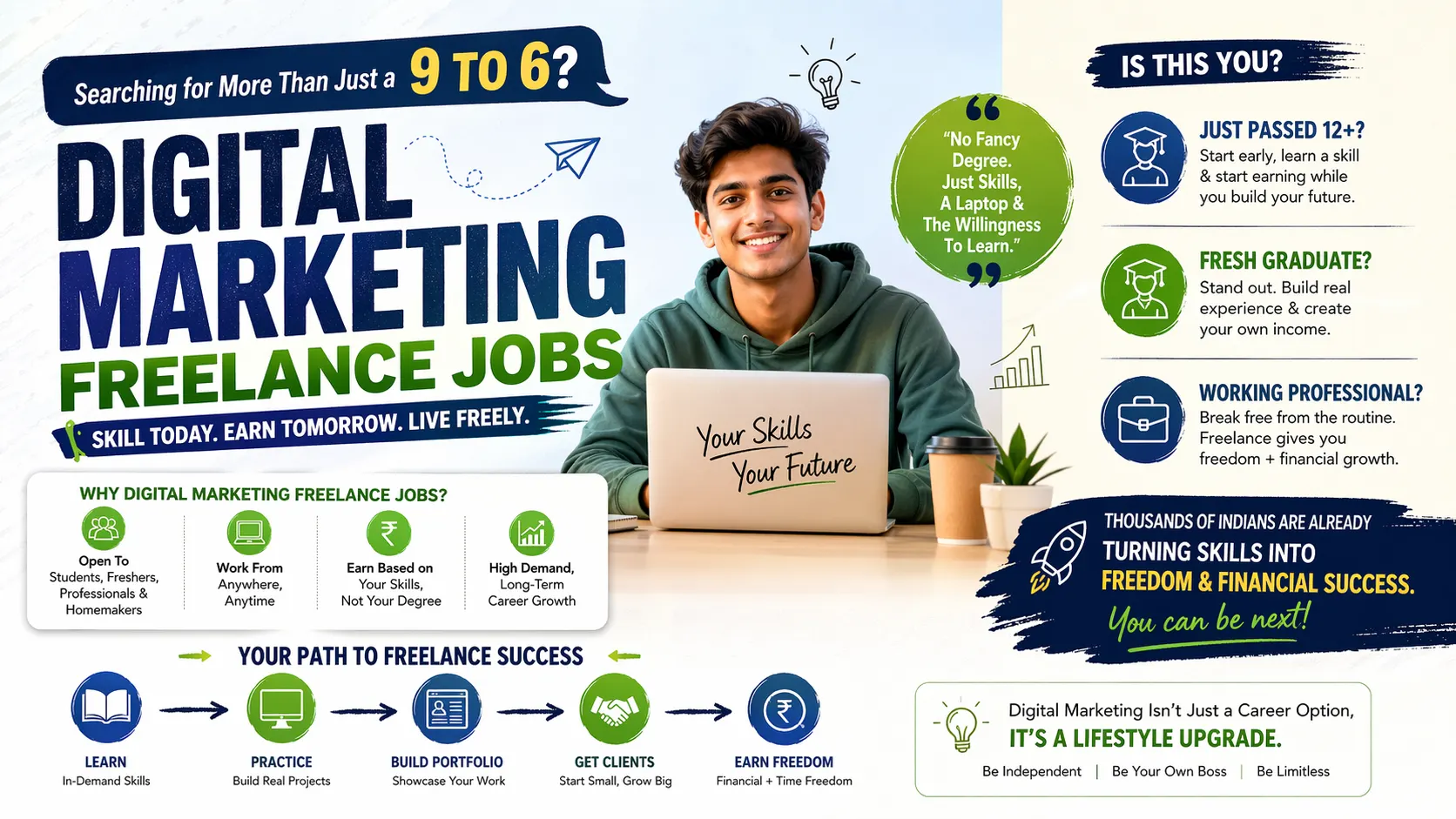
Digital marketing freelance jobs are quietly changing the way thousands of Indians are building their careers. Students, fresh graduates, working professionals, even homemakers; people from all kinds of backgrounds are picking up digital marketing skills and turning them into a full-time income. No fancy degree needed. No corporate ladder to climb. Just skills, a laptop, and the willingness to learn.
Let’s get into it.
Here’s the simplest way to understand it:
In a regular digital marketing job, you work for one company, follow their goals, take their salary, and show up at their timeline. In freelance digital marketing, you work independently; you choose your clients, set your rates, decide your hours, and most importantly, you build your own career rather than someone else’s business.
A freelance digital marketer helps businesses grow online. That could mean getting a local restaurant to rank on Google, helping a D2C brand run profitable Facebook Ads, writing SEO content for a startup, or managing the Instagram account of a growing coaching brand.
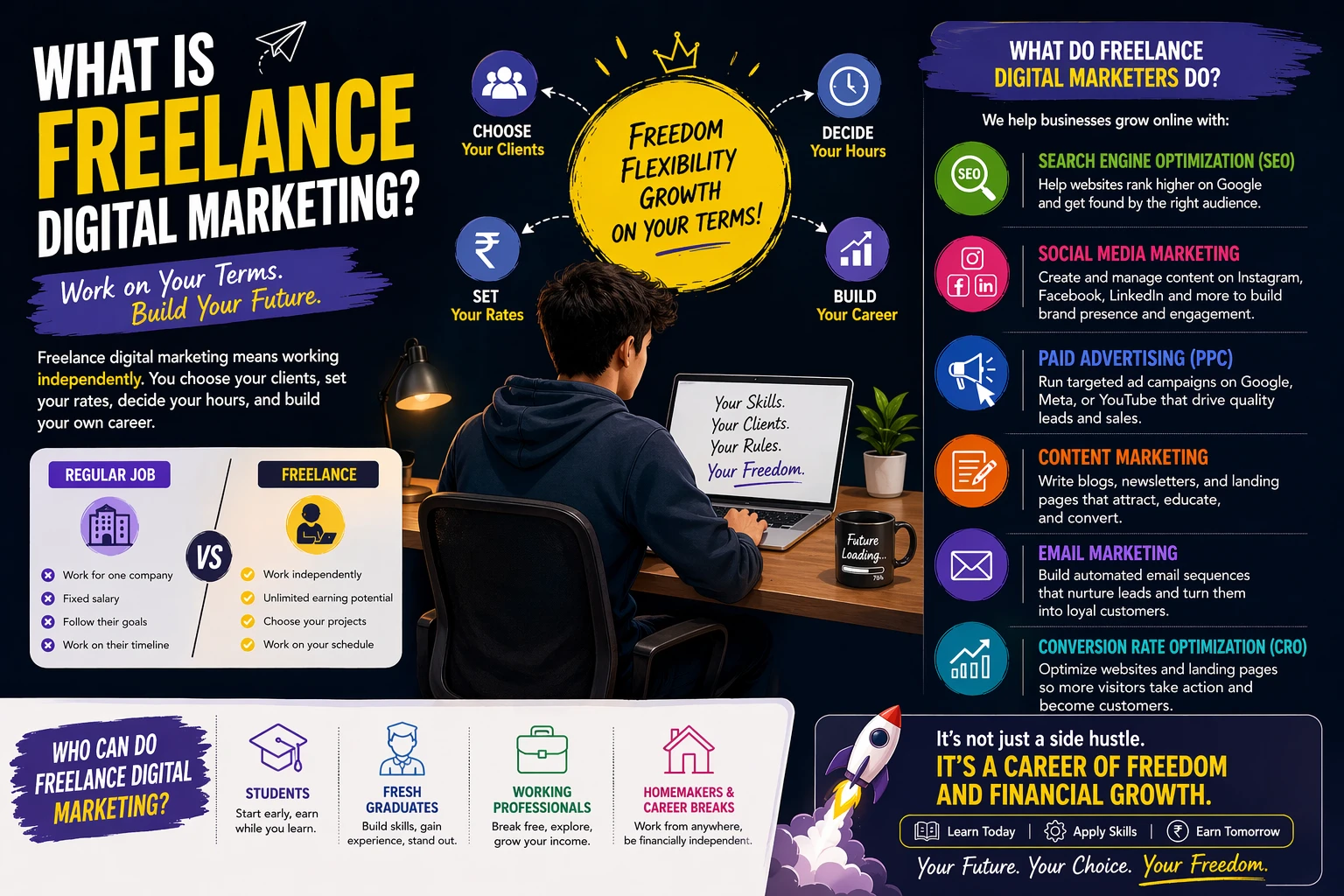
The services that freelance digital marketers typically offer include:
Here’s the important part: you don’t need to offer all of these. Most successful freelancers start with one or two areas, go deep on them, and expand over time. Niche specialization, focusing on a specific service or industry is actually one of the fastest ways to grow your income as a freelancer.
This is one of the most searched questions around this topic, and the answer is a clear yes, but with some context.
You can absolutely work as a freelance digital marketer regardless of whether you have a formal degree, work experience, or even prior clients. What you do need is:
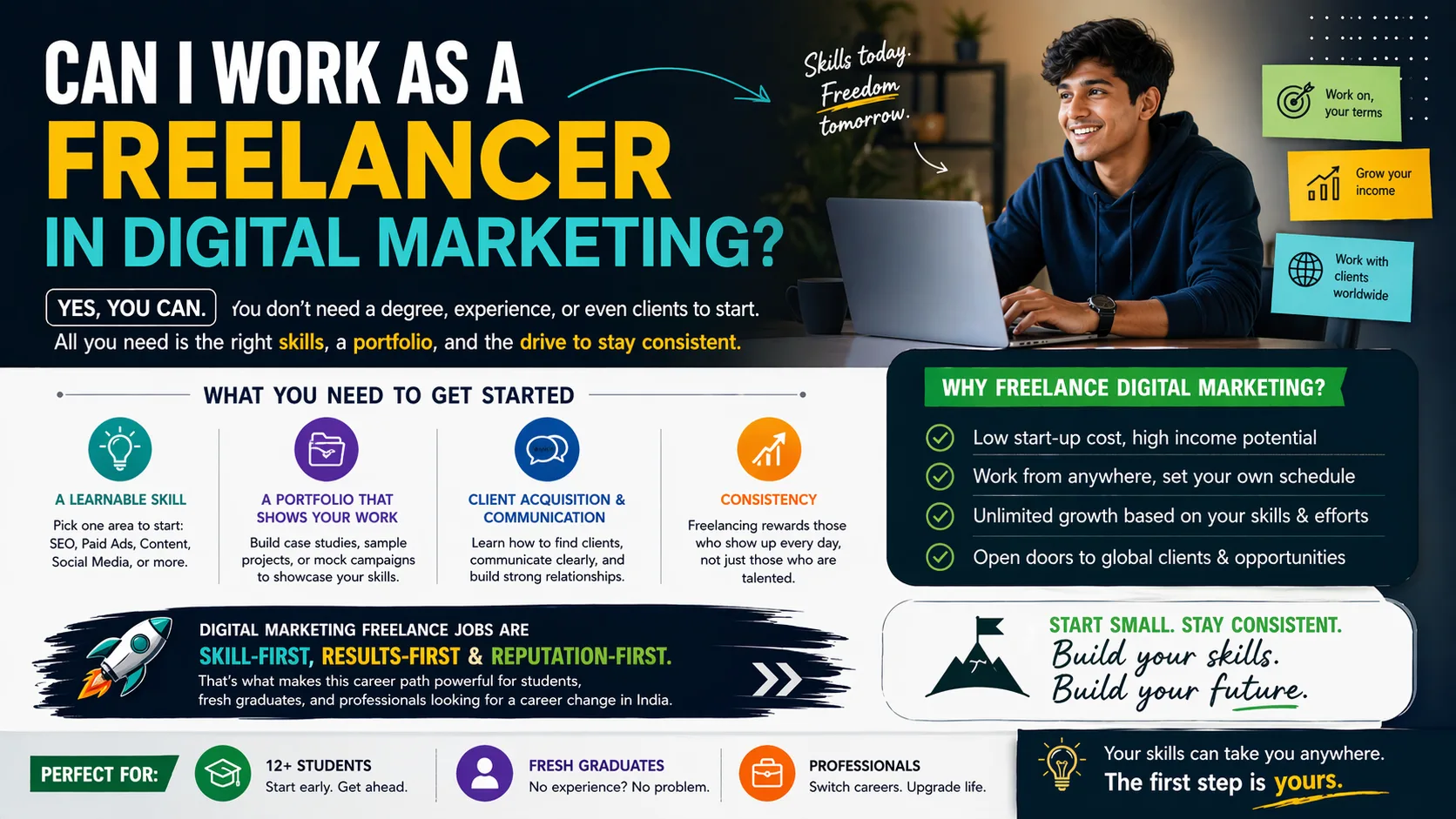
Digital marketing freelance jobs are not gatekept behind degrees or connections. They are skill-first, results-first, and reputation-first. That’s what makes this career path particularly powerful for students and fresh graduates in India who are just starting out.
Let’s break this down by the three groups reading this blog most often:
If you’re in college or have just finished school, you are in an ideal position to start. You have time to learn, low financial pressure compared to later in life, and a long runway ahead. Digital marketing for students works because you can start building your portfolio with personal projects such as a blog, a mock social media campaign, a YouTube channel, before you ever approach a client.
You’re not “too late” and you’re not “too inexperienced.” Fresh graduates searching for digital marketing freelance jobs for freshers often underestimate how much value they can provide if they’ve learned the right skills properly. One well-run Google Ads campaign, one piece of content that ranks on page one, that’s your proof of work.
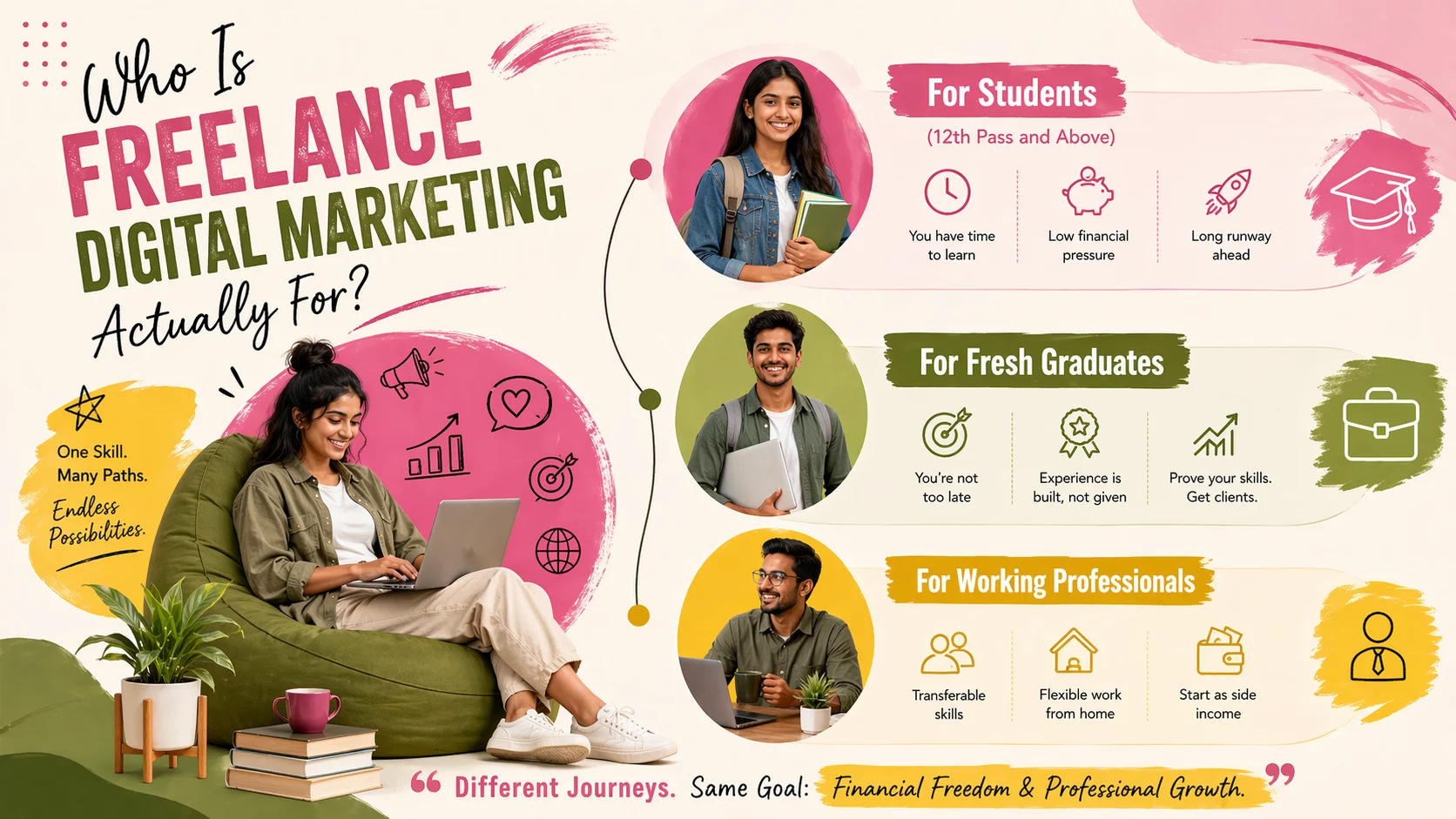
This group often has the most untapped potential. If you’re already working in marketing, sales, communications, or even a non-related field, you have transferable skills, understanding customers, writing, presenting data; that combine beautifully with digital marketing knowledge. Many professionals start with freelance digital marketing as a side income before transitioning fully. The flexibility of work from home digital marketing jobs makes this transition completely manageable.
Step Into the World of Digital MarketingLearn from Digital Marketing Experts |
|
| Advanced Diploma in Digital Marketing | |
| More Learning Options for you: Diploma in Digital Marketing | Google Ads Certification Training | Certification Course |
Here’s the honest, no-fluff version of how to actually get started, not just in theory, but in a way that actually leads to income.
The biggest mistake beginners make is trying to learn everything at once. SEO, ads, social media, content, email, they dive into five courses simultaneously and master none of them.
Instead, pick one skill and learn it deeply before expanding. Consider these based on your interests:
A structured digital marketing course that covers practical application, not just theory, is the fastest way to build this foundation. Self-learning through random YouTube videos can work, but it often leaves critical gaps that only show up when you’re working with a real client.
The number one excuse beginners use is, “I don’t have experience, so I can’t show a portfolio.” But here’s the truth: you can build a portfolio before you have a single paying client.
Here’s how:
Your freelance portfolio doesn’t need to be fancy. It needs to show: “Here is a problem I identified, here is what I did, and here is the result.” Case studies built from even small projects will get you clients.
When building your portfolio, look at strong freelance portfolio examples online; notice how top freelancers present before and after data, screenshots of results, and short explanations of their process.
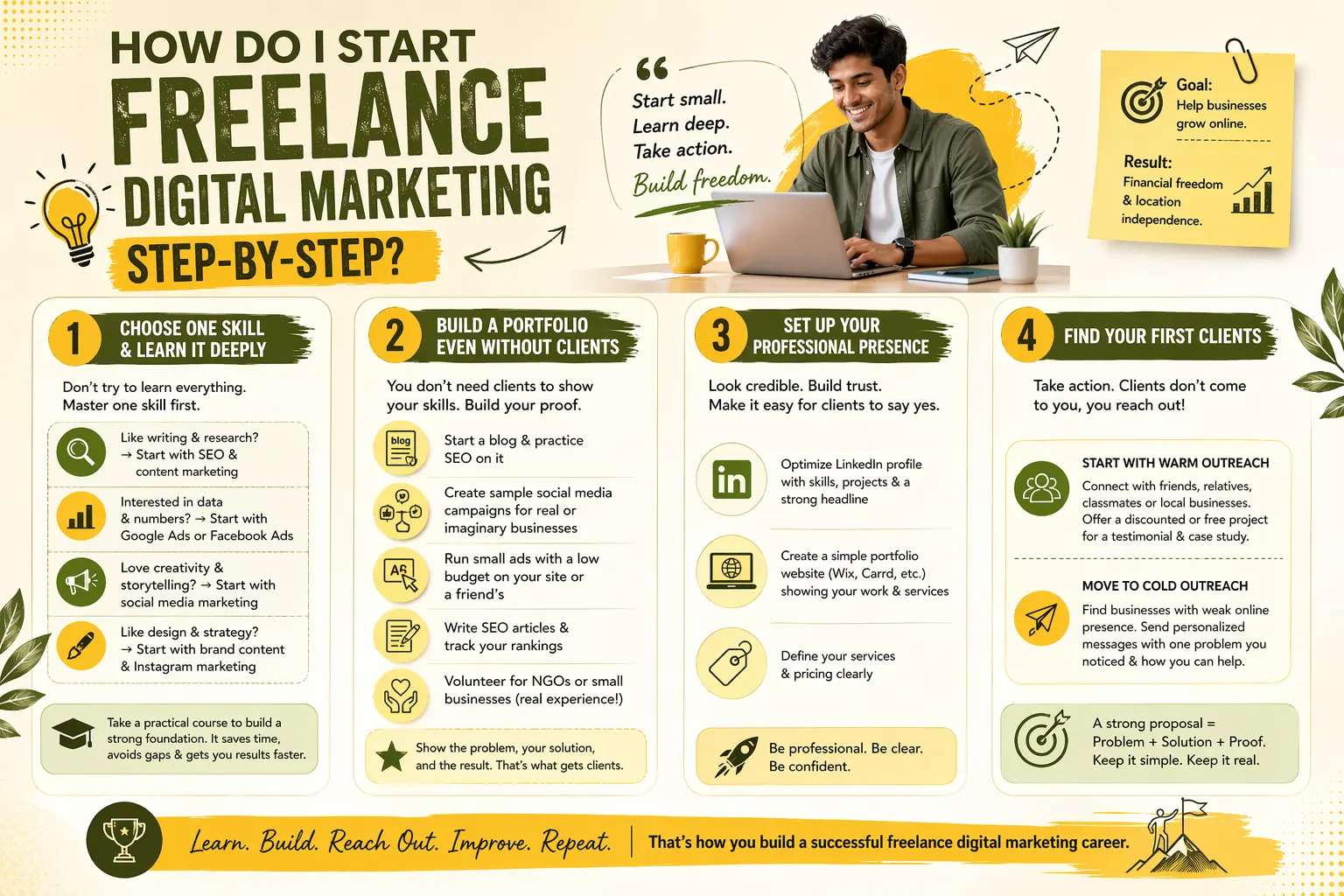
Before you pitch a single client, you need to look credible. This means:
For your pricing: don’t undervalue yourself, but be realistic as a beginner. We’ll cover exact freelance rates in a later section.
This is where most beginners get stuck. They wait. They keep learning. They delay reaching out because they feel “not ready yet.”
Here’s the truth: you become ready by doing, not by preparing forever.
Start with warm outreach, people who already know you. Friends running small businesses, relatives with shops, former classmates who started startups. Offer a discounted or free first project in exchange for a testimonial and a case study. This is not charity but a a strategic investment in your reputation.
Then move to cold outreach. Identify businesses in your city or niche that have weak social media, poor Google rankings, or no active content strategy. Send them a short, personalized message (not a generic copy-paste) explaining one specific problem you noticed and how you can help.
Your freelance proposal doesn’t need to be five pages long. It needs to show three things: you understand their problem, you have a solution, and you have evidence that your solution works.
Whether you’re looking for online digital marketing jobs, freelance digital marketing jobs work from home, or projects for specific niches, these platforms are where the work is:
The largest and most established freelancing platform globally. Competition is high, but so is client quality and project value. Build a strong profile, start with competitive rates, and collect reviews aggressively. Once you have 5–10 solid reviews, your hourly rate can climb significantly.
Works on a “gig” model where you list your services and clients come to you. Great for productizing your skills (e.g., “I will write 5 SEO blog posts for ₹3,000”). Keywords in your gig title matter enormously for visibility.
Similar to Upwork, with a bidding model. The margins can be tight initially, but it’s a solid starting point for building an international portfolio.
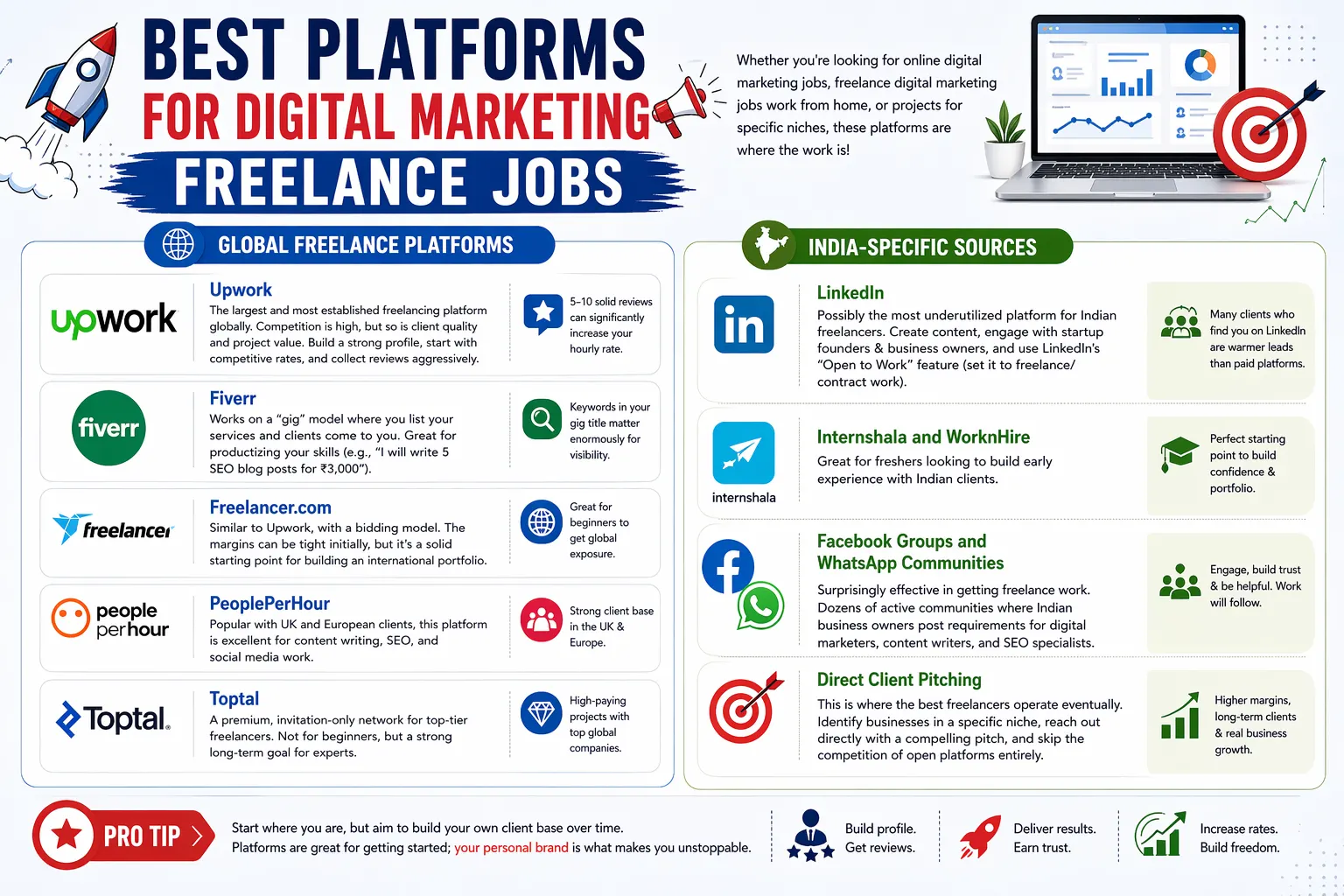
Popular with UK and European clients, this platform is excellent for content writing, SEO, and social media work.
A premium, invitation-only network for top-tier freelancers. Not for beginners, but a strong long-term goal for experts.
Possibly the most underutilized platform for Indian freelancers. Create content around your skills, engage with startup founders and business owners, and use LinkedIn’s “Open to Work” feature (set it to freelance/contract work). Many clients who find you on LinkedIn are warmer leads than those on paid platforms.
Great for freshers looking to build early experience with Indian clients.
It is surprisingly effective in getting freelance work. There are dozens of active communities where Indian business owners post requirements for digital marketers, content writers, and SEO specialists.
This is where the best freelancers operate eventually. Identify businesses in a specific niche (say, coaching institutes or D2C skincare brands), reach out directly with a compelling pitch, and skip the competition of open platforms entirely.
Let’s talk numbers now, because this is the question everyone actually wants answered.
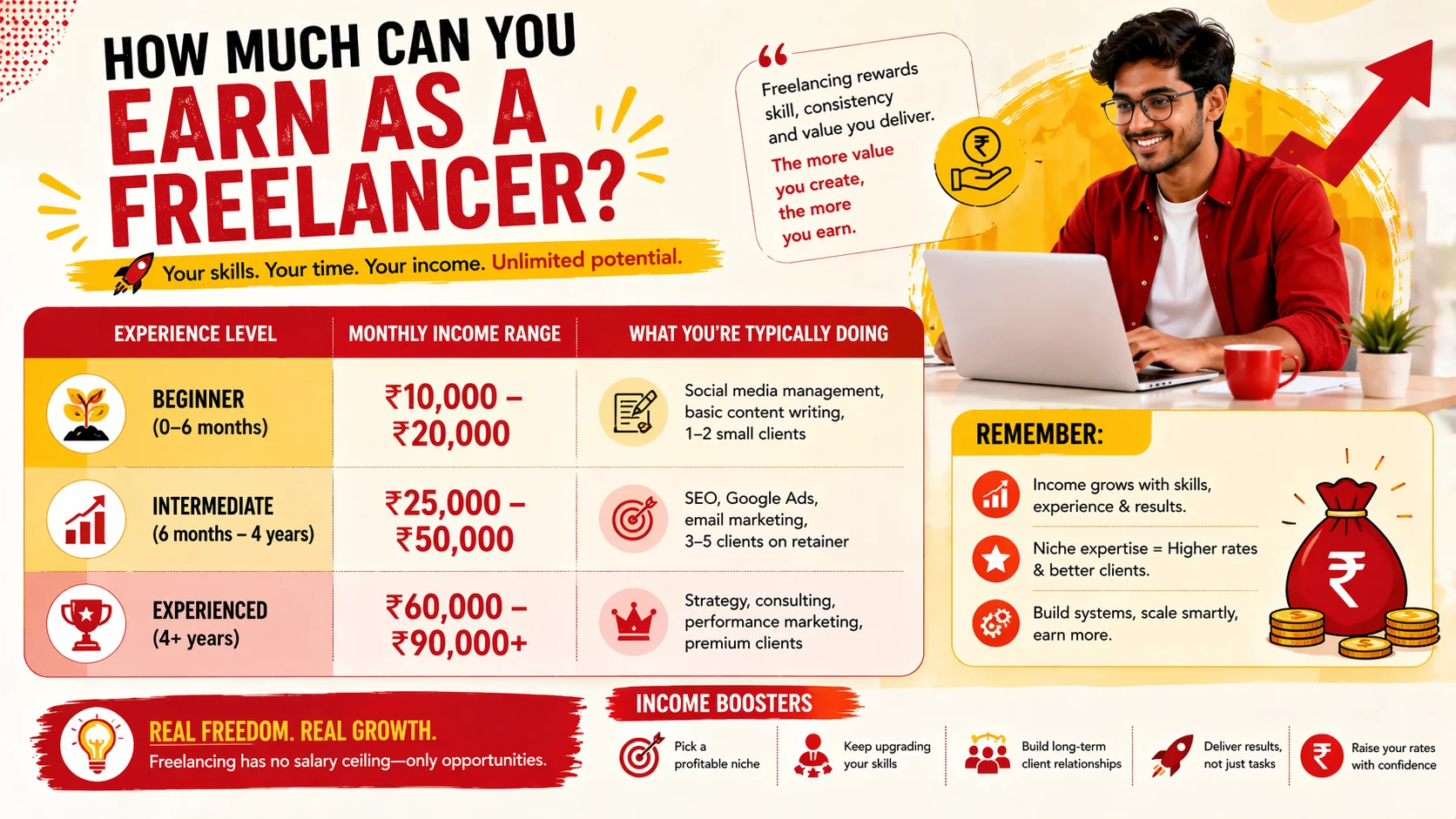
Freelance digital marketing salary in India is not fixed. It depends on your skills, your niche, your client base, and your experience. But here’s a realistic breakdown:
| Experience Level | Monthly Income Range | What You’re Typically Doing |
|---|---|---|
| Beginner (0–6 months) | ₹10,000 – ₹ 20,000 | Social media management, basic content writing, 1–2 small clients |
| Intermediate (6 months – 4 years) | ₹25,000 – ₹50,000 | SEO, Google Ads, email marketing, 3–5 clients on retainer |
| Experienced (4+ years) | ₹ 60,000 –₹90,000+ | Strategy, consulting, performance marketing, premium clients |
Yes, but it requires strategy, time, competence, experience and not just skill. Here’s what ₹1 lakh per month can look like in practice:
Option 1: Multiple retainer clients 4 clients paying ₹25,000/month each for ongoing SEO or social media management. This is very much achievable once you have 1–2 years of proven results.
Option 2: Fewer, premium clients 2 clients paying ₹50,000/month each for comprehensive digital marketing management (ads + SEO + content). This requires stronger positioning and case studies.
Option 3: Project-based pricing 3–4 high-ticket projects per month, website audits, ad campaign setups, content strategies, at ₹25,000–₹50,000 per project.
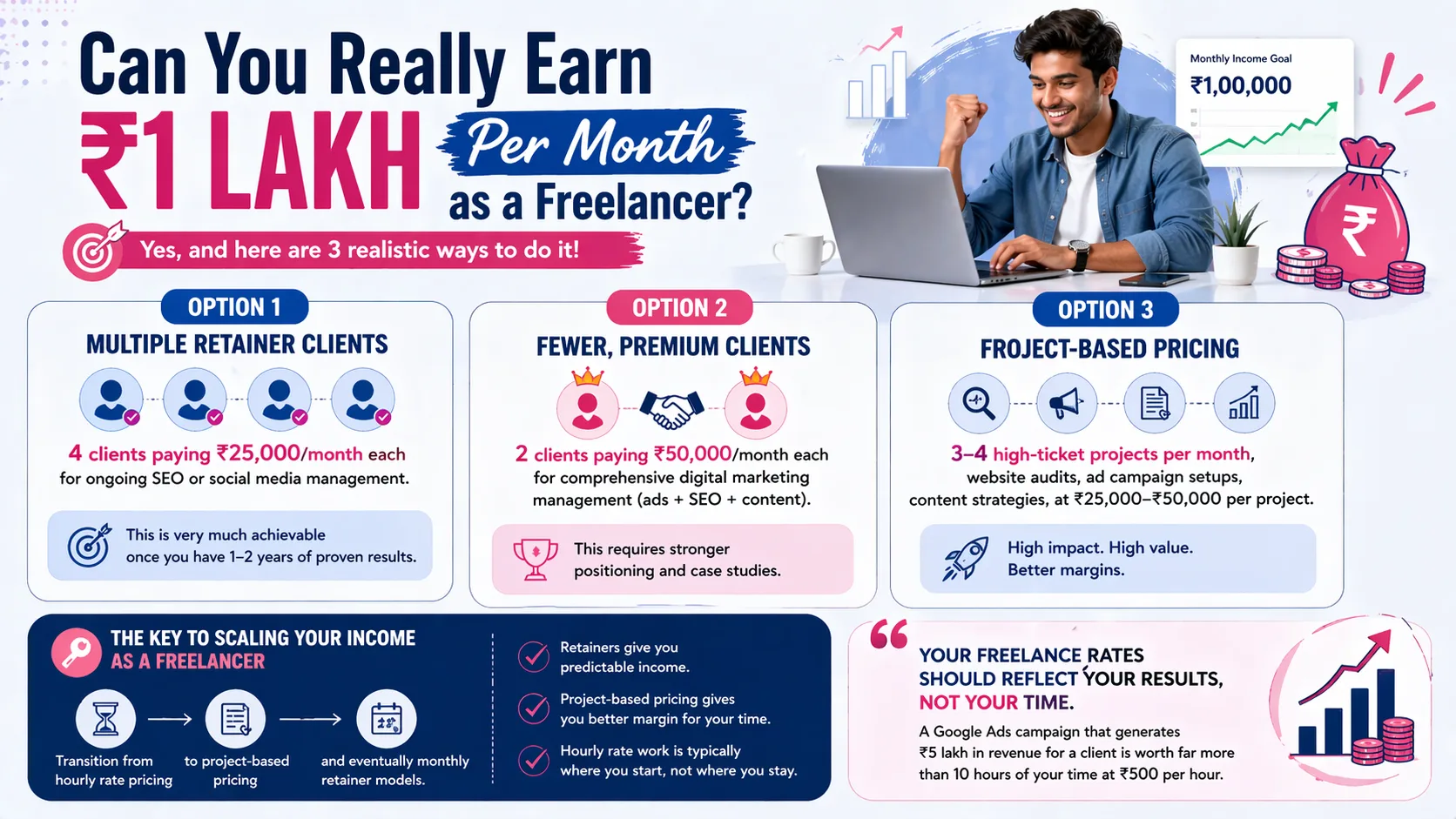
The key to scaling your income as a freelancer is transitioning from hourly rate pricing to project-based pricing and eventually monthly retainer models. Retainers give you predictable income. Project-based pricing gives you better margin for your time. Hourly rate work is typically where you start, not where you stay.
Your freelance rates should reflect your results, not your time. A Google Ads campaign that generates ₹5 lakh in revenue for a client is worth far more than 10 hours of your time at ₹500 per hour.
This is a question that comes up often, both from beginners trying to understand the landscape and from clients who want to know what exactly you offer. Here’s a clean breakdown:
As a freelance digital marketer, you don’t need expertise in all seven. But understanding all seven helps you position your services accurately, identify upsell opportunities for your clients, and have intelligent conversations about their overall marketing strategy.
The promise of work from home digital marketing jobs sounds like the dream and honestly, it can be. But there are realities that nobody talks about enough.
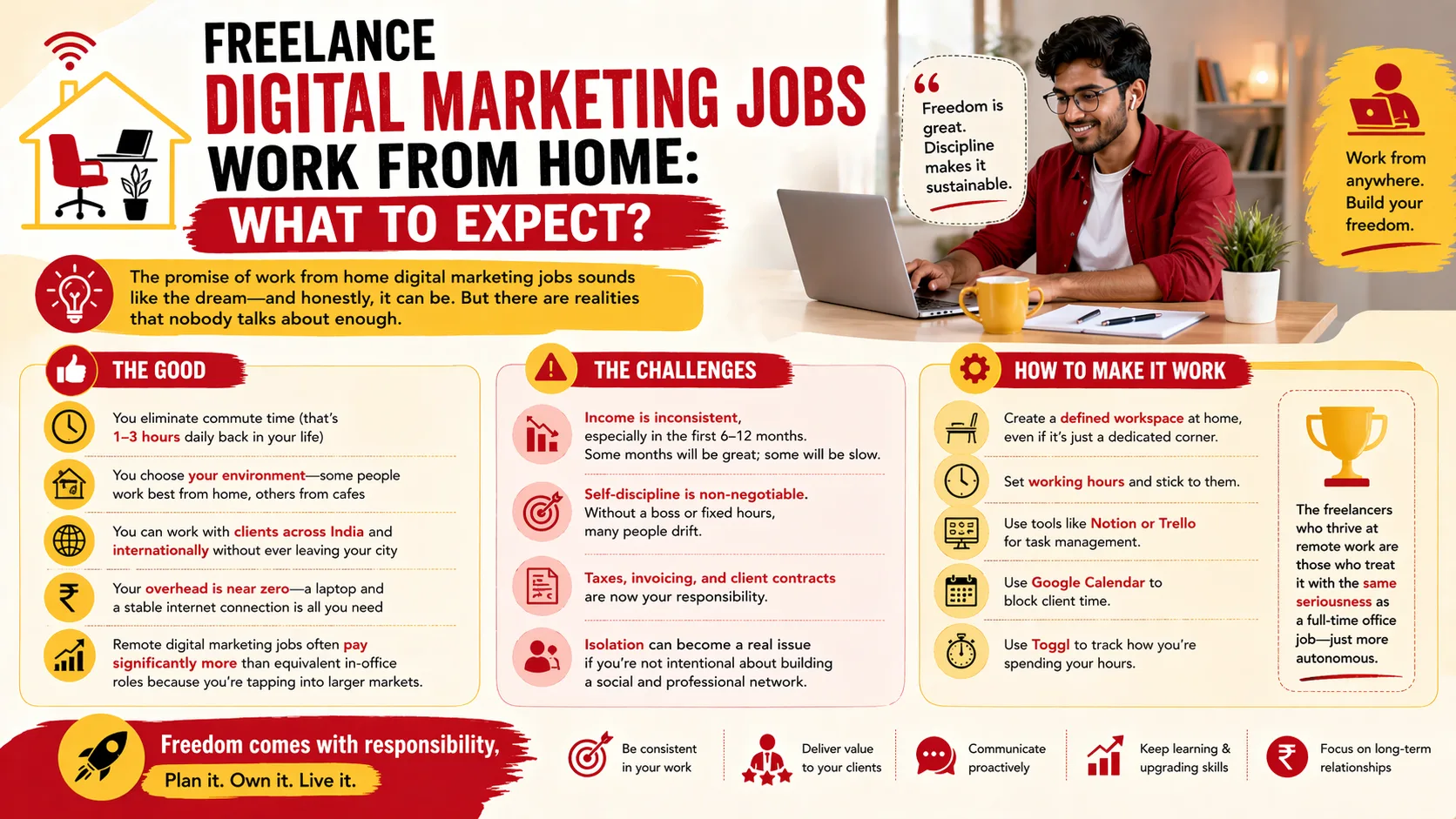
Create a defined workspace at home, even if it’s just a dedicated corner. Set working hours and stick to them. Use tools like Notion or Trello for task management, Google Calendar to block client time, and Toggl to track how you’re spending your hours. The freelancers who thrive at remote work are those who treat it with the same seriousness as a full-time office job, not more relaxed, just more autonomous.
This section is where most freelancing guides go vague. So let’s get specific.
The average cold outreach message sounds like this: “Hi, I am a digital marketer with X years of experience. I would love to work with your brand. Please check my portfolio.”
This does not work. Here’s why: it’s about you, not them.
A message that works sounds like this: “Hi this is Ayantika (you can put your name), I noticed your Instagram hasn’t been updated in three weeks and your last Google review was from six months ago. I specialize in helping startup businesses like yours build active social media presence and improve their local SEO. Would a quick 15-minute call this week work?”
See the difference? Specific observation. Clear value. Low-commitment.
Every project needs a simple scope of work document before you start. This protects you from scope creep, the slow expansion of a project beyond what you originally agreed to. Your scope of work should define:
This isn’t about being difficult. It’s about being professional, and professional freelancers get paid more and experience fewer disputes.
Most deals close after the third or fourth follow-up, not the first message. A simple rule: if someone doesn’t respond, follow up once after 3 days, and once more after 7 days. After that, move on. Don’t chase endlessly, your time is your most valuable asset.
Here are the mistakes I see most often and how to avoid them:
New freelancers often charge too little out of fear that clients won’t pay more. But rock-bottom pricing actually signals low quality. Instead, price based on the value you deliver, not the hours you spend.
Early on, it feels like you need every client. But bad-fit clients, the ones who constantly demand changes, pay late, and don’t value your work. It drains your time and energy from clients who would pay more and treat you better. Learn to say no.
A handshake agreement is not a contract. Even a simple one-page document protecting your payment terms and scope of work will save you from painful situations.
You’re so busy working for clients that you never market yourself. This creates feast-or-famine income cycles. Dedicate at least 2–3 hours per week to your own LinkedIn presence, portfolio updates, and outreach, even when you’re fully booked.
Track everything. Measurable results are your most powerful sales tool. If your SEO work moved a client from page 3 to page 1, document it. If your Google Ads campaign achieved a 4x return on ad spend, document it. These case studies become your most persuasive marketing material.
You can learn digital marketing for free. YouTube, Google’s own certifications, HubSpot Academy, there is no shortage of free resources.
But here’s what free resources don’t give you: structure, accountability, mentorship, and the ability to ask a real expert why something isn’t working.
A structured digital marketing course, especially one focused on practical, hands-on learning, compresses your growth timeline significantly. Instead of spending 18 months figuring out what works through trial and error, you learn it in a focused period with guidance from people who’ve already made those mistakes.
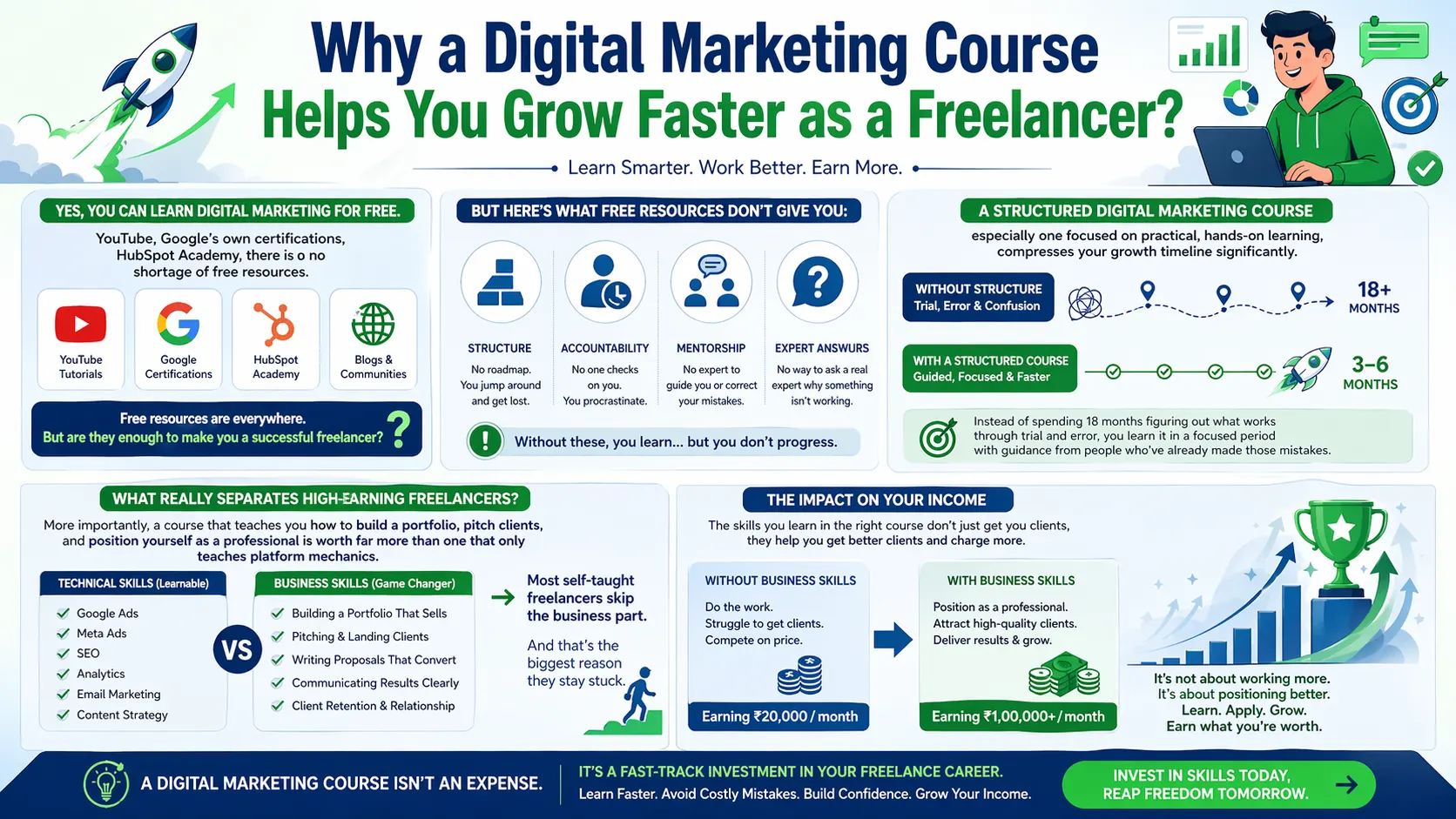
More importantly, a course that teaches you how to build a portfolio, pitch clients, and position yourself as a professional is worth far more than one that only teaches platform mechanics. The technical skills are learnable. The business skills, knowing how to present yourself, write proposals, and communicate results are what most self-taught freelancers skip, and those skills are exactly what separate the ones earning ₹20,000 per month from the ones earning ₹1 lakh and above.
At IDCM (Institute of Digital and Content Marketing), the curriculum is built around exactly this kind of practical, career-oriented learning. Whether you’re a student starting from scratch, a fresher looking for your first break, or a working professional planning a transition, the training is designed to take you from learning to earning, not just to certification.
Let’s address this honestly. The gig economy in India is real and growing. More Indian businesses than ever before are investing in digital marketing, and a large portion of that investment is going to independent contractors and freelancers rather than full-time hires. Why? Because hiring a full-time digital marketer is expensive and inflexible. A skilled freelancer who delivers measurable results at a clear project-based or retainer price is a smarter investment for most small and mid-sized businesses.
The opportunity is real. The income potential is real. The flexibility is real.
But it’s also not a shortcut. Freelancing rewards skill, discipline, and patience. Your first three to six months will likely be slow. You’ll face rejection, scope creep, difficult clients, and moments of self-doubt. Every successful freelancer has been through this phase.
The ones who succeed are not necessarily the most talented. They’re the most consistent. They keep learning. They keep reaching out. They keep delivering results. And eventually, the compound effect of good work and good reputation starts working in their favor.
That’s when freelancing stops feeling like hustle and starts feeling like freedom.
To sum up our discussion about digital marketing freelance jobs, I would like to share my experince. Here is something nobody tells you a when you’re just starting out and that is your starting point matters far less than the direction you’re moving in.
You might be starting with zero experience, zero clients, and zero confidence. That’s okay. Every freelancer you admire was exactly there once. What changed things for them wasn’t a lucky break, it was a decision to start, combined with consistency in showing up.
Digital marketing freelance jobs are not a distant dream. They are a genuinely realistic path that thousands of students, freshers, and professionals across India are already walking and earning well on.
The question isn’t whether this career is right for you. The question is: are you willing to invest in learning properly, building your portfolio seriously, and putting yourself out there even when it feels uncomfortable?
If yes, then everything else is learnable. And the first step starts now.
Few related topics for your knowledge
Yes, absolutely. Freelance digital marketing is one of the most accessible career paths available today, regardless of your academic background. What matters is your skill level, your ability to demonstrate results, and your professionalism in working with clients.
Start by choosing one core skill (SEO, social media, paid ads, or content), learning it properly through a structured course or reliable resources, building a portfolio with real or practice projects, setting up a professional LinkedIn profile and simple portfolio website, and then beginning to reach out to potential clients , starting with warm contacts and gradually moving to cold outreach on platforms like Upwork, Fiverr, or LinkedIn.
The seven main types are: Search Engine Optimization (SEO), Search Engine Marketing/PPC, Social Media Marketing, Content Marketing, Email Marketing, Affiliate Marketing, and Influencer Marketing. As a freelancer, you typically specialize in one or two of these rather than trying to offer all seven at once.
Earning ₹1 lakh per month as a freelancer is achievable but requires a clear strategy. Focus on high-demand, high-value skills like performance marketing (Google Ads and Meta Ads), SEO strategy, or full-service digital marketing management. Build a strong portfolio with measurable results. Move away from hourly pricing to retainer-based contracts with 3–5 stable clients. Invest in upskilling continuously, and use your own results as case studies to attract better clients over time. Most freelancers reach this milestone within 1.5 to 3 years of consistent, focused work.

 }})