
Courses
Quick Answer: How do you know if an influencer campaign made money?
Influencer marketing ROI compares the profit a creator campaign generates with what the campaign cost.
ROI (%) = (Contribution profit – Campaign investment) / Campaign investment x 100
Always calculate it on contribution profit, not revenue: in the worked example below, the same campaign shows 300% ROI on revenue but only 80% on profit.
A creator’s Reel crosses 1,00,000 views. The comments are positive, and the likes keep climbing. Then someone from finance asks the only question that matters: did the campaign make the business money?
That is what influencer marketing ROI answers. Likes, views and follower counts show visibility, but none of them proves revenue, leads or profit. A post can go viral and lose money, while a smaller creator with 12,000 views can bring in customers who actually buy.
This guide shows how to calculate influencer marketing ROI in rupees, how to track it, how to measure it when your goal is leads rather than sales, and which Indian disclosure rules every campaign must follow. New to the basics? Start with our guide to what influencer marketing is and how it works, then come back here for the measurement.
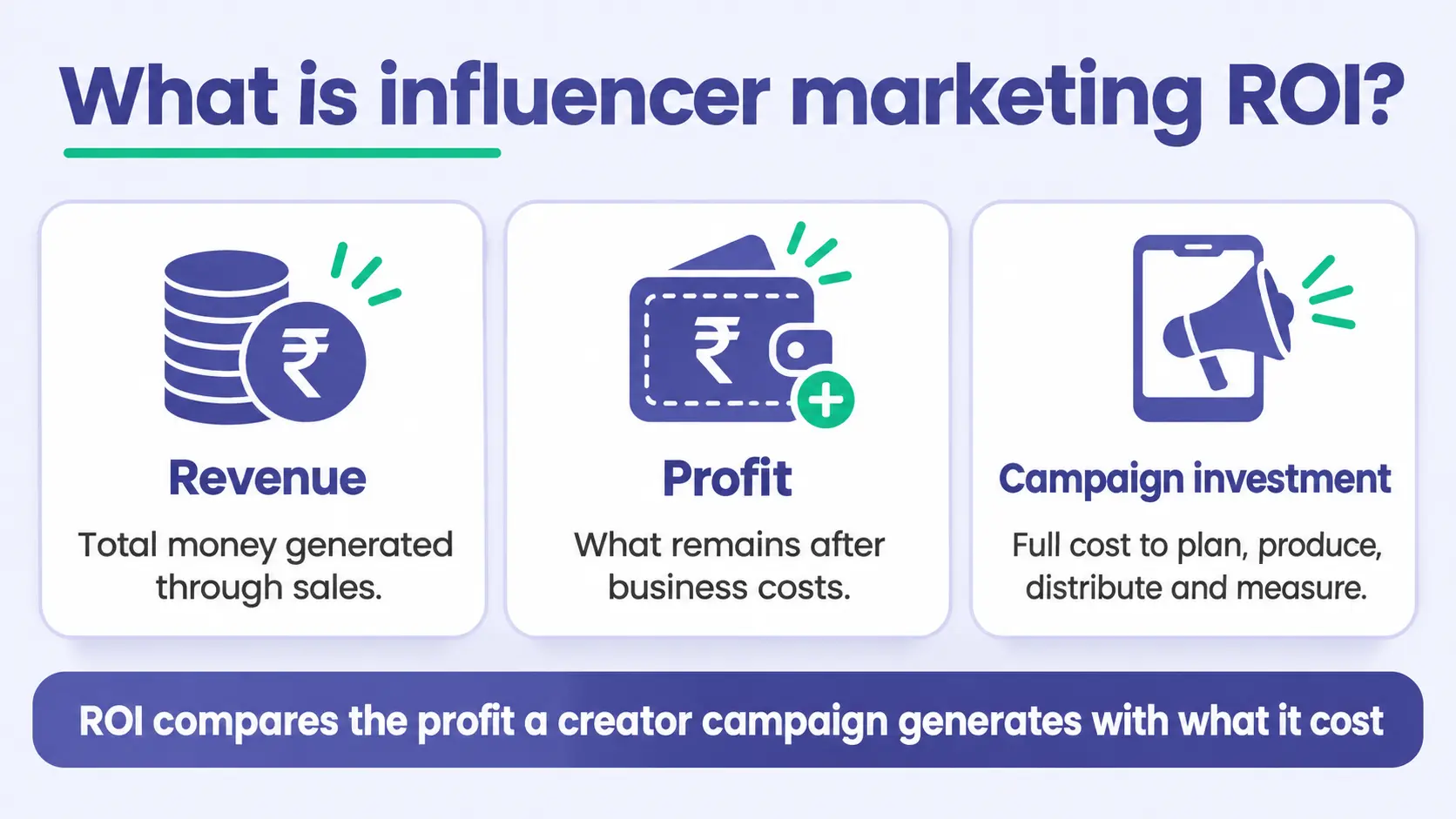
Influencer marketing ROI (return on investment) measures the financial return a creator campaign generates relative to its total cost. It tells a business whether the profit the campaign produced justifies the money spent on creators, content, distribution and tracking.
Three terms keep the calculation honest:
ROI sits alongside other metrics that describe different parts of performance. Use the one that matches the question you are answering.
| Metric | Full form | What it tells you | Formula |
|---|---|---|---|
| ROI | Return on Investment | Profit generated relative to the full campaign cost | (Contribution profit – Investment) / Investment x 100 |
| ROAS | Return on Ad Spend | Revenue generated per rupee of ad spend | Attributed revenue / Ad spend |
| CPA | Cost Per Acquisition | Cost of one defined conversion, such as a purchase | Campaign cost / Acquisitions |
| CPL | Cost Per Lead | Cost of one lead or enquiry | Campaign cost / Leads |
| CAC | Customer Acquisition Cost | Cost of acquiring one paying customer | Total acquisition cost / New customers |
| LTV / CLV | (Customer) Lifetime Value | Estimated value of a customer across the relationship | Based on purchase history and retention |
| EMV | Earned Media Value | Estimated monetary value of exposure | Impressions x Assumed value per impression |
Lifetime value matters because one creator may drive fewer first purchases but more repeat buyers. A customer acquired for ₹500 who spends ₹800 and then buys twice more is worth more than the first order suggests. LTV is still an estimate built from your own customer data, not guaranteed future revenue.
Calculate influencer marketing ROI by subtracting the campaign investment from the contribution profit it generated, dividing by the investment, and multiplying by 100.
Formula: ROI (%) = (Campaign contribution profit – Campaign investment) / Campaign investment x 100
Campaign contribution profit is the revenue attributable to the campaign after deducting variable costs such as product, packaging and shipping, but before deducting the campaign investment. That order prevents double-counting: if you have already deducted campaign spend to reach a net profit figure, do not subtract it again.
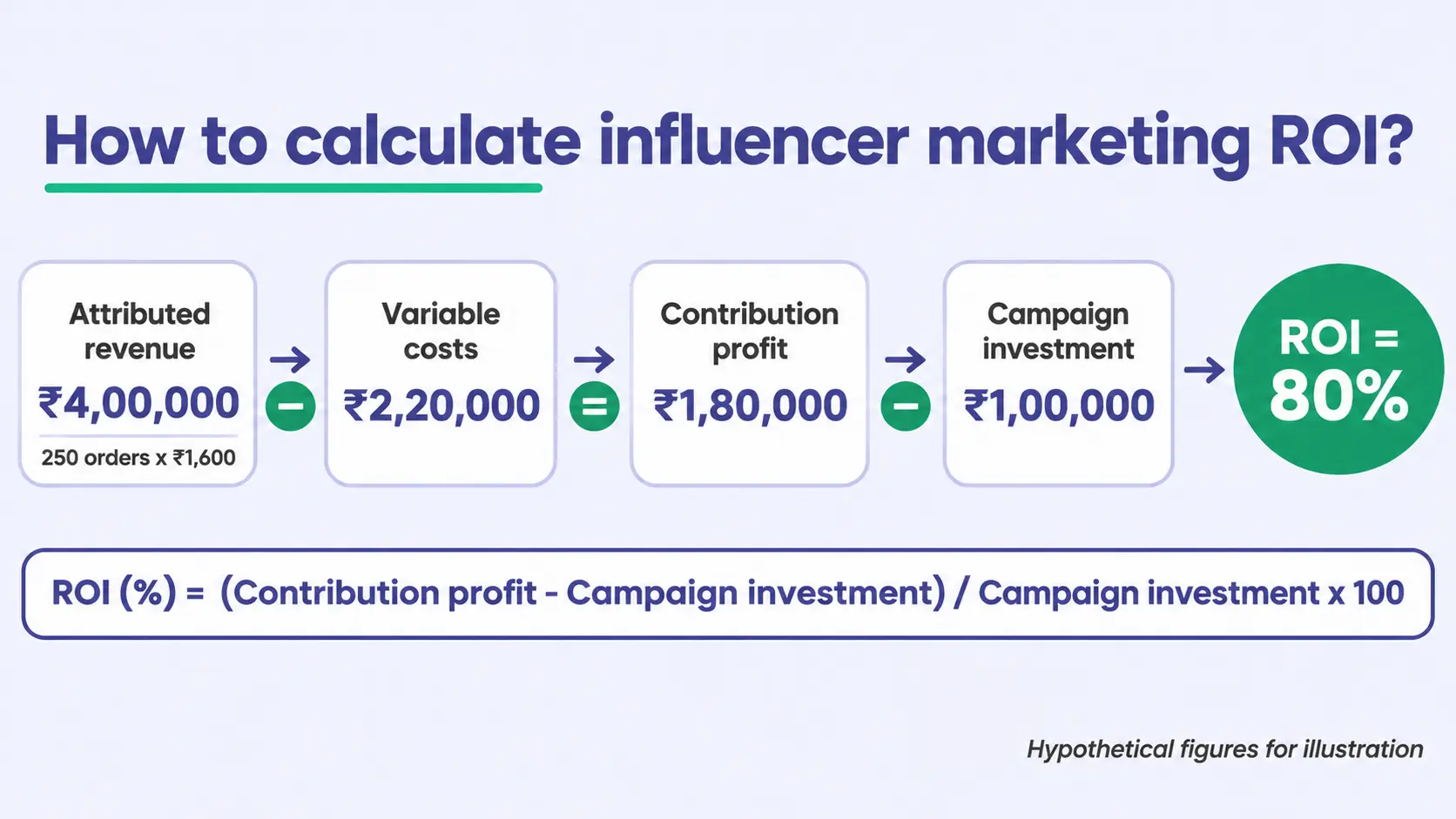
The numbers below illustrate the method only. They are not benchmarks. A skincare brand works with three beauty creators to launch a new moisturiser.
| Campaign investment | Amount |
|---|---|
| Creator fees | ₹60,000 |
| Product gifting | ₹8,000 |
| Shipping | ₹2,000 |
| Paid content amplification | ₹30,000 |
| Total investment | ₹1,00,000 |
The campaign generated ₹80 in profit above its cost for every ₹100 invested. A real report should also account for returns, refunds, discounts, GST where relevant, agency fees and production costs.
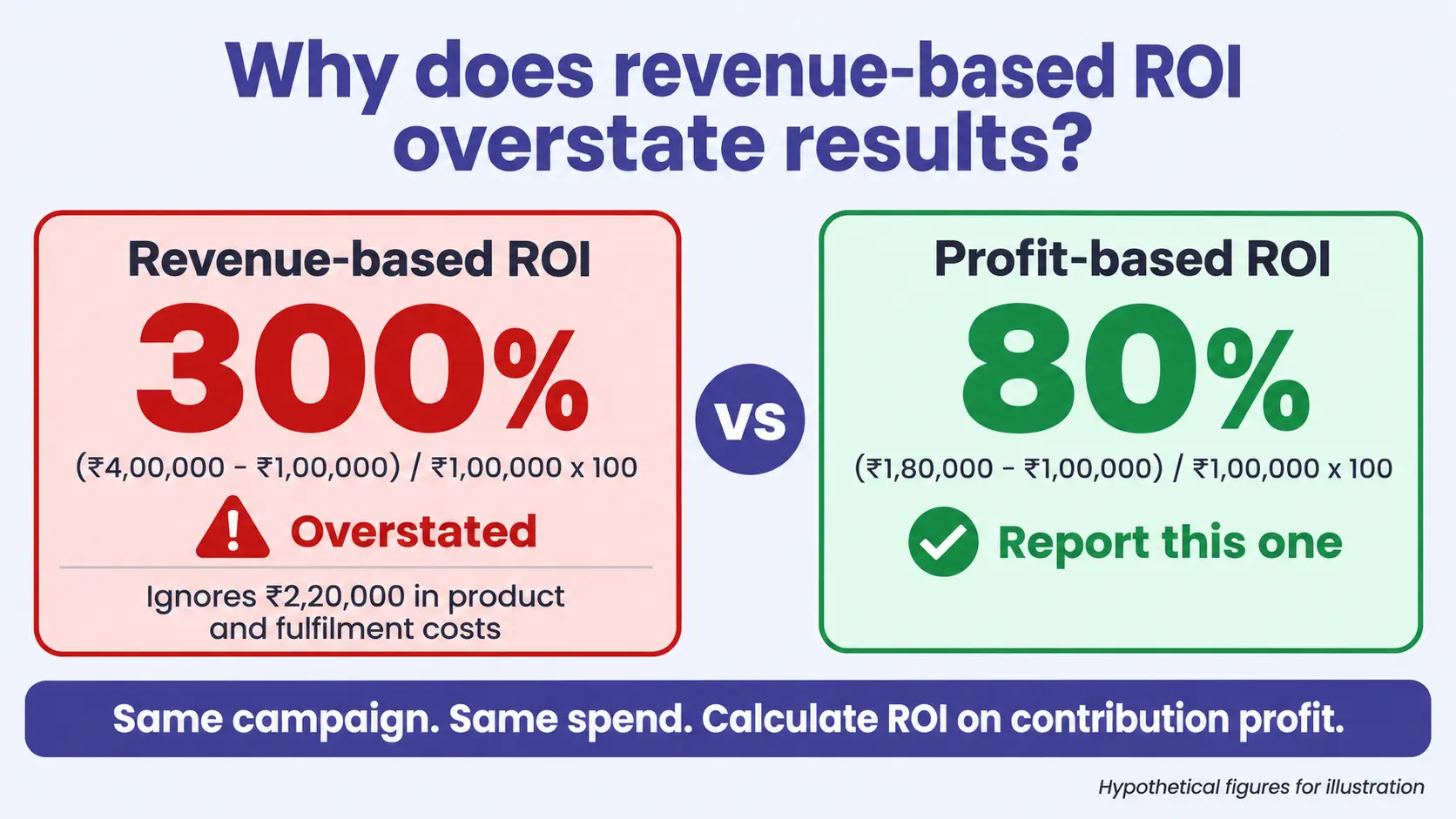
Many ROI calculators plug revenue straight into the formula. On the same campaign, that gives (₹4,00,000 – ₹1,00,000) / ₹1,00,000 x 100 = 300%.
The same campaign shows 300% ROI on revenue and 80% ROI on contribution profit. The difference is ₹2,20,000 in product and fulfilment costs that the revenue version ignores.
Report the profit-based figure to management. If you must show revenue, label it as ROAS, not ROI.
ROAS measures revenue against ad spend only. If a brand spends ₹20,000 on paid amplification and generates ₹80,000 in attributed revenue, ROAS is 4: ₹4 of revenue per ₹1 of ad spend. That says nothing about creator fees, product costs or profit, so a campaign can show a strong ROAS and still lose money.
Earned Media Value puts an estimated rupee value on exposure. If a campaign earns 1,00,000 impressions and the business assigns ₹0.50 per impression, EMV is ₹50,000. That is not ₹50,000 of revenue or profit. Platforms and agencies calculate EMV differently, so treat it as an indicative awareness metric and never put it into the ROI formula.
Why we don’t quote an “average” influencer marketing ROI: You will find headline figures claiming brands earn a fixed amount for every dollar spent. Before using one, check whether it comes from audited profit data, self-reported surveys or EMV estimates, because each produces a very different number. A good ROI for your campaign depends on your margins, objective, category and customer lifetime value, not on a global average.
Skill Up. Show Up. Stand Out — in the Digital Marketing World!Gain Hands-On Skills Taught by Real Industry Experts |
|
| Diploma Course | |
| More Learning Options for you: Advanced Digital Marketing | Certificate in Digital Marketing | Facebook Ads Course |
A campaign can serve more than one objective, but pick one as primary so the evaluation stays focused. Decide what the campaign is meant to achieve before it goes live, because the objective decides which numbers count as success. An awareness campaign judged only on direct sales will look like a failure even when it did its job.
| Objective | Example | Primary KPIs | Don’t judge it by |
|---|---|---|---|
| Brand awareness | A new sportswear brand works with fitness creators | Reach, impressions, watch time, branded search growth | Same-week sales |
| Direct response | A food delivery app gives local food creators an exclusive first-order code | Clicks, conversion rate, purchases, CPA, ROI | Likes and follower growth |
| Community trust | A skincare brand partners with dermatology educators | Saves, shares, comment quality, sentiment, repeat engagement | Raw view counts |
A metric is only useful when it answers a business question. 500 website visits look positive until you see that nobody took the next step.
| Surface metric | Business-focused metric | What it tells you |
|---|---|---|
| Follower count | Relevant audience reach | Whether the creator reaches your buyers |
| Likes | Meaningful interactions | How the audience responds |
| Views | Watch time and completion | Whether people actually consumed the content |
| Link clicks | Qualified website sessions | Whether interested users arrived |
| Comments | Sentiment and purchase questions | Whether the content created consideration |
| Promo-code uses | Attributed purchases | Whether trackable sales followed |
| Total enquiries | Qualified leads | Whether the campaign attracted real prospects |
| Revenue | Contribution profit and ROI | Whether the campaign created financial value |
Track influencer results by giving every creator their own UTM link and discount code, sending traffic to a dedicated landing page, and reading conversions in Google Analytics 4. Set all of this up before the first post goes live; you cannot add tracking retroactively.
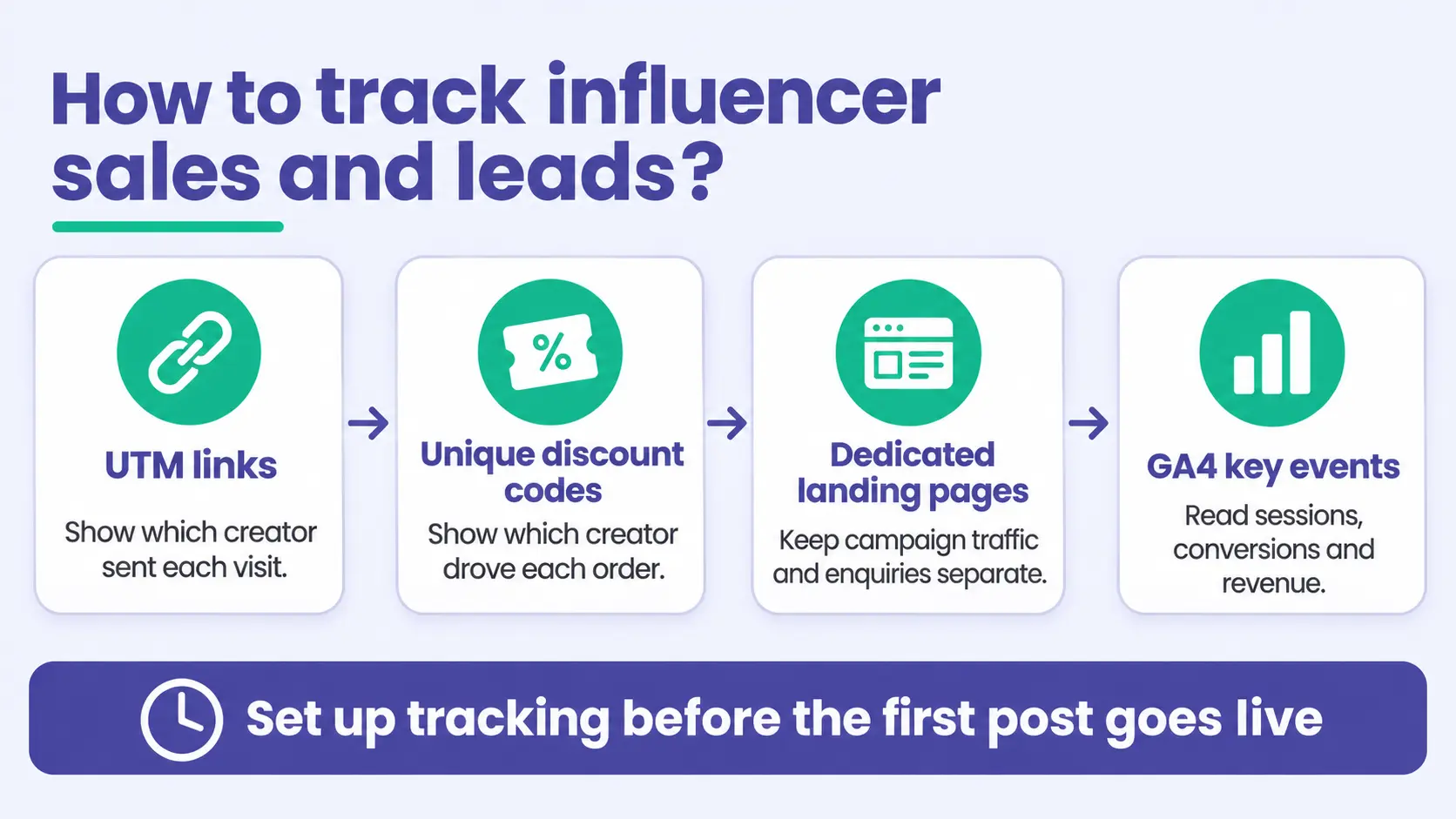
UTM parameters are tags added to a URL that tell your analytics where a visit came from:
Example of a UTM-tagged creator link
https://example.com/product?utm_source=instagram&utm_medium=influencer&utm_campaign=summer_skincare&utm_content=creator_a
Blue = parameter name, green = the value you set for each creator.
Keep naming consistent. Using “Instagram”, “instagram” and “IG” in different links splits one source into three rows in your reports. Build links with Google’s free Campaign URL Builder.
Give each creator a separate code, such as CREATORA10 and CREATORB10, so checkout data shows which creator drove each order. Codes leak to coupon sites and get shared, and some buyers forget to use them, so treat code redemptions as one signal rather than the full count.
A landing page built for one campaign or creator keeps the message consistent from the post to the page and isolates that traffic in your reports. It works especially well for lead generation, where the page carries the enquiry form.
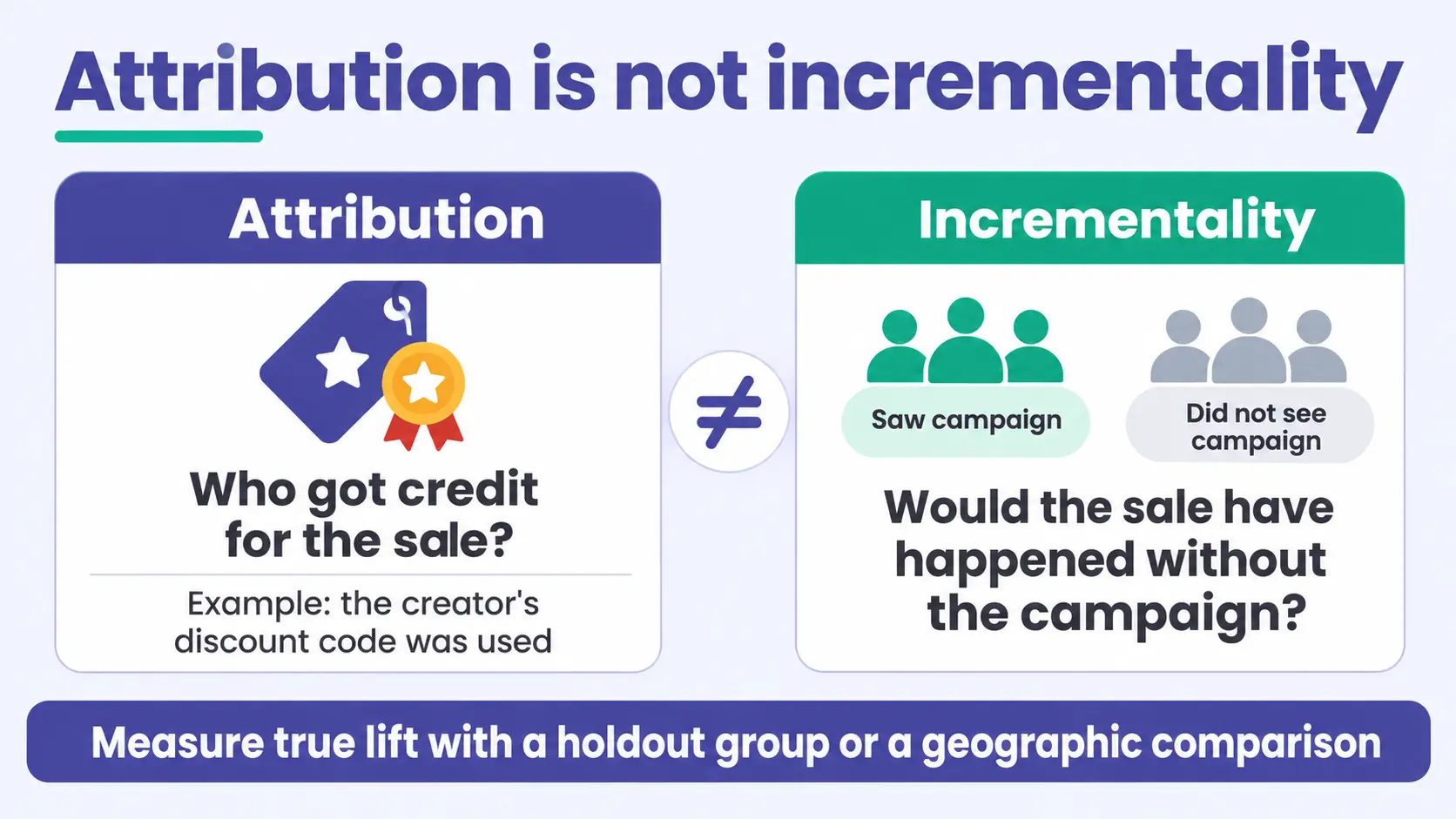
Attribution tells you which touchpoint received credit for a sale. Incrementality asks whether the sale would have happened without the campaign. A customer who already planned to buy may still use a creator’s code. Where budget allows, run a holdout group or a geographic comparison to estimate the true incremental lift.
Try this yourself: Before your next campaign, build one UTM link per creator in Google’s Campaign URL Builder. When the campaign ends, run the numbers through the ROI formula above. If you do not know your contribution margin, ask your finance team before trusting the result.
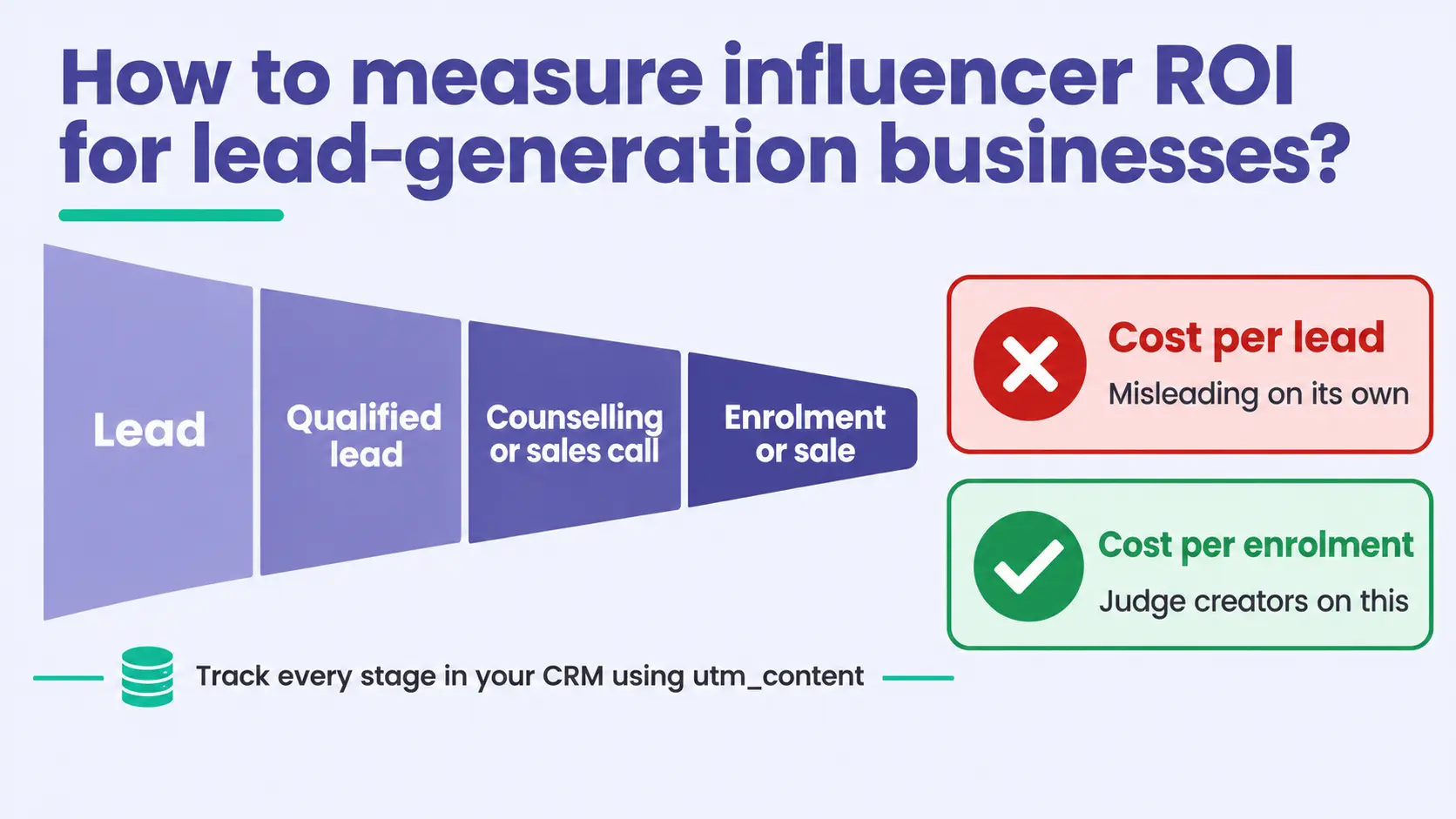
If your business sells through enquiries, as education, real estate, healthcare and B2B services do, judge creators on cost per final conversion, not cost per lead. A cheap lead that never converts is the most expensive lead you can buy.
Track every creator’s leads through the full chain: lead, qualified lead, sales or counselling call, and final enrolment or sale. Tag the lead source in your CRM using the same utm_content value, so each enrolment can be traced back to a creator.
Two creators each receive ₹30,000 to promote the same course.
| Stage | Creator A | Creator B |
|---|---|---|
| Spend | ₹30,000 | ₹30,000 |
| Leads | 150 | 60 |
| Cost per lead | ₹200 | ₹500 |
| Qualified leads | 30 | 36 |
| Counselling calls held | 9 | 18 |
| Enrolments | 3 | 9 |
| Cost per enrolment | ₹10,000 | ₹3,333 |
Creator A looks better on CPL and worse on everything that matters. Creator B’s audience was smaller but closer to the buyer, so it converted at every stage.
Cost per enrolment = Campaign cost / Enrolments attributed to the campaign
Lead-gen ROI (%) = (Enrolments x Contribution per enrolment – Campaign cost) / Campaign cost x 100
Use an attribution window that matches your sales cycle. If prospects typically take several weeks to decide, a 7-day window will undercount every creator. Compare influencer leads with Google Ads and Meta Ads leads using the same definitions, the same window and the same quality criteria.
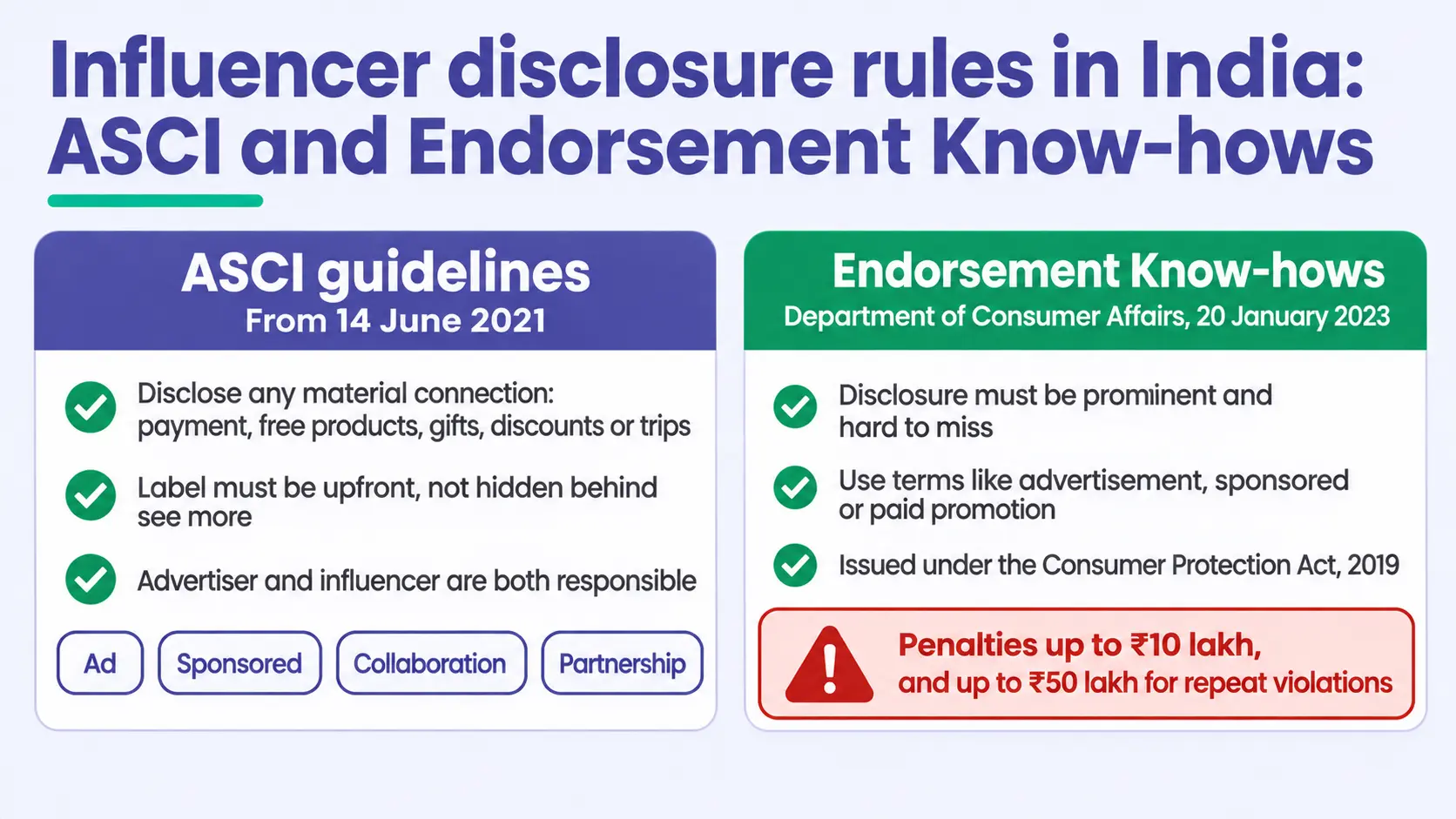
Every paid, gifted or otherwise rewarded influencer post in India must carry a clear disclosure. Two sets of rules apply: the ASCI guidelines and the government’s “Endorsement Know-hows!”. A non-compliant post can be pulled down, which wipes out the asset you paid for, so disclosure is part of protecting ROI.
The stakes are growing. The Department of Consumer Affairs Secretary put India’s social media influencer market at ₹1,275 crore in 2022, projected to reach ₹2,800 crore by 2027 (Inc42).
Build the disclosure requirement into every creator contract, and check each post before you amplify it with paid spend.
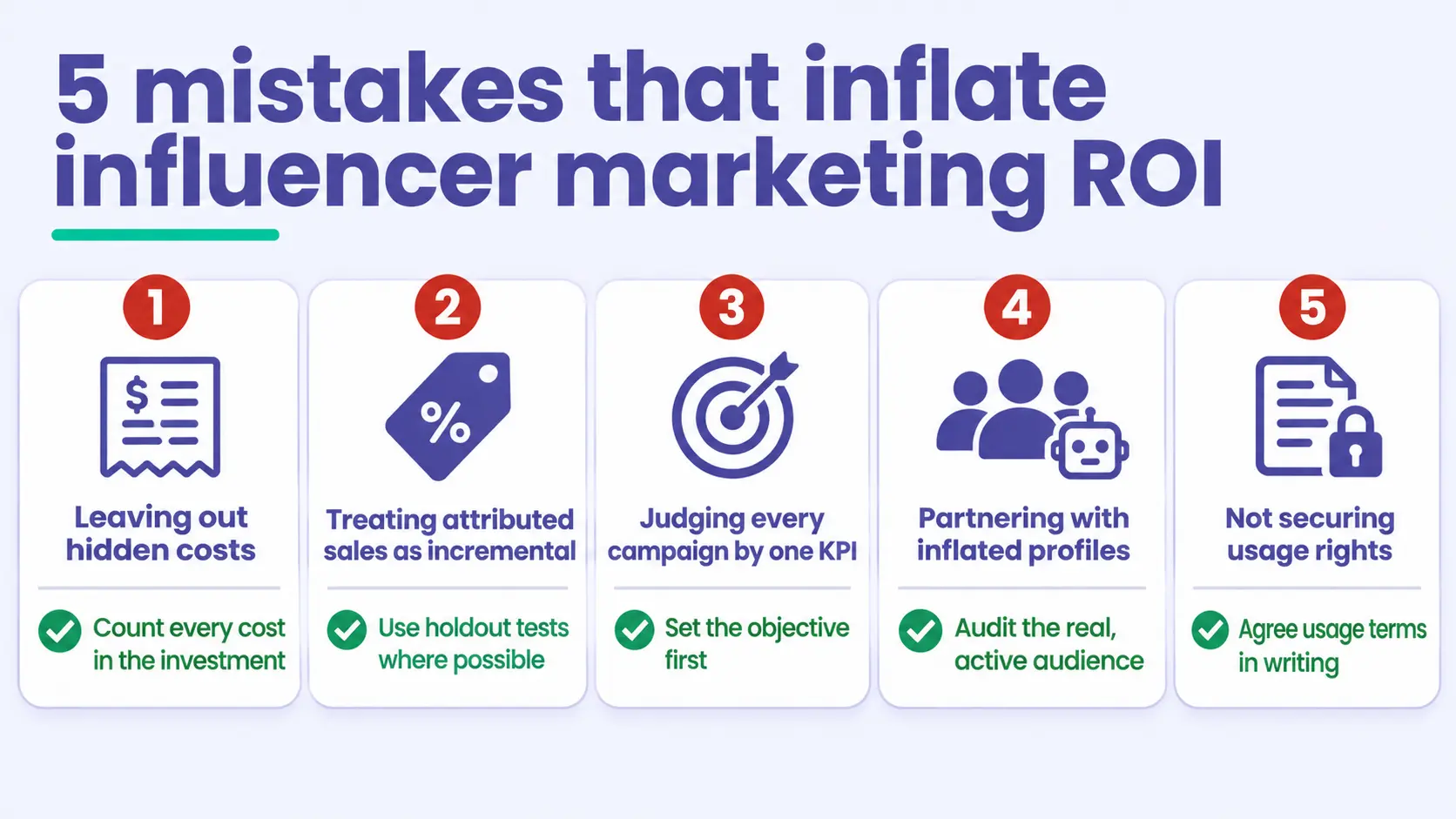
Most inflated ROI figures come from five avoidable errors: missing costs, confusing attribution with causation, using one KPI for every campaign, paying for fake reach, and losing rights to the content.
Start with native platform analytics, UTM links, GA4 and a spreadsheet. Add specialist influencer and affiliate platforms once you understand how the data is collected.
| Tool | Primary use |
|---|---|
| Start here | |
| Instagram Insights | Reach, engagement and content performance |
| YouTube Studio | Views, watch time and audience behaviour |
| Google Analytics 4 | Website traffic, events and conversions |
| Google Campaign URL Builder | Creating UTM-tagged links |
| Your CRM | Lead source, qualification and enrolment tracking for lead-gen campaigns |
| Specialist tools | |
| Shopify Analytics | Ecommerce sales and store performance |
| Modash | Creator discovery and audience credibility checks |
| impact.com | Partnership and affiliate tracking |
| Looker Studio | Performance dashboards |
Employers hire marketers who can connect campaigns to business results, not only publish content. Picture two candidates. One can define engagement rate. The other can plan a creator campaign, build UTM links, read GA4, calculate cost per enrolment and explain why one creator outperformed another. The second candidate can show how the knowledge applies to real work.
If you are preparing for interviews, our influencer marketing interview questions and answers are a useful next step.
Learn this hands-on at IDCM. The Institute of Digital and Content Marketing’s Advanced Diploma in Digital Marketing covers social media and influencer marketing, SEO, Google Ads, analytics and performance measurement, and AI tools for marketing, with live projects, interview preparation and placement support.
Grow Your Digital Marketing SkillsLearn Practical with Expert Instructors |
|
| Advanced Digital Marketing | |
| More Learning Options for you: Diploma Course | Google Ads Certification | Facebook Ads Course |
Influencer marketing ROI is the difference between a campaign that looked successful and one that actually made money. Views, likes and follower growth show that people noticed. Only contribution profit, qualified leads and final conversions show whether the business gained anything.
The method is easy to state and easy to skip. Set the campaign objective before you choose creators. Give every creator their own UTM link and discount code, so results never blur together. Count every cost, from creator fees to shipping and content licensing. Calculate on contribution profit, not revenue, and remember that an attributed sale is not always an incremental one. For lead-generation businesses, follow each creator’s leads all the way to enrolment or purchase, because the cheapest lead is rarely the cheapest customer.
Above all, plan your measurement before the first post goes live. Tracking cannot be added once a campaign ends, and a campaign you cannot measure is one you cannot defend or improve.
Start small. Pick one upcoming creator collaboration, set its objective, build its tracking links, and run the results through the formula in this guide when it ends. Attention only becomes valuable when you can show what it contributed to the business.
Influencer marketing ROI measures the financial return of a creator campaign compared with its total cost. It shows whether the profit the campaign generated justifies the money spent on creators, content, amplification and tracking.
Use ROI (%) = (Campaign contribution profit – Campaign investment) / Campaign investment x 100. Contribution profit is attributed revenue minus variable costs such as product and shipping, calculated before deducting the campaign investment.
Revenue ignores product and fulfilment costs, so it overstates returns. In this guide’s example, the same campaign shows 300% ROI on revenue but 80% on contribution profit. Report revenue-based results as ROAS instead.
There is no universal benchmark. A good ROI depends on your profit margins, campaign objective, product category, acquisition costs and customer lifetime value. Awareness campaigns are judged on different criteria from sales campaigns.
ROI measures profit against the full campaign investment. ROAS measures revenue against ad spend only. A ROAS of 4 means ₹4 of attributed revenue per ₹1 of ad spend; it does not mean ₹3 of profit.
No. Earned Media Value estimates what the exposure would have cost as paid media, using an assumed value per impression. It is not revenue or profit, and calculation methods vary, so it should never be entered into the ROI formula.
Track each creator’s leads through qualification, sales or counselling calls and final conversion in your CRM. Judge creators on cost per final conversion, such as cost per enrolment, rather than cost per lead.
Give each creator a unique UTM link and discount code, send traffic to a dedicated landing page, and read conversions in Google Analytics 4. Cross-check with platform insights and customer surveys, since no single method captures every sale.
ASCI guidelines require a label such as Ad, Sponsored or Collaboration whenever there is a material connection between brand and creator. The Department of Consumer Affairs’ “Endorsement Know-hows!” (January 2023) also require prominent disclosure under the Consumer Protection Act, 2019.
Instagram Insights, YouTube Studio, Google Analytics 4, Google Campaign URL Builder, Shopify Analytics, Modash, Impact.com and Looker Studio. Lead-generation businesses also need a CRM that records lead source through to final conversion.

 }})