
Courses
The Meesho business model is a zero-commission marketplace: sellers pay nothing on a sale and keep their full margin. Meesho instead earns from seller advertising, logistics and shipping margins, float on in-transit payments, and value-added seller services. The strategy is low margin and massive volume: give away the thing competitors charge for, win the supply side, and monetise the services around the sale.
What if starting a business didn’t require a shop, a huge investment, or even a website? What if all you needed was a smartphone and people who trusted you
For millions of people who dream of earning independently, these things can make the difference between having an idea and actually starting something of their own.
Meesho recognised this opportunity.
When traditional business models made it difficult for people with limited capital to enter the market, Meesho introduced a different approach. It allowed individuals, including homemakers and aspiring entrepreneurs, to discover products, share them through WhatsApp and social media, and earn by connecting sellers with potential buyers.
Think about the marketing insight behind this idea. Instead of spending all its energy finding customers through traditional channels, Meesho tapped into something people already had: their personal networks, everyday conversations, and the trust they had built with others.
And that was just the beginning. The Meesho business model, which grew from a social commerce platform into a large value-focused e-commerce marketplace, offers a fascinating lesson in understanding customers, identifying untapped opportunities, and building a business around affordability and accessibility.
At IDCM, we teach a simple idea: the smartest businesses rarely win by spending the most. They win by removing friction that everyone else accepted as normal. Meesho looked at Indian e-commerce, saw two walls that kept ordinary people out- needing capital and needing an audience- and quietly knocked both down. Let us break down how the Meesho business model works, how it actually makes money, and what every aspiring marketer, fresher, and freelancer can learn from it.
Meesho was founded in 2015 in Bangalore by two IIT Delhi graduates, Vidit Aatrey and Sanjeev Barnwal. The name is short for “Meri Shop,” and it reflects who it was built for: people who wanted their own shop without the cost of owning one.
The original Meesho business model was social commerce. It let anyone, especially women at home, pick products from Meesho’s catalogue, share them on WhatsApp, Facebook, and Instagram, and earn a margin on every sale, while Meesho handled sourcing, delivery, and payments. Over the next decade, it became one of India’s largest e-commerce platforms by annual transacting users and placed orders, and a publicly listed company in December 2025. Vidit Aatrey remains its founder and CEO.
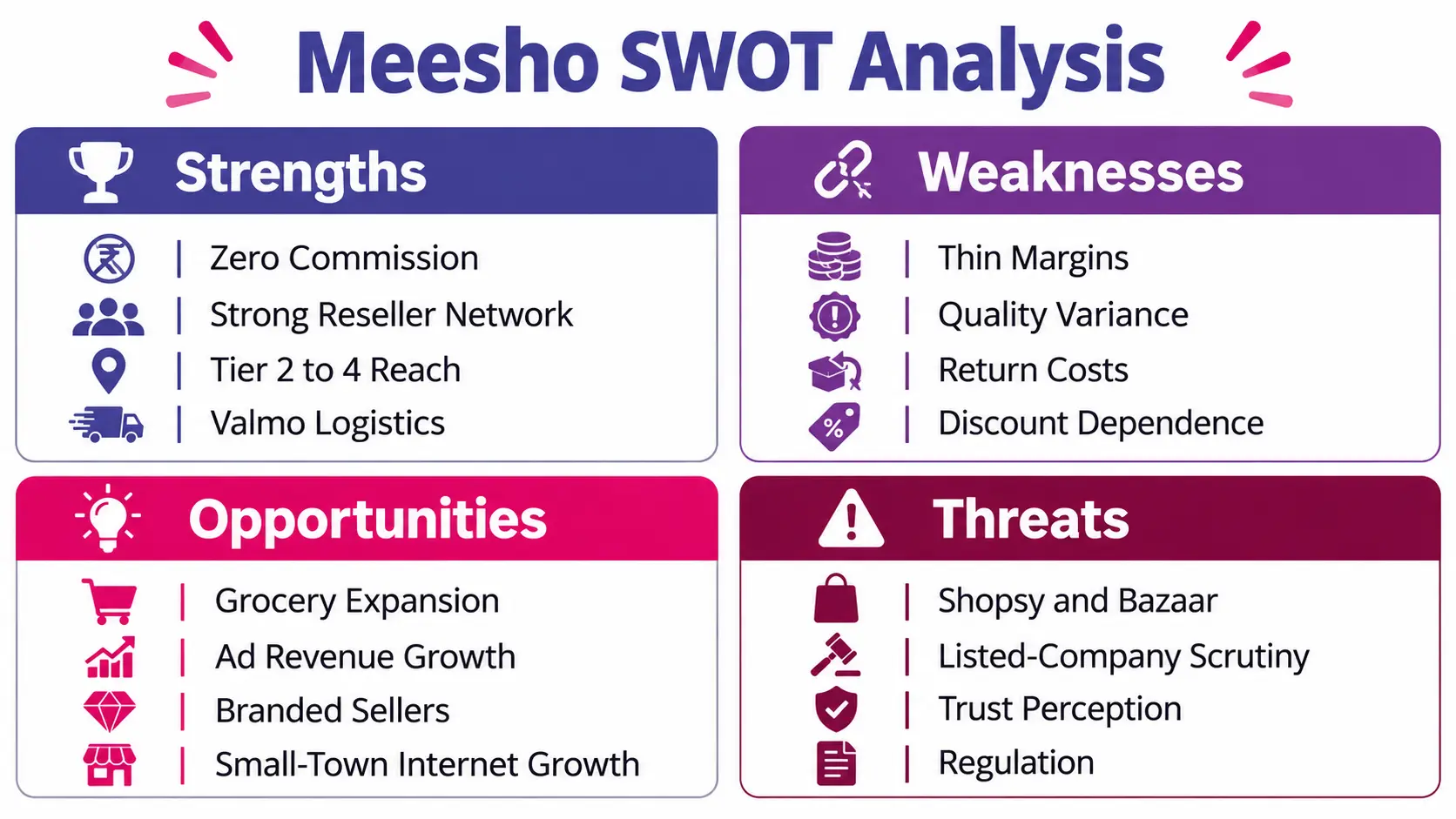
A SWOT analysis (Strengths, Weaknesses, Opportunities, and Threats) is a simple framework for judging where a brand stands. Strengths and weaknesses are internal, the things a company controls. Opportunities and threats are external, the forces in the market around it. Mapping all four is the fastest way to see why the Meesho business model works and where it is exposed.
Meesho has no identical twin, but it competes hard in India’s value-commerce space. Its closest competitors target overlapping audiences, but their business models, seller propositions, and distribution advantages are not exactly the same.
| Factor | Meesho | Flipkart/Shopsy | Amazon Bazaar |
|---|---|---|---|
| Positioning | Value-first social commerce and e-commerce | Hypervalue shopping | Low-price shopping within Amazon |
| Core audience | Price-conscious shoppers, especially in tier 2 to 4 markets | Value-conscious shoppers in smaller cities and towns | Budget shoppers who also value Amazon’s brand trust |
| Seller proposition | Zero commission on sales | Zero-commission positioning | Low-priced marketplace offering |
| Product focus | Unbranded fashion, home, lifestyle and everyday products | Low-cost products across value categories | Unbranded and low-priced products, including sub-₹500 items |
| Distribution advantage | Large value-commerce user base and social-commerce roots | Flipkart’s eKart logistics network | Amazon’s fulfilment and delivery infrastructure |
| Marketing approach | Affordability, social sharing, creators, performance marketing and regional messaging | Hypervalue positioning and Flipkart ecosystem reach | Amazon brand trust, value positioning and marketplace reach |
| Competitive strength | Low prices, seller acquisition and reach into underserved markets | Logistics scale and direct value-segment focus | Established customer trust and fulfilment capabilities |
The key competitive difference is that Meesho’s proposition combines low prices, a seller-friendly commission structure, broad value-commerce categories, and a history of social sharing. Shopsy and Amazon Bazaar compete for similar customers, but they can draw on the logistics and brand infrastructure of their parent platforms.
Grow Your Digital Marketing SkillsLearn Practical with Expert Instructors |
|
| Advanced Digital Marketing | |
| More Learning Options for you: Diploma Course | Google Ads Certification | Facebook Ads Course |
Meesho’s audience is where the whole model makes sense. It is built for value-first, mobile-first India, largely in tier 2, 3, and 4 towns, where price matters more than brand names. These are shoppers buying affordable fashion, home decor, and kitchen utility products, often making their first-ever online purchase.
On the selling side, the audience is just as specific: small manufacturers and MSMEs looking for reach without commission, and resellers—around 70% of them women—looking to earn from home with no capital or stock. Meesho does not try to be everything to everyone. It picked the underserved end of the market and built everything around it.
This is the heart of the case study and the reason the Meesho business model is studied so widely.
Meesho connects suppliers, resellers, customers, and delivery partners through a marketplace. Its original social-commerce model made it possible for individuals to sell products without buying inventory or managing delivery themselves.
How the process works:
Example: A product is listed for ₹299. A reseller shares it with a customer for ₹379. If the customer buys it at that price, the reseller’s potential margin is ₹80, before any applicable adjustments or order-related conditions.
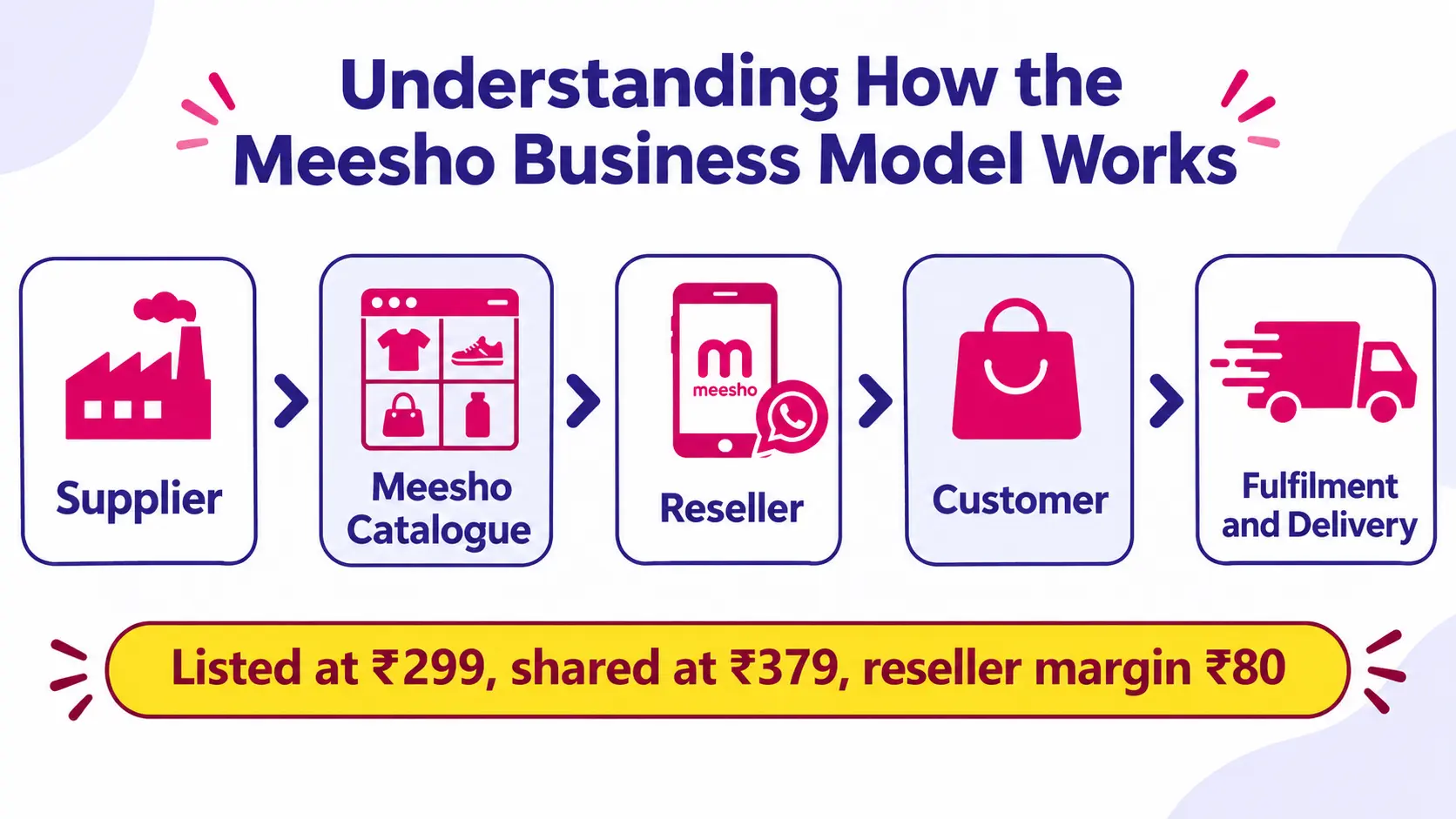 The flow can be understood as:
Supplier → Meesho Catalogue → Reseller → Customer → Fulfilment and Delivery
This model creates value for each participant:
Suppliers list unbranded products at factory prices. A reseller picks a product, adds a margin, and shares it on social media. When a buyer orders, Meesho handles packaging, shipping, payments, and returns, then pays the reseller the margin. Nobody in the chain needs capital, which is why it scaled so fast.
Unlike Amazon and Flipkart, Meesho historically charged sellers no commission on sales. For a first-time digital seller, keeping the full sale price is the single biggest reason to join.
The Meesho business model moves revenue away from the seller’s margin and into streams that reward growth instead of taxing it:
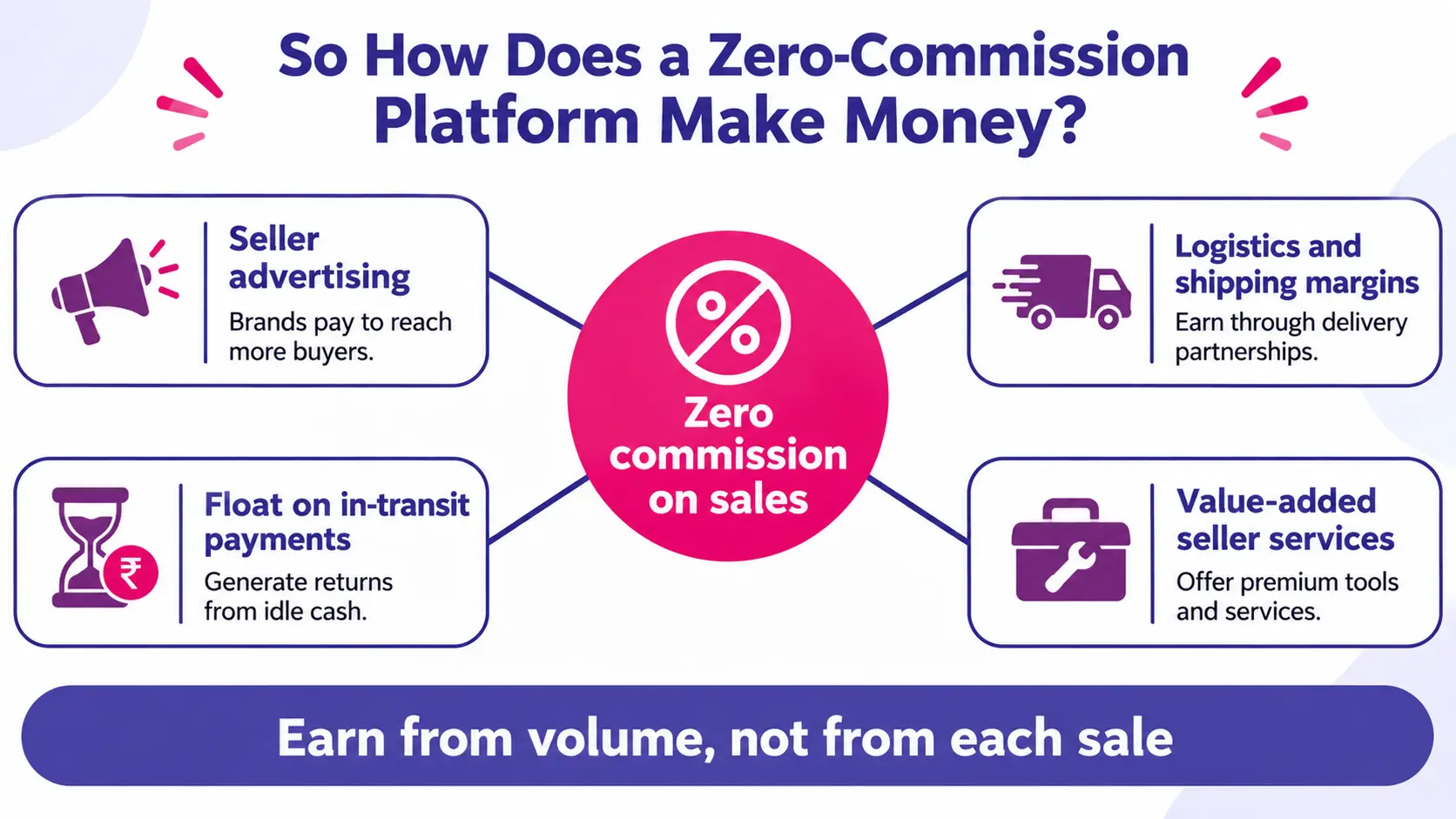
The lesson in one line: Meesho chose to earn from volume rather than to tax each sale. That one design choice let it keep prices low and still build a path to profit.
| Feature | Amazon / Flipkart | Meesho |
|---|---|---|
| Core model | B2C marketplace | Hybrid B2B2C social commerce |
| Seller commission | Charged per sale in many marketplace categories | Zero commission on sales |
| Core audience | Metro and tier-1 first | Tier 2, 3, and 4 India |
| Product focus | Branded, mid to premium | Unbranded, value-first |
| How it earns | Commission, ads, logistics | Ads, logistics, float, services |
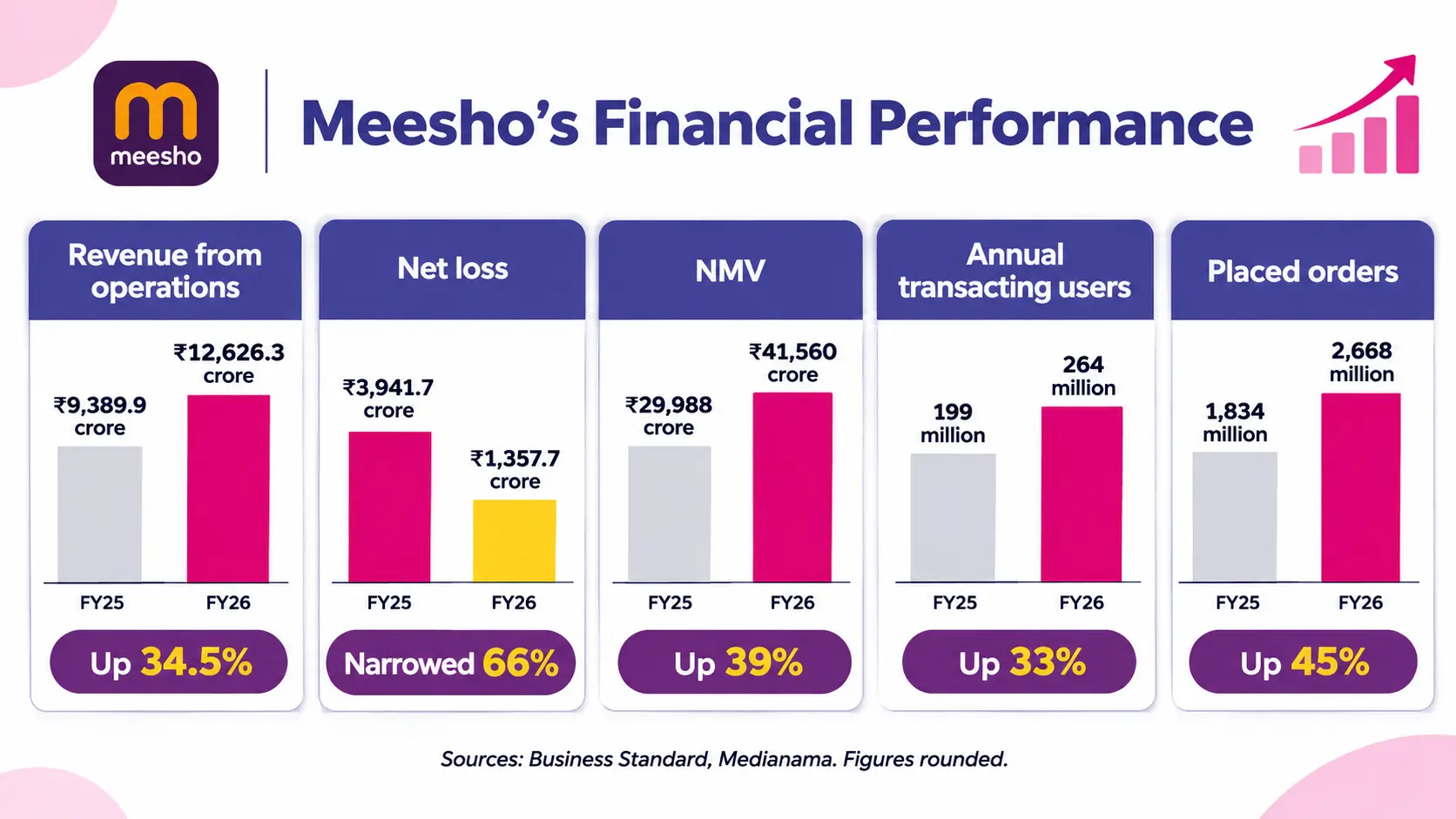
Numbers tell the clearest version of the story. Meesho went public on the NSE and BSE on 10 December 2025, raising roughly ₹5,421 crore, with shares debuting at around a 46% premium over the issue price. (Source: Business Standard.) Its first full year as a scaled platform shows revenue rising fast while losses shrink sharply.
| Metric | FY25 | FY26 | Change |
|---|---|---|---|
| Revenue from operations | ₹9,389.9 crore | ₹12,626.3 crore | Up 34.5% |
| Net loss for the year | ₹3,941.7 crore | ₹1,357.7 crore | Narrowed about 66% |
| Net Merchandise Value (NMV) | ₹29,988 crore | ₹41,560 crore | Up 39% |
| Annual Transacting Users (ATU) | 199 million | 264 million | Up 33% |
| Placed orders | 1,834 million | 2,668 million | Up 45% |
Figures are rounded. NMV measures marketplace transaction value and is not the same as revenue. Sources: Business Standard, Medianama.
The direction matters more than any single number. In Q4 FY26, Meesho’s net loss fell about 88% year on year to roughly ₹166 crore, and management reported an improving contribution margin. (Source: Inc42.) The company is not profitable yet, but it is moving toward it while still growing users and orders at a fast clip. That is the hard part of a value-commerce model, and the FY26 results suggest Meesho is managing it.
Meesho’s digital marketing is unusually disciplined for a company its size. Instead of outspending Amazon and Flipkart, it built a growth machine around organic search at scale, a reseller network that markets for free, performance ads measured to the rupee, and an AI recommendation engine that quietly does most of the selling. Here is how each piece works, with the numbers behind it.
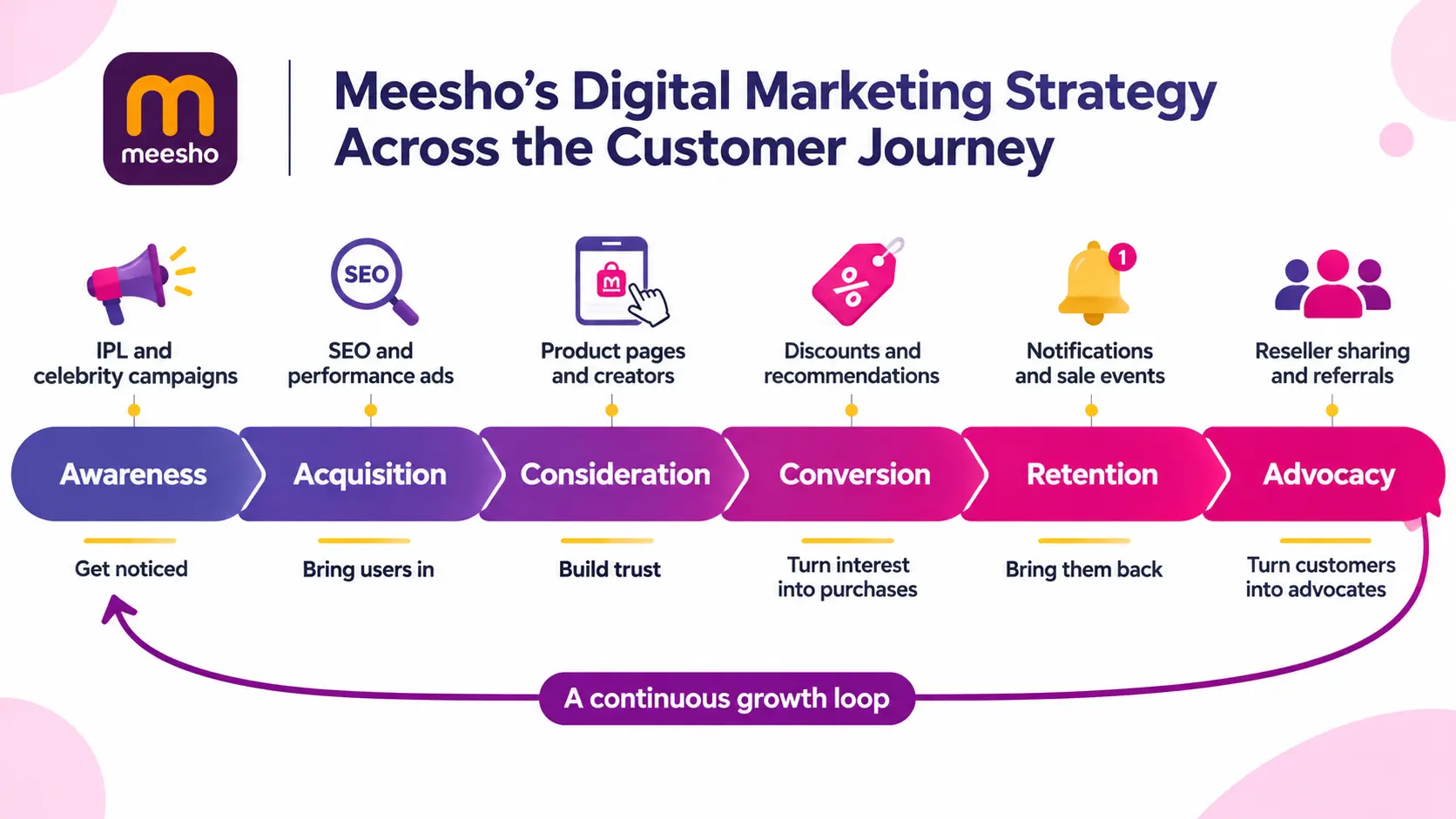
Meesho’s marketing channels work together across the customer journey. Search helps shoppers discover products, social sharing and creators build awareness, performance campaigns bring users into the app, and recommendations encourage conversion and repeat purchases.
| Customer journey stage | Meesho’s marketing activity | Role in growth |
|---|---|---|
| Awareness | Mass-media campaigns, IPL sponsorships, celebrity campaigns, creators and social content | Introduces Meesho to new audiences and builds brand recall |
| Acquisition | SEO, paid performance campaigns, app-install marketing and reseller sharing | Brings new shoppers and sellers to the platform |
| Consideration | Product pages, reviews, social content, creator demonstrations and value messaging | Helps users compare products and assess value |
| Conversion | Discounts, low-price positioning, personalised recommendations and app experience | Encourages users to complete an order |
| Retention | Recommendations, repeat-purchase prompts, app notifications and sale events | Encourages users to return and shop again |
| Advocacy | Reseller sharing, referrals, creator content and customer-generated recommendations | Turns users into a source of reach and new customers |
The strength of this approach is the connection between channels. Meesho does not rely on one campaign to do everything. It combines brand awareness, measurable acquisition, marketplace discovery, and social sharing to support growth.
For a marketplace with a near-infinite catalogue, search is the cheapest customer it can buy. Meesho leans into this hard.
Meesho did not start on social media. It started as social media commerce, and that DNA still drives both its organic reach and the Meesho business model itself.
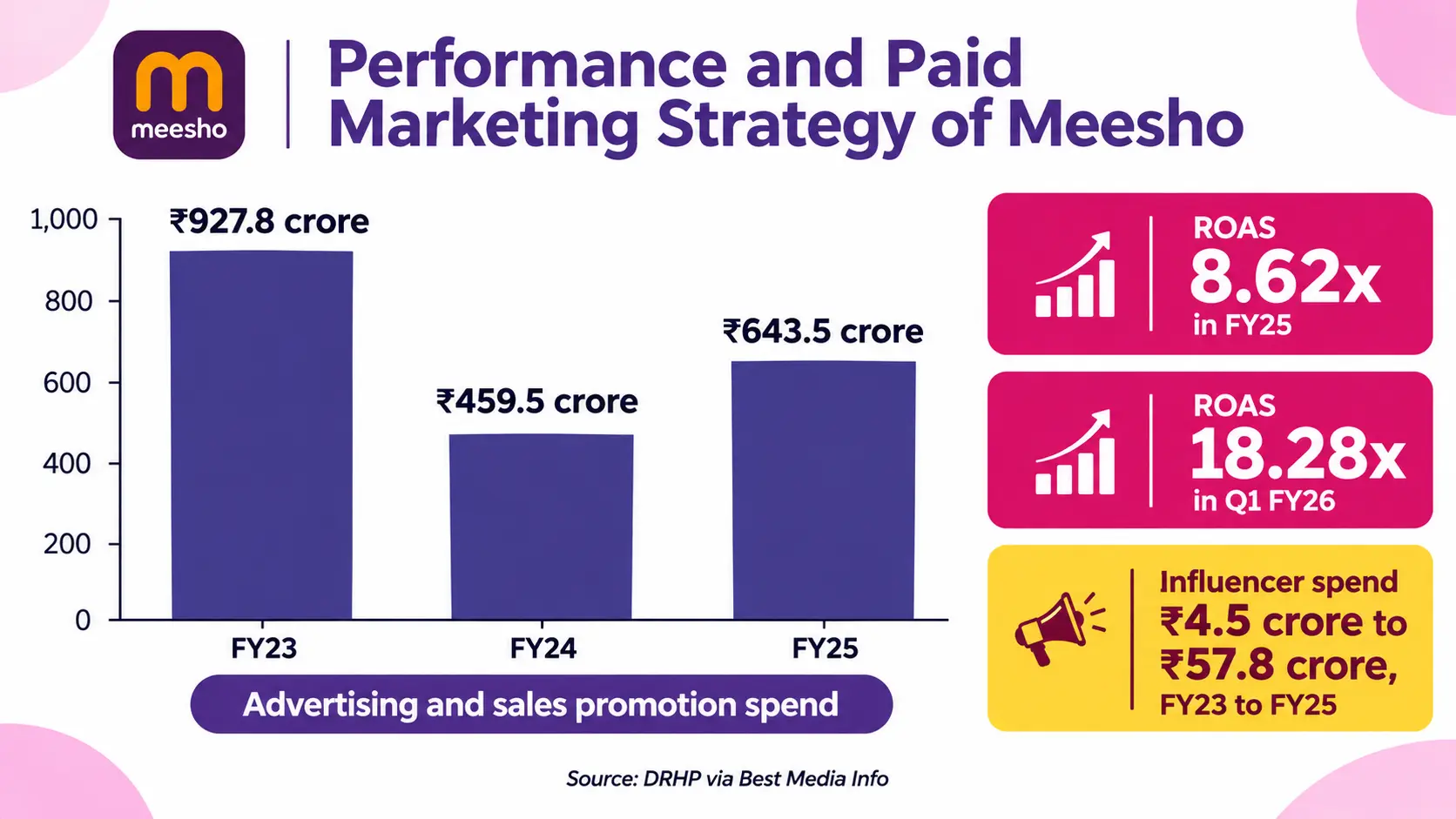
This is where Meesho’s discipline shows, and the numbers come straight from its SEBI filing (DRHP), the most credible source available.
Meesho’s campaigns show how a brand can use broad-reach media to build awareness and then connect that attention to shopping events and app activity.
| Campaign | Main objective | Execution | Marketing takeaway |
|---|---|---|---|
| IPL 2022 campaign | Expand awareness beyond Meesho’s existing audience, including men | Broadcast sponsorship and partnerships with four IPL teams | A large media platform can increase reach, but campaign success should be measured against the intended audience and business outcome |
| Mega Blockbuster Sale | Build excitement and drive shopping during a major sale event | Movie-launch-style posters, teasers, celebrity-led creative and PR | A sale can be positioned as an event, using anticipation and storytelling rather than only discount messages |
| “Aise Kaise?” campaign (2024) | Strengthen the sale-event identity and encourage participation | Campaign creative linked to the Mega Blockbuster Sale | A memorable phrase and consistent campaign identity can help make a promotion easier to recognise and recall |
The broader lesson is that mass media is not separate from performance marketing. Awareness campaigns create familiarity, while sale events, app experiences, product recommendations, and performance campaigns help convert that attention into orders.
Build the Skills That Power Platforms Like Meesho |
|
| Advanced Diploma in Digital Marketing | |
| More learning options: Digital Marketing Certification | Google Ads Certification | Facebook Ads Course |
No honest case study ends with applause. A few documented challenges a serious student should study:
In late 2024, Meesho (alongside Flipkart) faced sharp criticism after T-shirts featuring jailed gangster Lawrence Bishnoi appeared on the platform, including in children’s sizes. After a social media backlash, Meesho removed the listing. The lesson: on a marketplace with millions of third-party listings, brand safety is a constant operational challenge, not a one-time check.
India’s consumer protection regulator, the CCPA, penalised Meesho over misleading advertisements and unfair trade practices tied to the sale of restricted items such as walkie-talkies. It is a reminder that marketplace scale brings compliance obligations that regulators now actively enforce. (Source: Medianama.)
Meesho has faced repeated seller discontent over changes to its return and compensation policy, with some sellers leaving negative reviews, pausing orders, and in at least one reported case sending a legal notice. The root cause is structural: reverse logistics is expensive, and in a zero-commission model the tension over who absorbs return costs is never fully resolved. (Source: Inc42.)
Because sellers compete almost entirely on price, product quality varies widely between orders. Consumer complaints about items not matching listing photos, sizing inconsistency, and returns friction are common. This is less a single scandal and more the honest cost of a rock-bottom price point, and it is the trust gap Meesho has to keep closing.
Meesho’s growth offers lessons that apply beyond e-commerce. The central idea is to understand what prevents a customer or seller from participating, then design the business and marketing strategy around removing that barrier.
Meesho focused on price-conscious shoppers and small sellers who were not being served well by traditional e-commerce models. Instead of competing only for metro customers, it built for smaller cities and towns.
Lesson: Look for an audience whose needs are not being met by the market. A clear understanding of that audience can be more valuable than trying to appeal to everyone.
Meesho reduced the barriers to starting an online business by removing the need for inventory, upfront capital, and independent delivery arrangements.
Lesson: Identify the steps that stop people from buying, selling, signing up, or using a service. Simplifying those steps can become a strong competitive advantage.
The reseller model encouraged people to share products through their own social networks. This made product discovery part of the business model rather than only a marketing expense.
Lesson: Referral, sharing, and community mechanics work best when they provide real value to the person sharing—not just a request to promote a brand.
Meesho’s performance marketing strategy focuses on measurable acquisition and conversion outcomes. Large campaigns are useful, but they need to be evaluated against the audience and business objectives they were designed to achieve.
Lesson: Track metrics such as customer acquisition cost, conversion rate, repeat purchases, revenue, and return on ad spend alongside impressions and engagement.
Meesho’s affordability-led messaging and regional, women-centric storytelling reflect the needs and contexts of its audience.
Lesson: Localisation is more than translating copy. It means understanding the audience’s language, priorities, buying behaviour, and cultural context.
Meesho uses mass-media campaigns to build awareness and performance campaigns to drive measurable action. Sale events and app experiences connect the two.
Lesson: Brand campaigns and performance campaigns should support one another. Short-term conversions matter, but brand familiarity can also improve the efficiency of future acquisition.
Low prices can attract customers, but product quality, reliable delivery, transparent listings, and fair return processes help keep them.
Lesson: A value proposition should not stop at affordability. Trust and consistency are essential for repeat business.
The Meesho business model is a masterclass in doing less to achieve more. By removing inventory, removing commission, and turning ordinary people into a marketing force, Meesho unlocked a market the giants had underestimated. Its 2025 listing and its FY26 results, revenue up by about a third while losses fell by two-thirds show the model can turn scale into real financial progress. At the same time, thin margins, quality perception, and sharpening competition are reminders that a great model still has to be executed relentlessly, every single day.
For a student, fresher, or freelancer reading this, the takeaway is not “go build the next Meesho.” It is simpler. Great marketing is rarely about a bigger budget. It is about a sharper insight into who is being left out, and the courage to build for them.
So here is the question to sit with: in your next project, what is the one wall everyone accepts as normal that you could quietly knock down?
Meesho runs a social commerce marketplace. Suppliers list products, resellers share them for a margin, buyers order, and Meesho handles delivery and payments, with no commission charged to sellers.
Mainly through seller advertising, logistics and shipping margins, float money, and value-added seller services, rather than sales commission.
Flipkart’s Shopsy and Amazon’s Bazaar are its most direct rivals, with DealShare, CityMall, and newer entrants like Swiggy Bazaar competing in parts of the value-commerce space.
The model lets anyone earn from home with just a phone and a contact list, no capital or stock required, which made it especially accessible for homemakers and women entrepreneurs.
Meesho listed on the NSE and BSE on 10 December 2025, raising roughly ₹5,421 crore, with shares debuting at around a 46% premium over the issue price.
Not yet, but it is getting closer. Meesho’s FY26 consolidated net loss narrowed to about ₹1,357.7 crore from ₹3,941.7 crore in FY25, and its Q4 FY26 loss fell about 88% year on year, while revenue grew 34.5% to ₹12,626 crore.
Build referral growth into the product, optimise for business metrics over vanity metrics, target underserved markets, and use vernacular, mobile-first creative.

 }})