
Courses
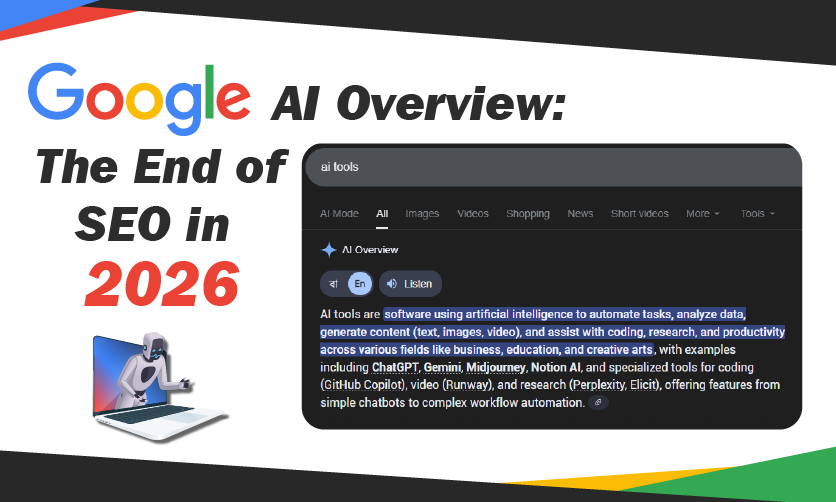
Search is no longer just about blue links. If you have Googled something recently, you have likely seen it: a shaded box at the very top of the results, offering a complete, conversational answer before you even scroll.
This is the Google AI Overview, and it is the single biggest shift in SEO since the invention of the keyword.
For marketers and business owners, this technology presents a dual reality: it is a massive opportunity to build authority, but a significant threat to traditional website traffic. If you want to stay visible in 2026, you cannot ignore it. Here is everything you need to know about Google AI Overviews, how they impact your traffic, and how to optimize your content to rank inside them.
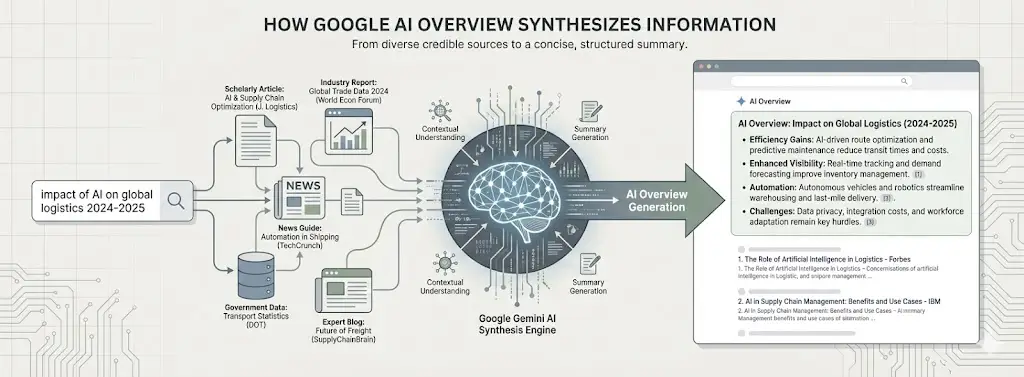
Google AI Overview is a search feature that uses generative AI (powered by Google’s Gemini models) to synthesize information from multiple web sources into a single, cohesive answer.
Unlike traditional search results that require users to click different links to gather information, the AI Overview does the heavy lifting. It reads the top-ranking pages, extracts the key facts, and writes a unique summary directly on the search results page.
It appears for:
The introduction of AI Overviews has accelerated a trend known as Zero Click Search.
A Zero Click Search happens when a user’s query is answered directly on the Google results page, meaning they never click through to a website. According to recent industry data, informational queries are seeing a drop in organic click-through rates (CTR) as AI provides instant satisfaction.

What this means for you:
Improve Your Digital Marketing SkillsMaster New Skills Through Hands-On Mentorship |
|
| Advanced Diploma in Digital Marketing | |
| More Learning Options for you: Google Ads Certification | Certificate in Digital Marketing | Diploma in Digital Marketing |
Ranking in an AI Overview requires a different approach than traditional SEO. This new discipline is often called Generative Engine Optimization (GEO).
The AI wants to be confident that it is giving the correct answer. To rank here, your content must be structured so clearly that a machine can easily parse and verify it.
Focus on questions that require a specific, structured answer. The AI loves “How-to” guides, “Best of” lists, and comparisons.
AI models rely on structure to understand relationships between ideas.
Experience, Expertise, Authoritativeness, and Trustworthiness (E-E-A-T) are critical. The AI cites sources it trusts. Ensure your content includes unique insights, expert quotes, or original data that generic AI content cannot replicate.
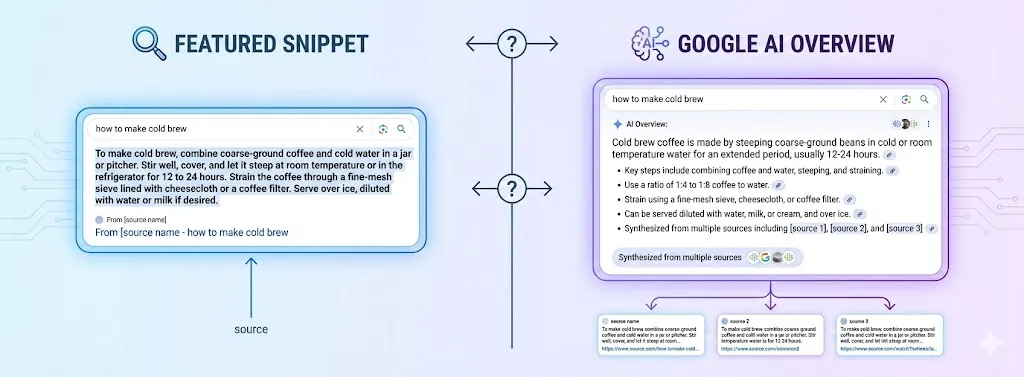
Many people confuse AI Overviews with Featured Snippets (Position 0). While they both appear at the top, they are fundamentally different.
| Feature | Featured Snippet | Google AI Overview |
|---|---|---|
| Source | Pulls a direct excerpt from onesingle web page. | Synthesizes information from multiple sources. |
| Format | Usually a paragraph or list copied word-for-word. | A unique, AI-generated summary written in natural language. |
| Goal | To answer a specific, factual question quickly. | To answer complex, open-ended, or multi-part questions. |
| Traffic | High click-through rate to the source. | Lower click-through rate (Zero Click), but higher brand authority. |
Few related topics for your knowledge
Google AI Overview is not a trend; it is the new interface of the internet. While it might reduce traffic for simple keywords, it opens a massive door for creators who focus on deep, high value content.
If you can answer questions better, clearer, and deeper than the AI can summarize, you will not just survive this shift, you will thrive in it. Start optimizing your content for the answer engine today.
Currently, Google does not offer a permanent “off” switch for AI Overviews in the standard search interface, as it is considered a core feature of the search experience. However, users can sometimes bypass it by using the “Web” filter tab at the top of the search results, which forces Google to show only text-based links without AI summaries or other rich snippets.
Ranking in AI Overviews requires Generative Engine Optimization (GEO). Unlike traditional SEO which focuses on keywords, GEO focuses on structured data and direct answers. To increase your chances, format your content with clear headings, bullet points, and data tables. Ensure your content directly answers specific questions (e.g., “What is X?”, “How to do Y”) in the first few sentences of your paragraphs.
AI Overviews will likely reduce traffic for simple, informational queries (like definitions or quick facts) because users get the answer instantly. This phenomenon is called “Zero Click Search.” However, it is unlikely to “kill” SEO entirely. Instead, it shifts the focus to complex, experience-based content. Users seeking deep analysis, personal reviews, or specific services will still click through to websites.
Not exactly. Google Gemini is the underlying Large Language Model (LLM), the “brain”—that powers the AI. Google AI Overview is the specific feature or “product” you see on the search results page. Think of Gemini as the engine, and AI Overview as the car that uses that engine to drive you to an answer

 }})