
Courses

Digital marketing for construction companies has changed how builders, contractors, architects, real-estate businesses, and infrastructure firms win work. Referrals, hoardings, and brokers no longer bring these companies enough customers on their own. Buyers research online before they call. Digital marketing helps builders, contractors, architects, real-estate businesses, and infrastructure firms get found online and turn that visibility into enquiries.
For anyone who has finished Class 12, graduated, or wants to switch careers, that shift opens a door. You can learn digital marketing and apply it to a specific industry like construction.
Digital marketing for construction companies means using online channels to attract buyers, generate enquiries, build trust, and promote construction services. Those channels include SEO, Google Ads, social media, content marketing, email, websites, online reviews, analytics, and local search.
Good construction marketing connects a company’s online presence to a business result: enquiries, site visits, consultations, or project opportunities. Construction services are high-value, and buyers research heavily before deciding, giving marketers many ways to reach them.
A construction company needs visibility before it can get enquiries. A buyer wants to know who the company is, what it builds, where it works, and why to trust it.
A firm can have strong engineers, good projects, and years of experience. If a buyer can’t find credible information online, none of that shows.
Google says its systems favour helpful, reliable, people-first content over content built to game rankings. For a construction company, that means writing pages a buyer can actually use.
Construction buying takes time, and searches are tied to place. A buyer might search for:
The search depends on the project and how close the buyer is to deciding. Each query is a chance to reach someone through search, maps, video, or content.
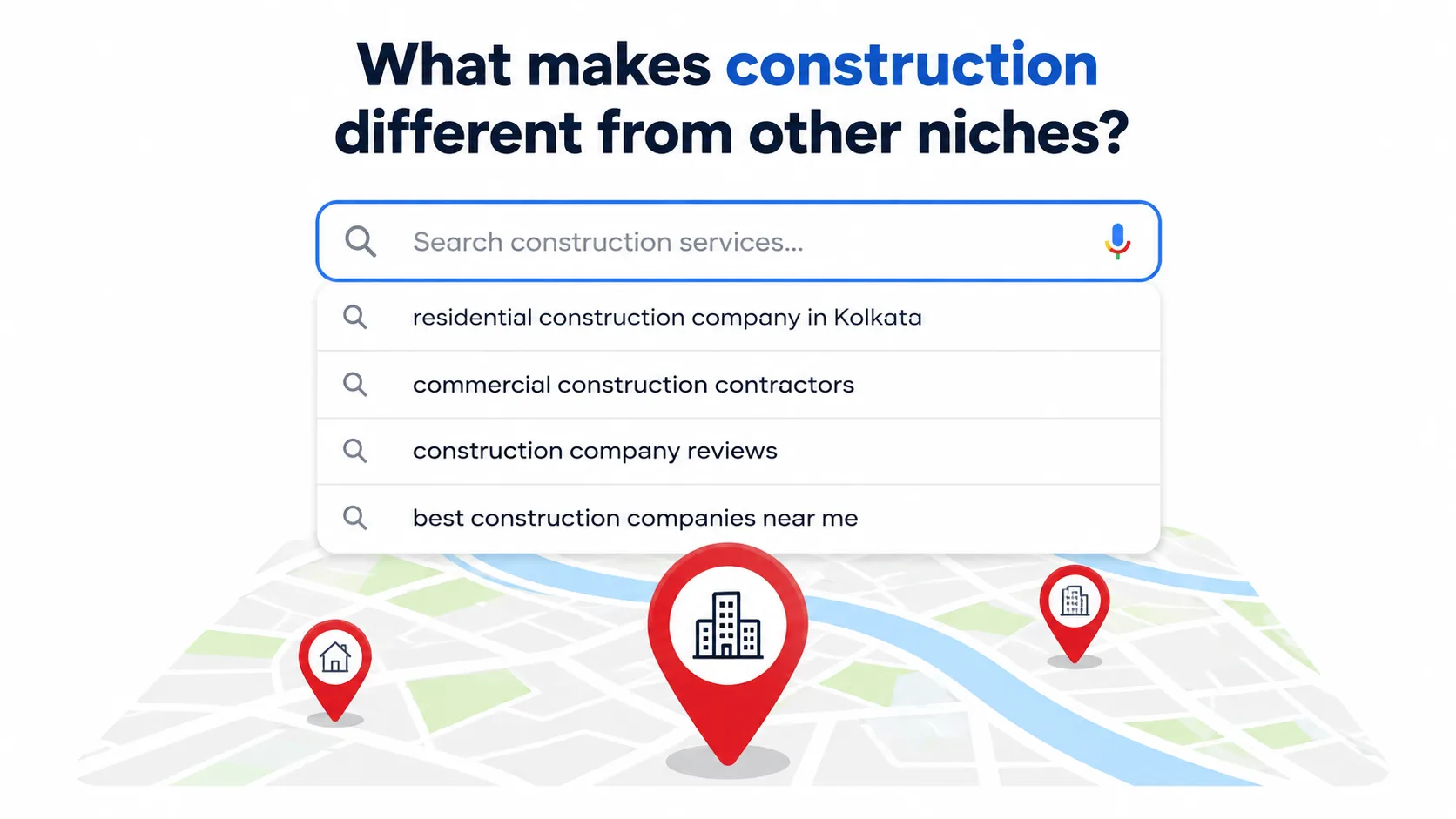
SEO puts a company in front of people already searching for its services, without paying per click. A construction firm can build pages around residential construction, commercial construction, industrial projects, renovation, interior construction, turnkey projects, civil contracting, and infrastructure work.
Service pages are only the start. A site can also answer buyer questions: how much it costs to build a house, how long construction takes, and what to check before hiring a contractor. That content reaches people earlier, before they’ve built a shortlist.
Google’s SEO guidance recommends helpful, people-first content that uses the words people actually search for.
Construction work is local, so local SEO carries weight. Google says local results depend mainly on relevance, distance, and prominence, and that complete, accurate business information helps a company show up. A verified Google Business Profile can display a company’s location or service area, website, phone number, photos, and reviews across Search and Maps.
For a marketer, that means real work: Google Business Profile optimisation, local keyword research, review and reputation management, local landing pages, business citations, location content, and reporting through Search Console and analytics. That is a real skill set.
Google Ads reaches people when they search. If someone searches “home construction company in Kolkata,” a firm can appear right then. Google also runs local ads through Maps and its wider network for businesses with a location or service area.
Good paid marketing takes more than a boost button. A marketer handles keyword research, search intent, campaign structure, audience targeting, ad copy, landing pages, conversion tracking, cost per lead, lead quality, and ongoing optimisation. This is the core of performance marketing.
Yes, when it shows the company’s expertise. Construction is visual. Before-and-after transformations, project walkthroughs, design concepts, progress updates, completed work, safety practices, materials, and customer stories all make good content.
Instagram suits visual projects. LinkedIn suits B2B work: professional branding, hiring, and industry conversation. The audience changes with the service. A residential builder speaks to homeowners. A commercial contractor speaks to developers, procurement teams, and architects.
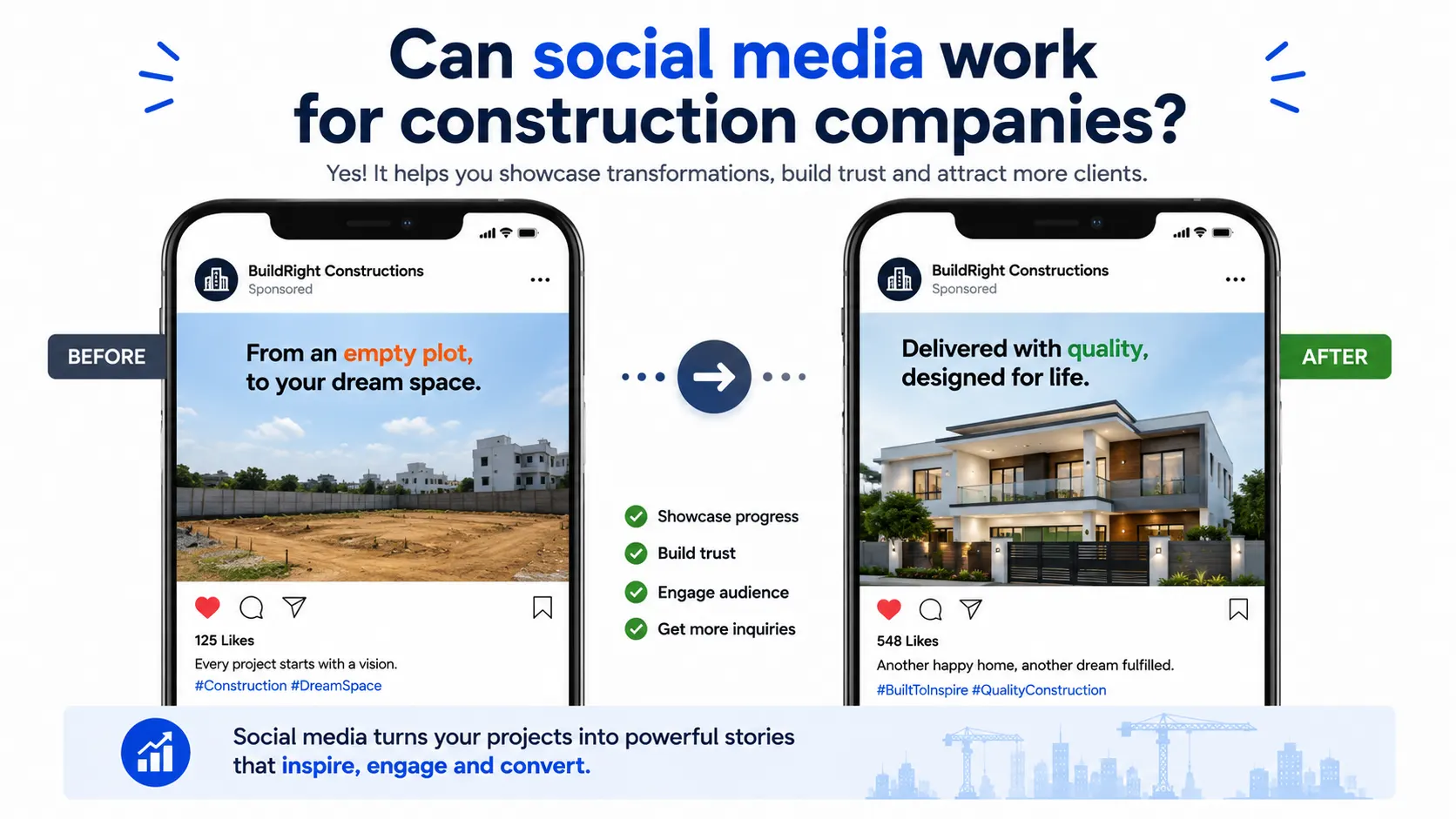
Content that answers buyer questions and proves the company knows its work.
Google encourages content that gives real value, shows expertise, and gives readers enough to act.
Analytics tells a company whether marketing is working. Traffic alone means little. Hence, a site can get thousands of visits and few serious enquiries, while another gets fewer visits and better leads.
A marketer tracks organic traffic, search queries, conversion rate, leads, cost per lead, ad performance, landing-page performance, calls and enquiry forms, engagement, and results by location. Google Analytics and Search Console show traffic, visibility, and behaviour. The useful questions are why people visited, what they did, and whether the business gained anything.
Yes, because the sector is large, varied, and local. According to Statista, India’s construction sector contributed about ₹15.28 trillion to GDP in 2024 and employed more than 70 million people as of 2023. (Statista) Another Statista survey found construction leaders adopting digital methods across cost estimation, prediction, planning, and project control. (Statista)
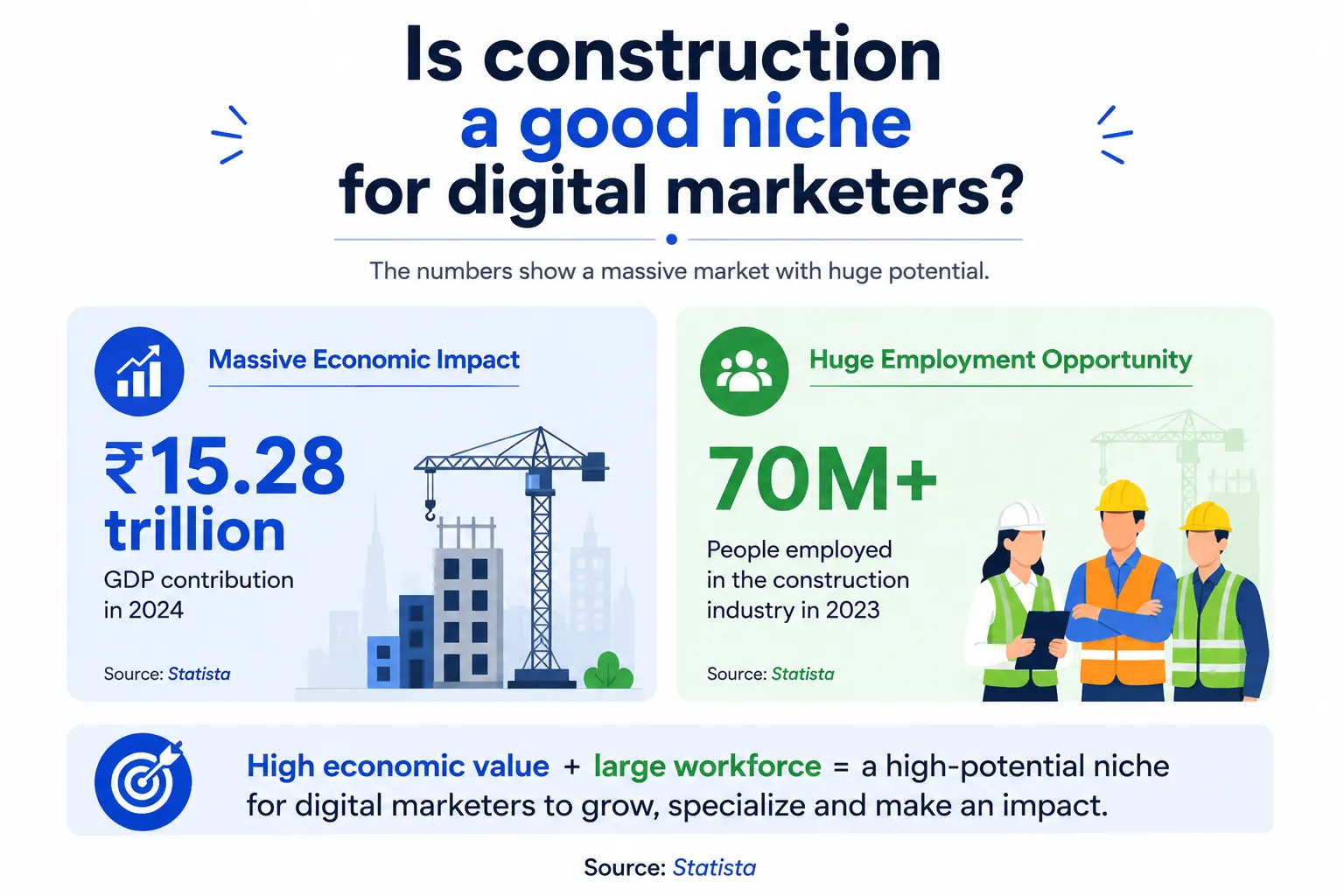 Construction is a large market: builders, contractors, architects, material suppliers, real-estate companies, engineering and interior firms, infrastructure companies, and the services around them. Each has different marketing needs. That mix of scale and locality is what makes digital marketing for construction companies a practical specialisation for a new marketer.
You don’t need a civil engineering degree. You need solid digital marketing fundamentals and enough industry knowledge to write accurately.
Google’s guidance on AI search asks for unique, useful, reliable content rather than mass-produced pages chasing traffic.
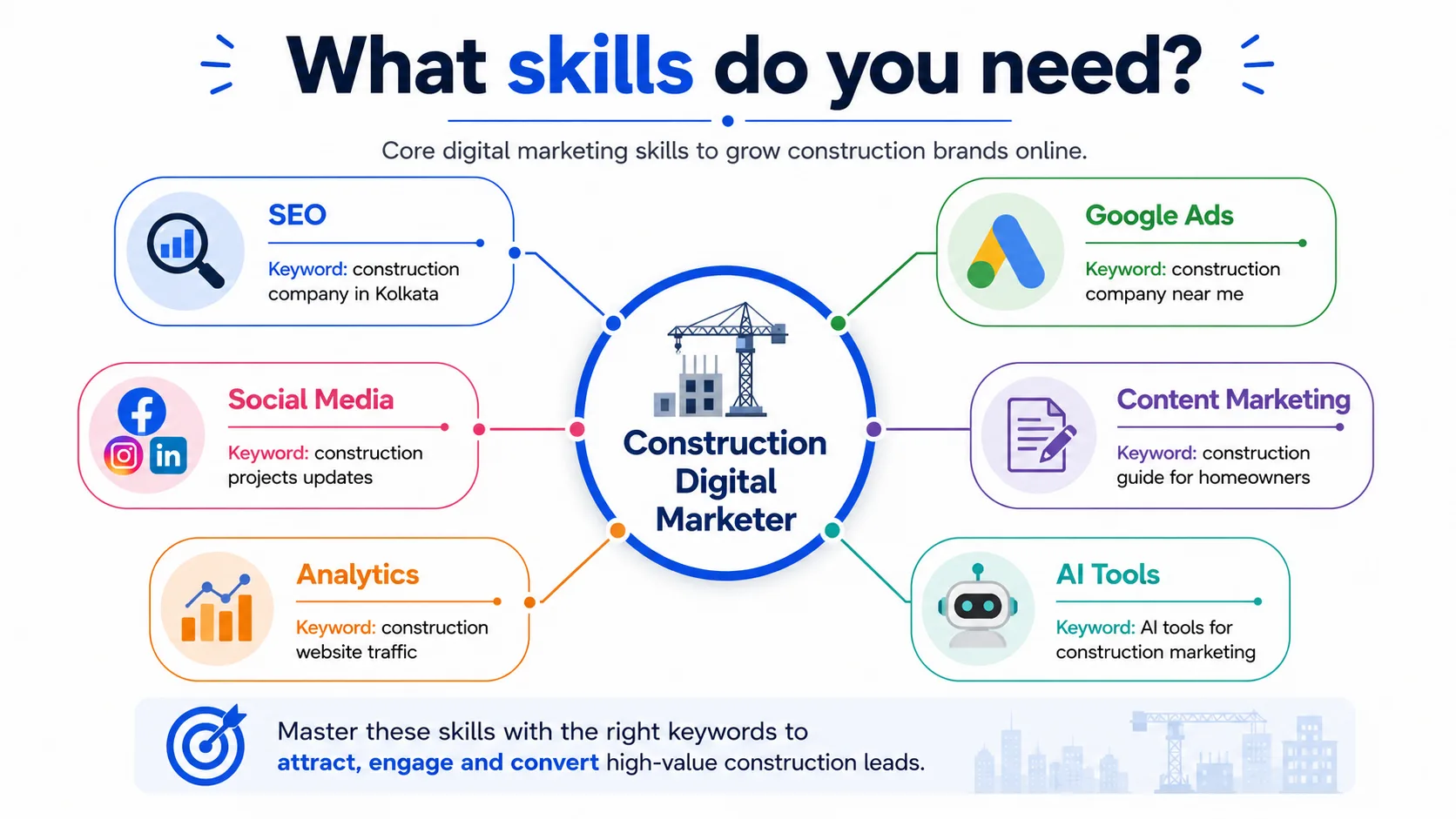
Yes. You can begin without an engineering or marketing degree. The gap to close is between knowing digital marketing and being job-ready for it. Free videos cover the concepts. Getting hired takes repeated practice: real projects, campaign exercises, analytics, content, and reporting.
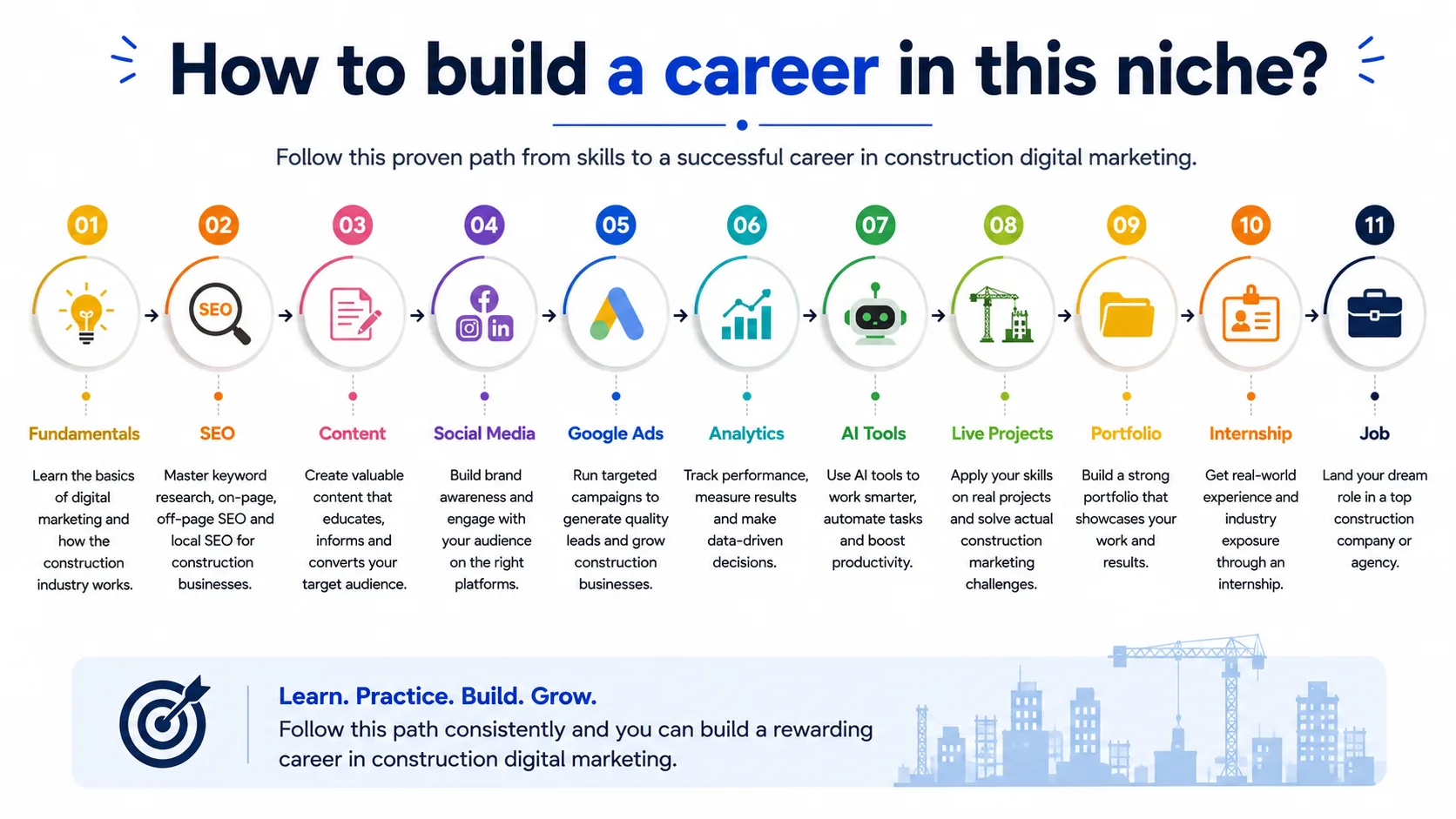
A workable path after Class 12: fundamentals, SEO, content, social media, Google Ads, analytics, AI tools, live projects, portfolio, internship, job. Graduates can follow the same path and use their degree as an edge. Career changers can lean on transferable skills and build practical projects that show what they can do.
Learn digital marketing broadly, then specialise in construction through real projects. Build a mock campaign for a residential construction firm: research keywords like “house construction company,” draft a content plan, plan a Google Business Profile, write a landing page, set up Google Ads campaigns, and build a simple reporting dashboard.
That gives you proof you understand marketing, which is worth more than a certificate alone, and a project to talk through in interviews.
Institute of Digital and Content Marketing’s digital marketing programs currently cover SEO, PPC, social media, content, analytics, and AI. Its 3-month Certificate in Digital Marketing is a short-term program, and the institute also offers 6-month Diploma and 9-month Advanced Diploma in Digital Marketing options.
Digital marketing skills open several roles: SEO Executive, Digital Marketing Executive, Performance Marketing Analyst, Social Media Specialist, Content Marketing Executive, Digital Marketing Analyst, PPC Executive, Brand Associate, and Content Creator. These sit inside construction firms, real-estate businesses, agencies, startups, and companies serving the sector. The niche is your specialisation, and the skills transfer beyond it.
Digital marketing for construction companies now runs on digital discovery, local search, online reputation, paid ads, content, and data. That makes it a strong niche for a new marketer.
You can also apply these skills to any business that needs customers: a construction firm, a dental clinic, an educational institute, a restaurant, a hotel, or a local service. The job stays the same: understand the buyer, pick the right channels, write useful content, measure results, and improve.
You don’t need to know everything on day one. Learn the fundamentals, practice them on real problems, build proof, and keep improving. Construction can be your first specialisation, and your career can grow well beyond the site.
Digital marketing for construction companies is a practical place to start a career because the work is concrete. You can see whether a Google Business Profile got more calls, whether a landing page turned visits into enquiries, and whether an ad brought leads at a workable cost. That feedback teaches faster than theory.
The sector is large and local, so there’s steady demand for people who can run local SEO, Google Ads, and content. You don’t need an engineering background. You need the fundamentals and enough industry knowledge to target and write accurately. The same skills transfer to any local or high-value business: a dental clinic, a hotel, an educational institute, a manufacturer.
If you want to test the fit, build one project. Pick a real construction firm in your city, audit its online presence, and draft a 90-day plan covering local SEO, a Google Business Profile, and a small Google Ads test. That project tells you more about the career than any course description, and it gives you something to show in an interview.
No. You need digital marketing skills and enough industry knowledge to write and target accurately. You pick up the terms as you go: the services, the buyer types, the usual project stages. Marketers who can turn technical detail into clear pages are useful to construction firms without holding a civil degree.
Often, yes. Employers hiring for SEO, PPC, or social roles care most about whether you can do the work. In a junior interview, a portfolio with a real project, campaign results, and a reporting sample counts for more than a certificate alone. A degree helps in some companies, but it isn’t the deciding factor for many entry roles.
It depends on your pace and how much you practice. The concepts across SEO, ads, content, and analytics take a few weeks to grasp. Getting job-ready usually takes a few months of building real projects, running small campaigns, and reading the data. Structured programs run from 3 to 9 months and add live projects and mentoring.
There’s no single best channel. Local SEO and a verified Google Business Profile capture buyers searching nearby. Moreover, Google Ads reaches people when they search. Social platforms show project work and build trust. Most firms use a few together and measure which brings the best leads for the cost.
Paid ads can bring enquiries within days once campaigns and tracking are set up. SEO and content usually take a few months to move rankings and traffic. Thus, a realistic plan runs paid ads for quick leads while SEO builds over time.
It has steady demand, since most businesses need online visibility and marketing they can measure. The work suits people who like a mix of creative and analytical tasks. Pay and growth depend on your skills, your city, and the roles you take, so results vary from person to person.

 }})