
Digital Marketing for Solar Companies: A Practical Career Guide
Digital marketing for solar comapnies is getting prominece as India’s solar market is expanding quickly. It is also creating opportunities not only for solar companies but also for digital marketers. As more homeowners and businesses research solar panels, installation costs, subsidies, savings and local installers online, visibility on search engines can directly influence who receives the enquiry.
For an aspiring digital marketer, this makes the solar industry an excellent real-world example. The same skills used to market a solar business- SEO, Google Ads, Meta Ads, content marketing, analytics and lead nurturing are transferable skills that can be applied across many industries.
Table of Contents
- What Is Digital Marketing for Solar Panels?
- Why do Solar Companies Need Digital Marketing?
- Digital Marketing Channels for Solar Companies
- How to Build a Solar Lead Generation Strategy?
- A Simple Solar Digital Marketing Funnel
- Which Digital Marketing Skills Are Valuable in the Solar Industry?
- How Can You Build a Career in Digital Marketing in Solar Businesses?
- Final Takeaway
- Frequently Asked Questions
What Is Digital Marketing for Solar Panels?
Digital marketing for solar companies is the use of online channels such as search engine optimisation, Google Ads, social media, content marketing, email, WhatsApp and CRM-based follow-up to attract people interested in solar products or installation services and turn that interest into qualified enquiries.
The process is not simply about posting on social media. It starts by understanding what potential customers search for, matching content and advertising to their intent, capturing enquiries and then nurturing those leads until they are ready to make a decision.
For digital marketing students, this is an important lesson: effective marketing begins with customer intent, not with a platform.
Why do Solar Companies Need Digital Marketing?
Solar is a considered purchase. A potential customer may compare system sizes, installation prices, electricity savings, subsidies, financing, maintenance and local installers before contacting a company.
That research journey creates several digital marketing opportunities.
A person searching for “solar panel price” has a different intent from someone searching for “solar panel installer near me”. Someone reading about solar subsidies may still be researching, while a person requesting a quotation may be close to making a decision.
A good digital marketer maps these different stages and creates the right message for each one.
India’s PM Surya Ghar programme has a target of enabling rooftop solar for one crore households, making solar-related search demand a relevant area to understand. Government claims and programme details should always be checked against current Ministry of New and Renewable Energy information before publication.
What a Digital Marketing Student Can Learn?
The solar industry provides a practical case study for learning:
- Keyword research and search intent
- Local SEO and Google Business Profile optimisation
- Google Search Ads
- Meta advertising
- Content strategy
- Landing-page optimisation
- Lead generation
- WhatsApp and email nurturing
- Conversion tracking and analytics
Instead of learning these skills only as theory, students can understand how they work together inside a real customer journey.
Digital Marketing Channels for Solar Companies
1. Local SEO and Google Business Profile
Solar installation is strongly location-dependent. People commonly look for installers, dealers and service providers in or near their city.
A solar company can improve its local visibility by maintaining an accurate Google Business Profile, publishing useful information, earning genuine customer reviews and creating relevant service and location pages.
For a digital marketer, this is a practical application of local SEO. The objective is not simply to rank for “solar panels”. It is to connect a relevant business with a local searcher who may actually need its service.
2. Google Ads for High-Intent Searches
Paid search can help a business appear when users are actively researching products or services.
Keywords such as “rooftop solar cost”, “3kW solar system price” or “solar installer near me” can indicate commercial intent. A marketer must still research the market, select appropriate keywords, write relevant ads, use negative keywords and send visitors to a useful landing page.
For students, this demonstrates an important performance-marketing principle: clicks alone are not success. The campaign should ultimately be judged by qualified enquiries, conversion rate and cost per qualified lead.
3. Meta Ads and Social Media
Facebook and Instagram can introduce solar solutions to people before they reach the final search stage.
A campaign might use a short educational video about electricity savings, a subsidy explainer or a customer story. Lead forms can capture basic information, which can then be followed up by the sales team.
This gives digital marketing learners a practical example of the difference between demand capture and demand generation.
4. Content Marketing and SEO
Solar buyers often have questions before they are ready to contact a company.
Useful content can answer questions such as:
- How much does a rooftop solar system cost?
- How does solar reduce electricity bills?
- What is the PM Surya Ghar scheme?
- How does net metering work?
- How long does a solar system take to pay back?
A strong content strategy answers these questions clearly instead of producing articles only to insert keywords.
For students, this is an opportunity to practise keyword research, content briefs, copywriting, internal linking and conversion-focused content.
5. WhatsApp, Email and CRM Nurturing
Solar purchases can involve multiple conversations before a customer decides.
A lead may request information today, compare quotations next week and schedule a site visit later. Follow-up through appropriate WhatsApp or email communication, supported by a CRM, can help a business stay organised.
The marketing lesson is simple: generating a lead is not the end of the funnel. A marketer must also understand what happens after the form is submitted.
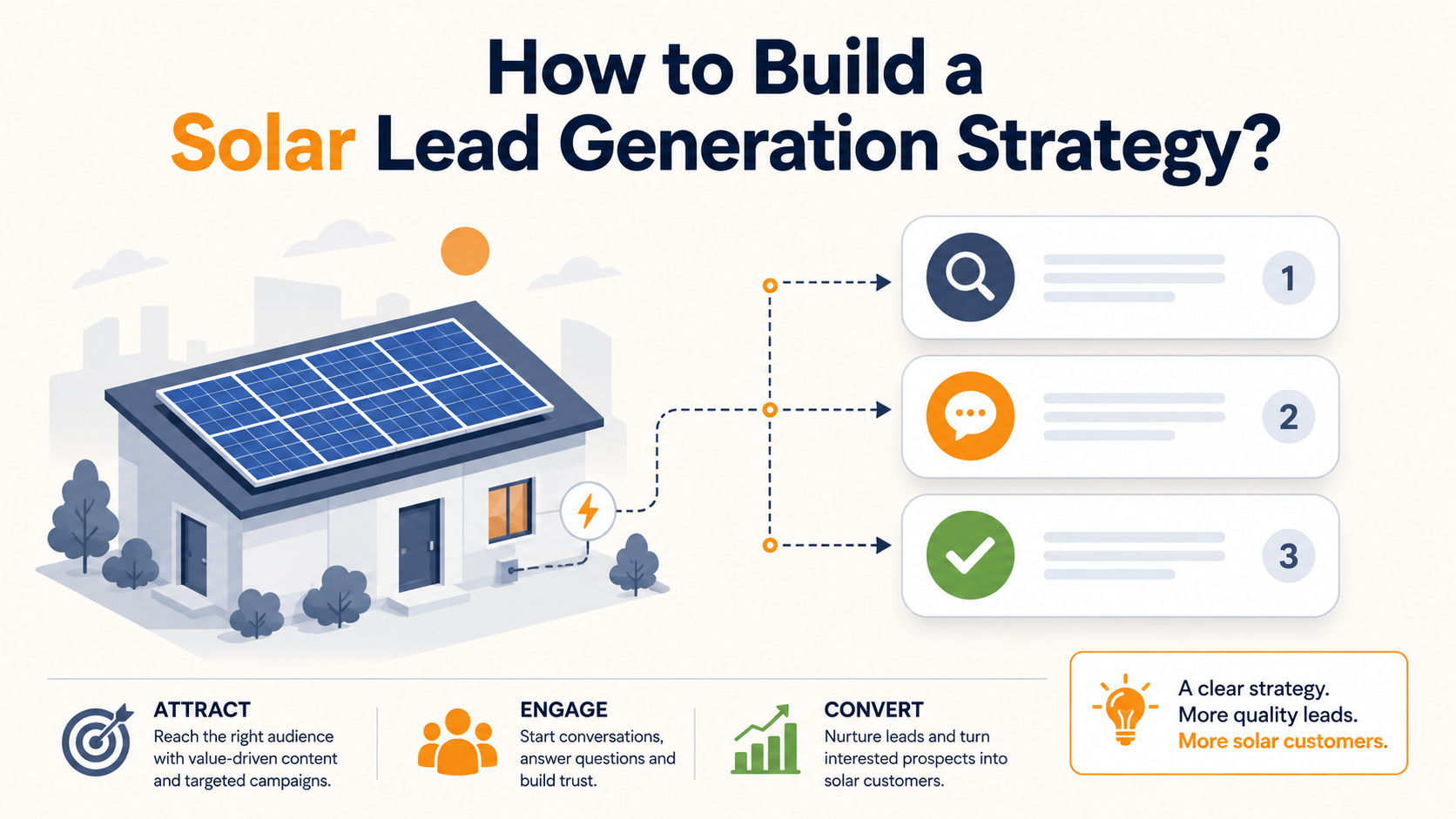
How to Build a Solar Lead Generation Strategy?
A practical solar marketing funnel can be understood in five steps.
Step 1: Understand Search Intent
Start with the questions potential customers ask. Separate informational searches from commercial and local searches.
For example:
Informational: “How does rooftop solar work?”
Commercial: “3kW solar system price”
Local: “solar panel installer near me”
This classification helps marketers create appropriate content, ads and landing pages.
Step 2: Build Local and Informational Content
Create useful service pages for relevant locations and supporting articles around cost, installation, savings and government programmes.
Every page should have a clear purpose. A service page may encourage a quotation request, while an informational article may guide the reader towards a calculator, consultation or related service page.
Step 3: Run Intent-Based Paid Campaigns
Google Ads can capture users who are already searching for solar solutions. Campaigns should be structured around relevant themes, with closely matched keywords, ads and landing pages.
Negative keywords are equally important. For example, a company selling installation services may not want to pay for searches related to jobs, courses or DIY instructions.
Step 4: Capture and Nurture Leads
A useful landing page should explain the offer, answer key questions and make the next action obvious.
After a form submission, the lead should enter an appropriate follow-up process. Depending on the business, this could include WhatsApp, email, a call, quotation and site-visit scheduling.
Step 5: Measure Qualified Leads
A marketer should move beyond impressions and clicks.
Important metrics can include:
- Cost per lead
- Cost per qualified lead
- Landing-page conversion rate
- Lead-to-site-visit rate
- Lead-to-sale rate
- Return on advertising spend
This is where SEO, paid advertising, analytics and sales data come together.
A Simple Solar Digital Marketing Funnel
A useful way to understand the complete process is:
Search query → Content or ad → Landing page → Lead form/WhatsApp → Qualification → Follow-up → Site visit → Sale
For example, a user searches for “3kW solar system price”. They see a relevant search result or advertisement, visit a page explaining the system and pricing factors, use a savings or quotation tool, submit their contact details and receive follow-up.
The marketer’s job is to improve each stage of this journey.
Which Digital Marketing Skills Are Valuable in the Solar Industry?
Solar is only one example of a wider principle: businesses in specialised industries need marketers who understand both marketing fundamentals and the customer’s context.
A marketer working with a solar company may need:
SEO: to improve organic visibility for relevant searches.
Google Ads: to capture high-intent demand.
Meta Ads: to generate awareness and leads.
Content and copywriting: to explain complicated products in simple language.
Analytics: to understand which campaigns and pages produce meaningful conversions.
CRM and lead nurturing: to manage enquiries beyond the first interaction.
These skills are not restricted to solar. The same capabilities can be applied to education, healthcare, finance, real estate, e-commerce, hospitality and many other sectors.
How Can You Build a Career in Digital Marketing in Solar Businesses?
You do not need an engineering background to start learning digital marketing for the solar industry. What matters is developing practical marketing skills and understanding how to apply them.
For a 12th-pass student or fresher, the first step can be learning the fundamentals of SEO, paid advertising, content, social media and analytics. A working professional may already understand business operations and can add digital skills to move into marketing or performance-focused roles.
The strongest learning approach combines structured training with practical work. Live projects, campaign simulations, portfolio work and exposure to real tools can help learners understand how marketing decisions are made.
This is where niche industry examples become valuable. A student who can explain how they would build a solar lead-generation campaign is demonstrating more than theoretical knowledge; they are showing how marketing skills can solve a business problem.
IDCM’s digital marketing programmes are designed around practical digital marketing skills across SEO, paid advertising, content, analytics and related areas. Learners can explore the Certificate, Diploma and Advanced Diploma in Digital Marketing; and each one of these options based on their experience and career goals.
Final Takeaway
Digital marketing for solar companies is more than social media posting or running advertisements. It is a complete process of understanding search intent, attracting the right audience, providing useful information, generating enquiries and nurturing those enquiries towards a business outcome.
For aspiring digital marketers, the solar industry offers a practical way to understand how SEO, paid advertising, content, analytics and CRM work together. More importantly, these skills remain useful far beyond one industry.
Learn the fundamentals, practise them on real-world scenarios, build a portfolio and keep improving as platforms and customer behaviour evolve.
Frequently Asked Questions
What is digital marketing for solar panels?
It is the use of SEO, paid advertising, social media, content marketing and lead-nurturing channels to attract potential solar customers online and convert relevant interest into enquiries.
How do solar companies generate leads online?
They can combine local SEO, Google Business Profile, Google Ads, social media, useful content, landing pages and follow-up systems such as WhatsApp, email and CRM workflows.
Which digital marketing channel is best for solar companies?
There is no single best channel. Google Ads can capture immediate search demand, while SEO and content can build organic visibility over time. Social media can support awareness and lead generation, while nurturing helps convert enquiries.
How can SEO help a solar company?
SEO can help a solar company become more visible when potential customers search for information, products, prices, services and local installers. Local SEO is particularly useful for businesses serving specific geographic areas.
Are Google Ads effective for solar lead generation?
Google Ads can be effective when campaigns target relevant search intent and connect users to useful, conversion-focused landing pages. Performance should be evaluated using qualified leads and business outcomes rather than clicks alone.
What skills are needed for digital marketing in the solar industry?
Useful skills include SEO, keyword research, Google Ads, Meta Ads, content writing, landing-page optimisation, analytics, conversion tracking and CRM-based lead nurturing.
Can freshers build a career in digital marketing for the solar industry?
Yes. Freshers can develop transferable digital marketing skills and use the solar industry as one practical area for applying them. A portfolio of relevant projects can help demonstrate those skills to employers or clients.

Qualification: M.A in English
Profession: Content Executive
Ayantika Banerjee is having 3 years of experience in SEO content writing, blogs writing, creative content writing, meta Ad copy writing and copy writing.
Linkedin: https://www.linkedin.com/in/ayantika-banerjee-748222325/
Profession: Content Executive
Ayantika Banerjee is having 3 years of experience in SEO content writing, blogs writing, creative content writing, meta Ad copy writing and copy writing.
Linkedin: https://www.linkedin.com/in/ayantika-banerjee-748222325/
Latest posts by Ayantika Banerjee (see all)
- Digital Marketing for Solar Companies: A Practical Career Guide - August 14, 2026
- Digital Marketing for Insurance Agents: A Career Guide - August 6, 2026
- Digital Marketing for Plastic Surgeons: A Roadmap to Consultation - July 31, 2026
 }})