
Courses
Digital marketing for hospitals might sound like something only hospital owners need to worry about. It is actually one of the widest-open career paths a fresher can walk into right now, and this is the story of why.
Think about the last time you booked something. A movie ticket, a new phone, a place to eat with friends. Before you paid, you almost certainly checked the star rating and read a few reviews on your phone first. If something showed two stars, you scrolled straight past it without a second thought.
Patients now do the same thing before they choose a hospital.
That one small habit has created one of the strangest situations in Indian business today. A company that owns no hospital, no beds and not a single doctor can beat the biggest hospital chain in the country, simply because it understands phones better than the hospital does.
If you have just finished your 12th, or you are fresh out of college, or you are sending out resume after resume and hearing nothing back, this blog is worth your time. It points to a real field that badly needs people and that almost nobody your age is training for.
Digital marketing for hospitals is the practice of helping a hospital get found and chosen by patients online. In plain terms, it means showing up on Google and Google Maps when people search, writing pages that answer patients’ health questions, collecting genuine reviews, running paid ads, and staying in touch through WhatsApp and email.
For a patient, good digital marketing is the difference between finding the right hospital in thirty seconds or never finding it at all. For a hospital, it has quietly become the main way new patients arrive.
Digital marketing is important for hospitals because patients now decide where to go online, long before they call or step outside. If a hospital is invisible on a phone, it is invisible at the exact moment the choice is made.
The numbers make this clear. According to DataReportal’s Digital 2026 report, India had about 1.03 billion internet users at the end of 2025. More than a hundred crore Indians now carry a search bar in their pocket, and they use it for their health. A 2024 study in the Indian Journal of Community Medicine found that 67.3% of patients had already used the internet to look up health information, and a 2025-26 Fellocraft Research analysis suggests close to 78% research online before choosing a hospital.
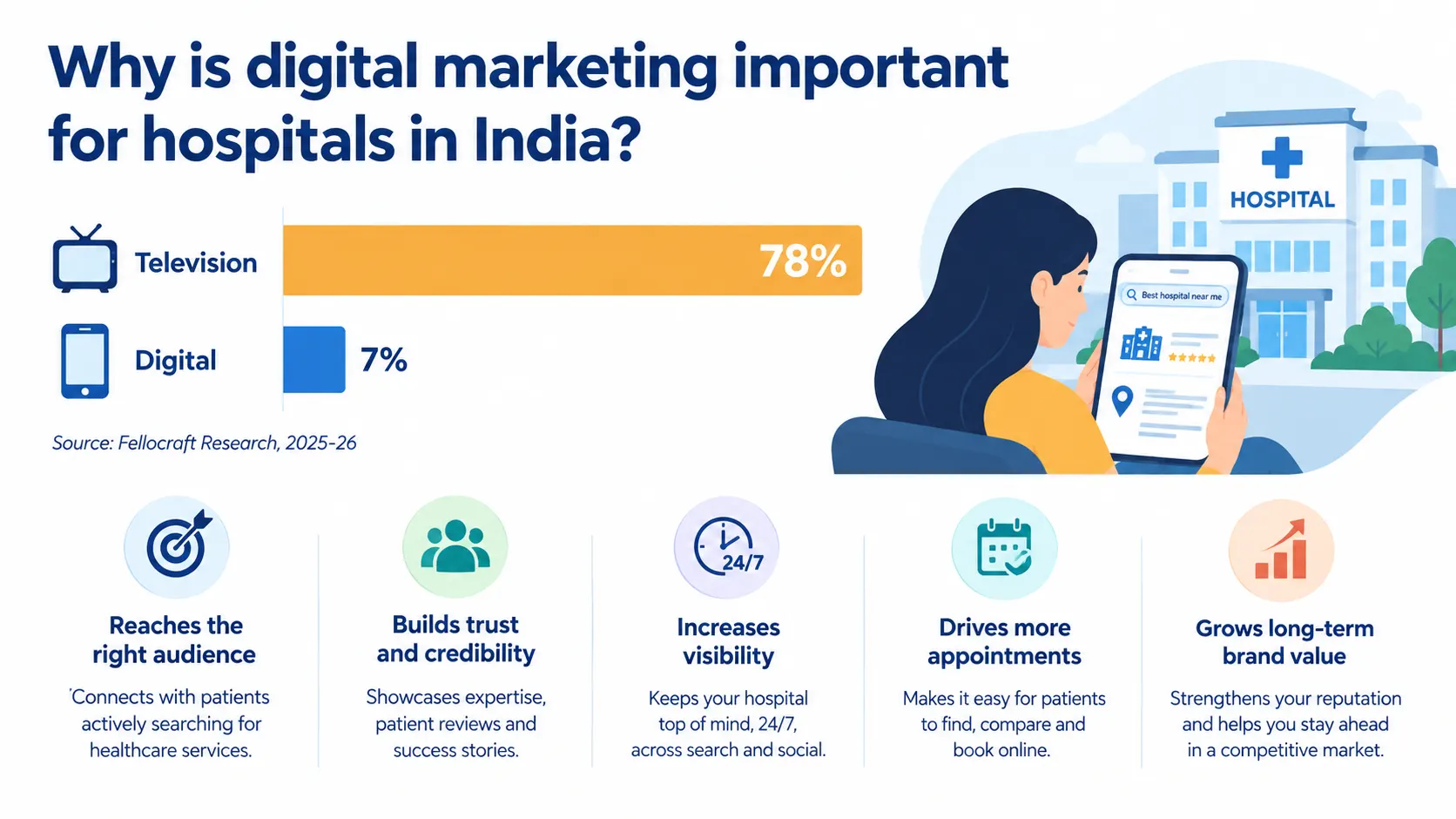
Now look at where hospitals put their money. The same Fellocraft study found that Indian hospital chains still spend about 78% of their advertising budget on television and only about 7% on anything digital. Patients decide online while hospitals keep spending offline. For comparison, Expert Market Research reports that digital advertising in India crossed television for the first time in 2024-25. The wider economy has moved to the phone. Hospitals, as a group, have not. That space is exactly where the small booking apps walked in.
A company with no beds wins by owning the online moment when patients decide, while big hospitals stay focused on their buildings. The one who shows up first on the phone often wins the patient, whether or not they own a single hospital bed.
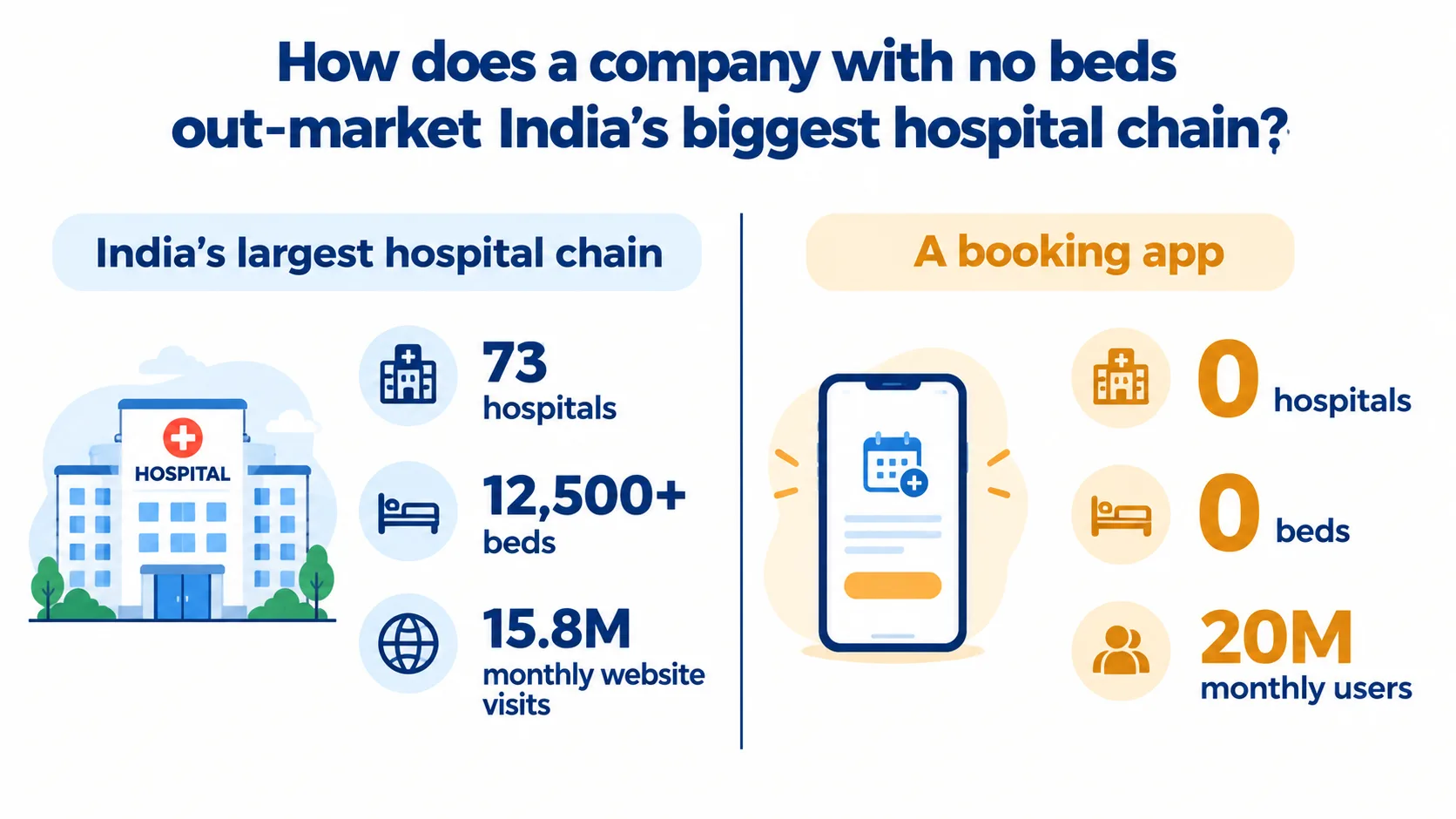
Take the clearest example. Apollo Hospitals, India’s largest private chain by revenue, runs 73 hospitals and more than 12,500 beds, and pulls roughly 15.8 million website visits a month from Google. That is strong by any measure. Yet booking-and-review apps such as Practo, which own no hospital at all, still reach many patients first. Practo reports around 20 million users a month, and industry data suggests nearly half of its bookings come from smaller tier-2 and tier-3 towns.
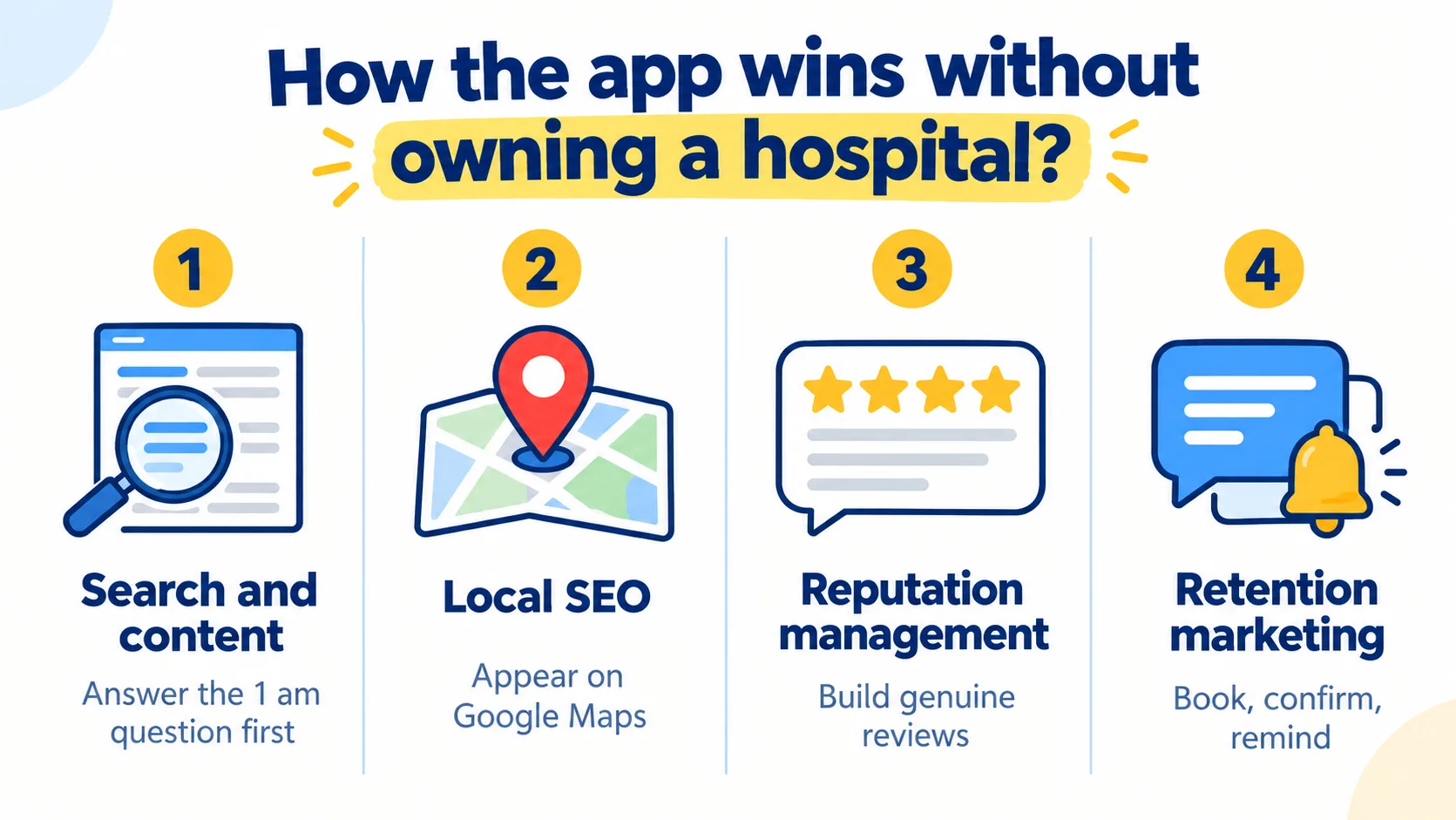
It answers the question first. Picture someone lying awake at 1 am typing “why does my chest feel tight” or “how much does a normal delivery cost” into Google. The app already has a clean, simple page ready. The hospital usually has nothing. So the app becomes the calm, helpful voice the patient meets first. Writing pages that show up on Google like this is called search and content.
It shows up on the map. Search “hospital near me”, and Google shows a small map with a few options, their timings and their star ratings. The apps make sure they appear there, complete and tidy. Many hospitals never set this up, so they simply do not show. Getting a business to appear on that map is called local SEO.
It builds trust with reviews. The apps make it easy to leave a rating and display those ratings proudly. Between a hospital with 4.5 stars from 800 people and one with three reviews, the patient picks the first every time. Building that steady flow of honest reviews is called reputation management.
It removes every last hassle. Book in two taps, get a confirmation on WhatsApp, get a reminder the day before. The app made saying yes so easy that the patient never paused. Staying in touch this way is retention marketing.
Notice what is missing from that list. No bigger building, no extra beds, no better machines. The app won a healthcare contest without owning a single thing a hospital owns, purely by being better on the phone.
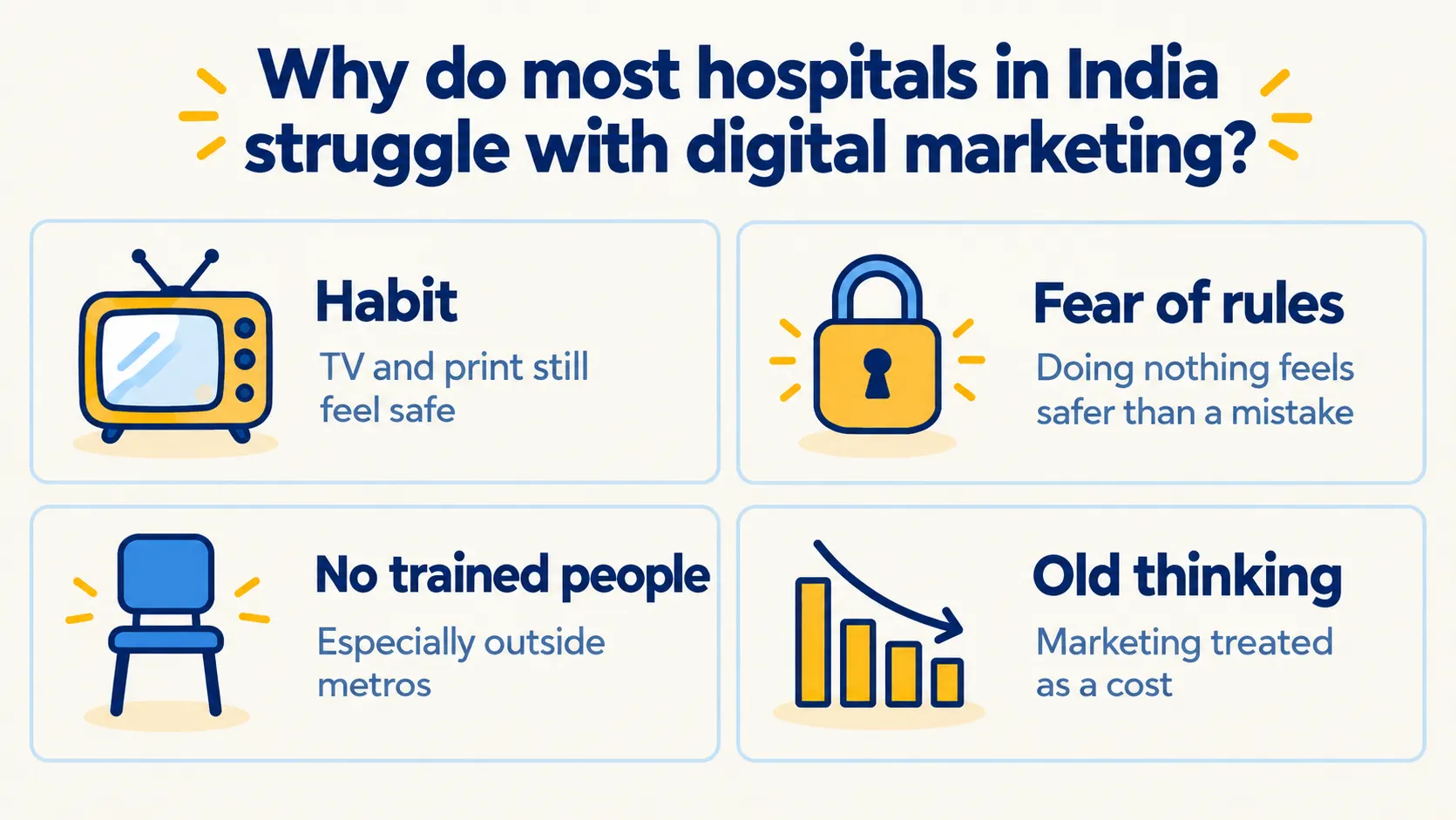
Most hospitals struggle for four reasons: habit, fear of rules, a shortage of skilled people, and old thinking about what marketing is for.
Habit comes first. The people who run hospitals grew up trusting television and newspapers, and those feel safe even when patients have clearly moved on. Fear comes second, because healthcare has strict rules about what an advertisement may say, so many hospitals do almost nothing online rather than risk a mistake. Third is a plain shortage of trained digital people, which reports on Indian healthcare flag again and again, especially outside the big cities. Fourth is old thinking, where marketing is treated as a cost to cut instead of the very thing that brings patients in.
None of these problems is permanent. Every one is slowly being solved by people who understand phones. The only real question is how many of those people exist. Right now, not many.
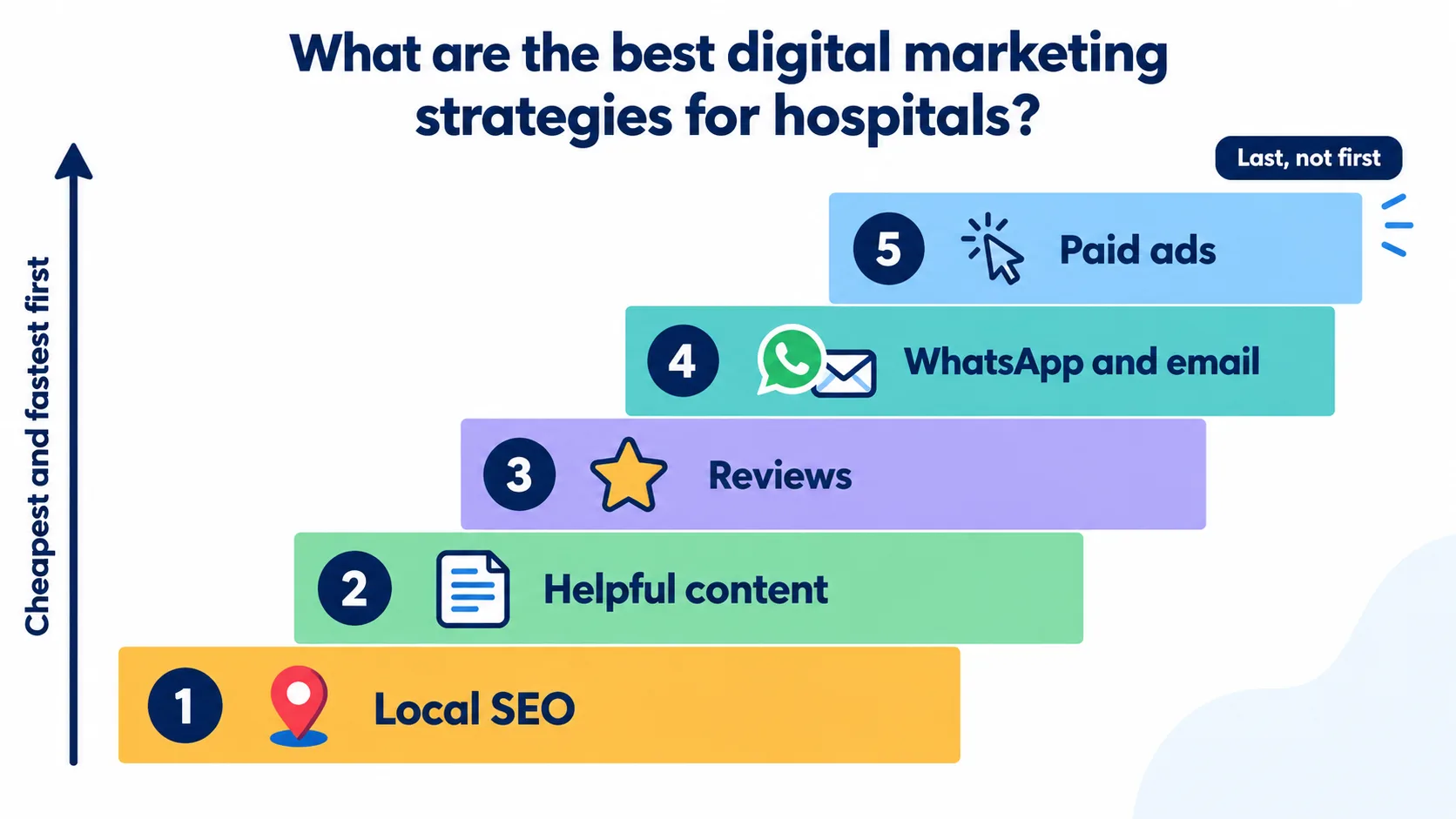
The best digital marketing strategies for hospitals, in the order that bring results fastest, are local SEO, helpful content, online reviews, direct messaging, and paid ads last.
Set up the hospital’s Google Business Profile and Maps listing with the correct name, address, hours, photos and services. This is the fastest win because it captures people searching nearby with clear intent.
Write simple, honest pages that answer the illnesses, treatments and costs patients actually type into Google. This earns trust and brings in search traffic.
Make it easy for happy patients to leave a review, and reply politely to every one, good or bad.
Handle booking, confirmations, reminders and follow-ups so no patient slips away and past patients return.
Only after the basics work, and only aimed at people who are clearly ready to book. Learn and Google Ads, Facebook Ads for running paid ads.
None of this needs a huge budget. It mostly needs one person who knows the right order to do it in. And that person is exactly who the market cannot find.
There is one twist that makes hospital marketing harder, and more skilled, than marketing a shop or a restaurant. In India, you cannot promote a hospital the way you would sell a phone. The law draws a line between informing and soliciting. A hospital may tell people it has a cardiology department with registered specialists. It may not run a “Book now, Dr Sharma has cured 500 patients” style ad. Getting real results while staying on the right side of that line is exactly the skill hospitals cannot find. The next section explains why.
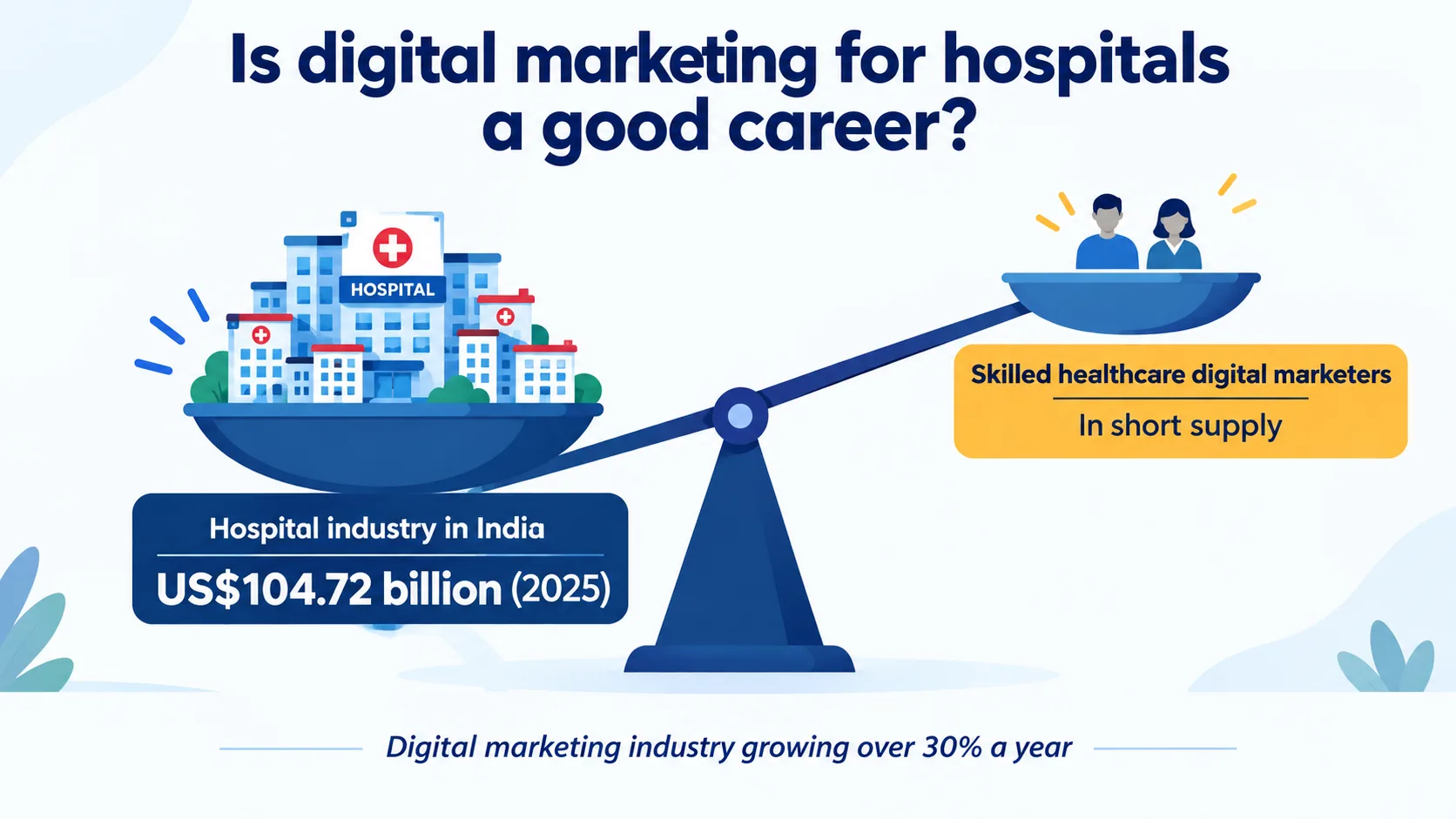
A career in hospital marketing is a strong choice precisely because so few people do it while demand keeps climbing. When strong demand meets a small supply of skilled people, the ones who prepare early hold the advantage.
The scale is real. Expert Market Research values India’s digital marketing industry at about 5.15 billion US dollars in 2024, growing by more than 30% a year, and the country’s hospital industry at around 104.72 billion US dollars in 2025. This is a massive, slow-moving field crying out for guides. You do not need a medical degree to be one. You need the phone skills from the list above, showing up on Google, writing helpful pages, managing reviews, running ads and staying in touch, plus the good sense to use them carefully in a place as sensitive as healthcare. Choose a specific corner like this, and you stop being one more general applicant in a crowd of thousands. You become one of the few people who can solve a problem an entire industry is stuck on.
Advertising a hospital in India is legal, but it is governed by stricter rules than almost any other industry, and most marketing advice online ignores them completely. Knowing these rules is what separates a professional from someone who quietly gets a hospital into trouble.
Here is what actually applies, as of 2026:
You cannot solicit patients. Clause 6.1.1 of the Indian Medical Council (Professional Conduct, Etiquette and Ethics) Regulations, 2002, the code currently in force, treats soliciting patients, directly or indirectly, as unethical. You are allowed to inform people, not to chase them. Stating the facts about a department is fine. Begging for the booking is not.
You cannot promise a cure. The Drugs and Magic Remedies (Objectionable Advertisements) Act, 1954 bans advertisements that claim to diagnose, cure or prevent a long list of named diseases and conditions. No guaranteed cures, no miracle-recovery claims.
Be careful with testimonials and before-and-after content. A stricter code, the National Medical Commission Registered Medical Practitioner (Professional Conduct) Regulations, 2023, was announced in August 2023 and then put on hold weeks later after protest from the medical community. It is not law today, but it shows where the regulator is heading, and it would have banned patient testimonials and cured-patient images outright. The smart hospitals already follow it as best practice, so a sudden rule change does not turn their whole content library into a liability overnight.
You must handle patient data lawfully. The Digital Personal Data Protection Act, 2023 governs the personal details a hospital collects through lead forms and enquiries. Clear consent and honest data-handling terms are no longer optional.
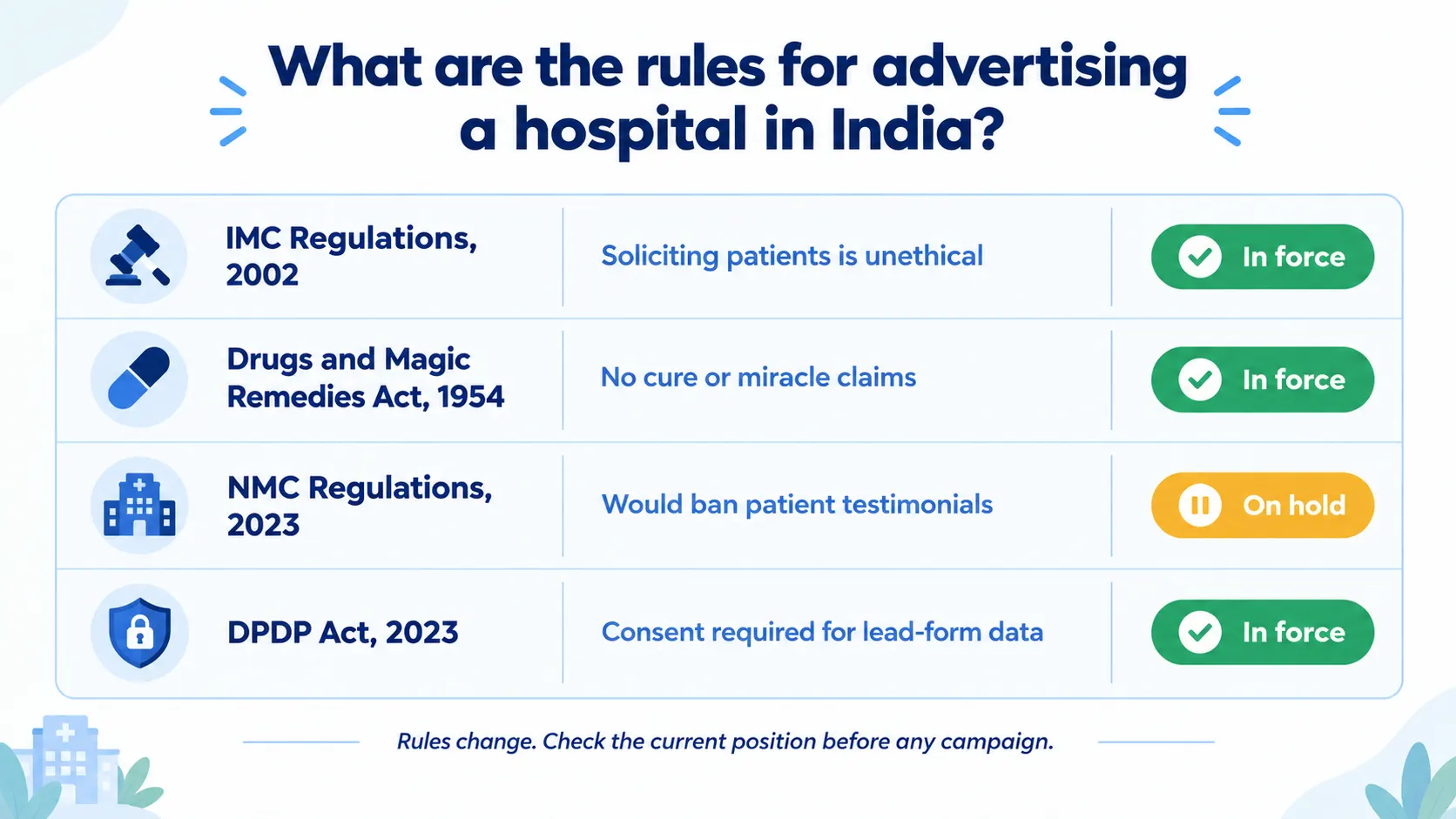
None of this means hospitals cannot market online. It means they must market carefully, informing rather than exaggerating, and never trading on a frightened patient’s fear. That is exactly why a trained person who understands both the tactics and the rules is so valuable, and so rare. Rules change, so anyone doing this work should check the current position before a campaign goes live.
A company with no beds keeps beating a company with 12,500 of them. Not because it is bigger, and not because it knows more about medicine, but because it understood one thing before anyone else did: patients now decide on their phones.
The hospitals already know they are falling behind, and they are quietly looking for people who can help them catch up. The skills to do it can be learned, the need for them is proven by real numbers, and the field is nowhere near crowded. The only question left is a simple one. Who walks in first?
Step Into the World of Digital MarketingLearn from Digital Marketing Experts |
|
| Advanced Diploma in Digital Marketing | |
| More Learning Options for you: Diploma in Digital Marketing | Google Ads Certification Training | Certification Course |
Start by claiming and completing your Google Business Profile so your hospital appears on Google Maps with correct hours, photos and services. Then publish simple pages that answer common patient questions, collect genuine reviews, and use WhatsApp for booking and reminders. Add paid ads only once these basics are working.
For most hospitals, local search on Google and Google Maps brings the highest-intent patients, followed by helpful content, online reviews and WhatsApp messaging. Social media builds trust and awareness, and paid ads work best once the free basics are in place. The right mix depends on the hospital’s location and services.
It depends on what you do. Setting up a Google Business Profile, gathering reviews and writing helpful pages costs mainly time and can begin with little or no ad spend. Paid ads cost more and scale with your budget. Most hospitals start with the low-cost basics and add paid ads only after those start bringing patients.
Yes, but under stricter rules than most industries. The medical ethics code in force, the IMC Regulations, 2002, treats soliciting patients as unethical, so hospitals may inform but not chase. The Drugs and Magic Remedies Act, 1954 bans cure claims for listed diseases, and the DPDP Act, 2023 governs patient data collected through lead forms. A tougher NMC 2023 code that would ban patient testimonials is currently on hold, but many hospitals follow it as best practice because it signals where the rules are heading.
No. You do not need a medical degree or a science background. You need digital marketing skills and the willingness to understand how healthcare is different, mainly that it is sensitive and built on trust. The marketing skills matter far more than any medical knowledge.
The biggest difference is responsibility. You are helping worried people make serious health decisions, so trust matters more than clever selling, and there are rules about what a hospital may claim. Careful, honest marketing is not just the ethical choice here; it is also what actually works.

 }})