
Courses
Digital Marketing for Doctors is one of the few skills in India right now where demand is high and trained competition is thin. That should matter to you, because if you just finished your 12th or your graduation, you are probably one of a few hundred people applying for the same generic job. Same resume. Same “willing to learn,” and the silence after you hit send.
Here is what nobody tells you at the placement drive. The problem is not that there are no jobs. The problem is that you are competing in the most crowded lane on the road. Everyone learned the same thing, so everyone is worth the same.
Now look at a different lane. Almost every doctor in your city is invisible online. Patients search for them and cannot find them. These doctors need help; they have the money to pay for it, and they do not know who to ask. That gap is a market. And a market that big, with so few skilled people serving it, is exactly where a fresher can build a career fast.
This is a case study of that gap. We will study the market the way a marketing analyst would: the opportunity, the data behind it, the exact strategies that work, the rules you must follow, and the roles you can step into. By the end, you will not be asking, ” Where do I find a job?” You will understand a skill that businesses are already looking for.
Digital marketing for doctors means helping a clinic or a practice get discovered online by the right patients at the right moment, through search engines, websites, social media, and online reviews.
It is not hard selling, and it is not glossy advertising. It is being visible and credible at the exact moment someone is already searching for care. A complete approach can include a fast website, a Google Business Profile, local SEO, educational content, social media, video, review management, Google Ads, WhatsApp and email follow-up, and analytics.
Here is the part most guides get wrong: a doctor does not need all of these on day one. They need the two or three channels that match their goal. Knowing which two or three to pick, and why, is the skill you are here to learn.
Think of this as the “competitor analysis” of our case study. Except the striking finding is that the competition barely exists. Doctors are trained for years in medicine. They are trained for zero minutes in marketing. So even excellent doctors sit behind a broken or missing online presence while a less skilled doctor two streets away, who happens to have a good Google profile and steady reviews, quietly takes their patients.
The gap shows up in a predictable pattern:
Every one of those is a fixable problem. And every fix is a service a trained marketer can deliver. That is the gap: high need, real budgets, and very few people who understand both healthcare sensitivity and digital marketing at the same time.
Step Into the World of Digital MarketingLearn from Digital Marketing Experts |
|
| Advanced Diploma in Digital Marketing | |
| More Learning Options for you: Diploma in Digital Marketing | Google Ads Certification Training | Certification Course |
A SWOT analysis is how a marketer sizes up an opportunity before entering it. Here is the healthcare digital marketing niche, seen through the eyes of a fresher deciding whether to specialise in it.
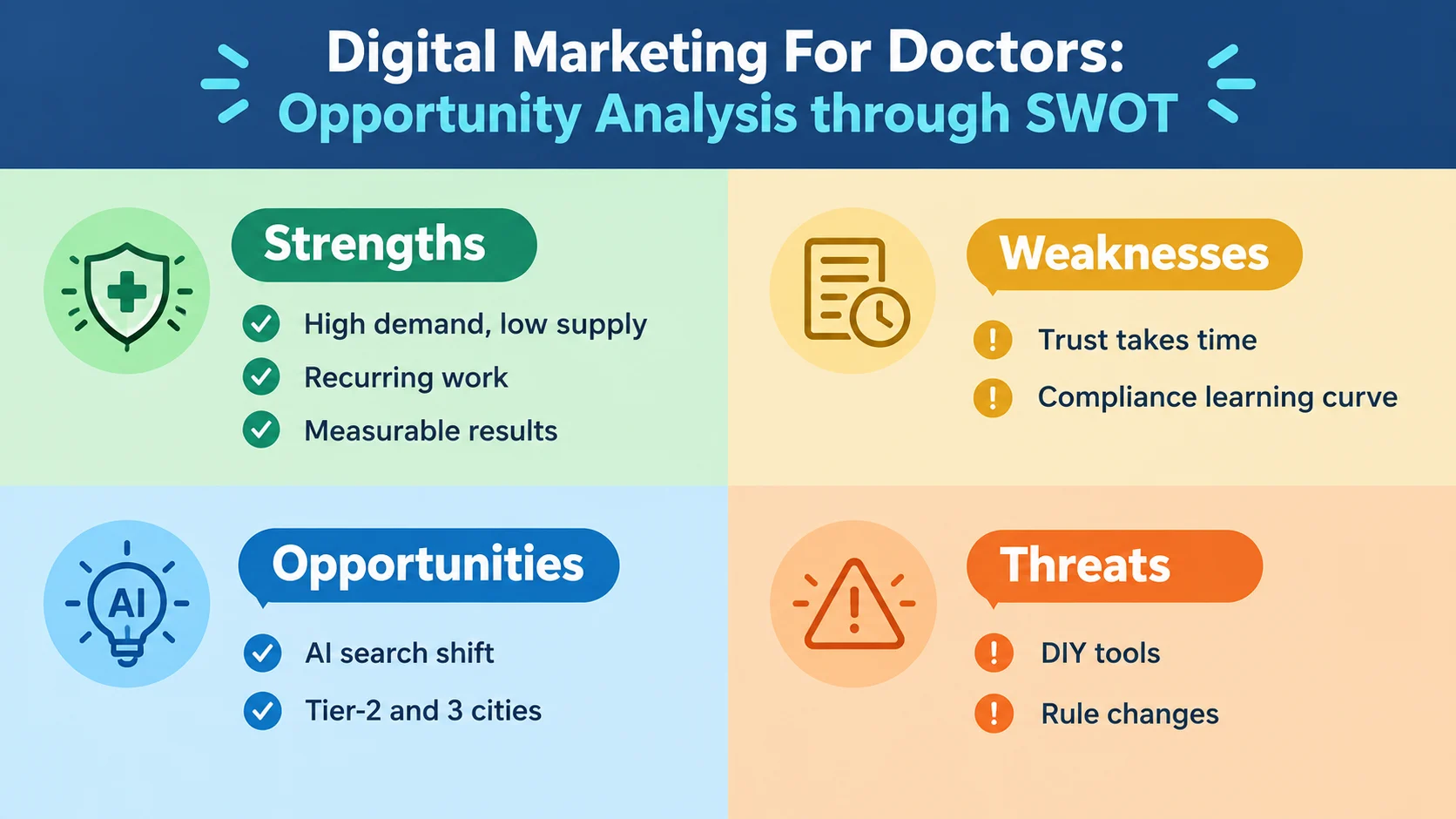
Read that SWOT again. The strengths and opportunities are large and specific. The threats are manageable with skill. That is what a good market entry point looks like.
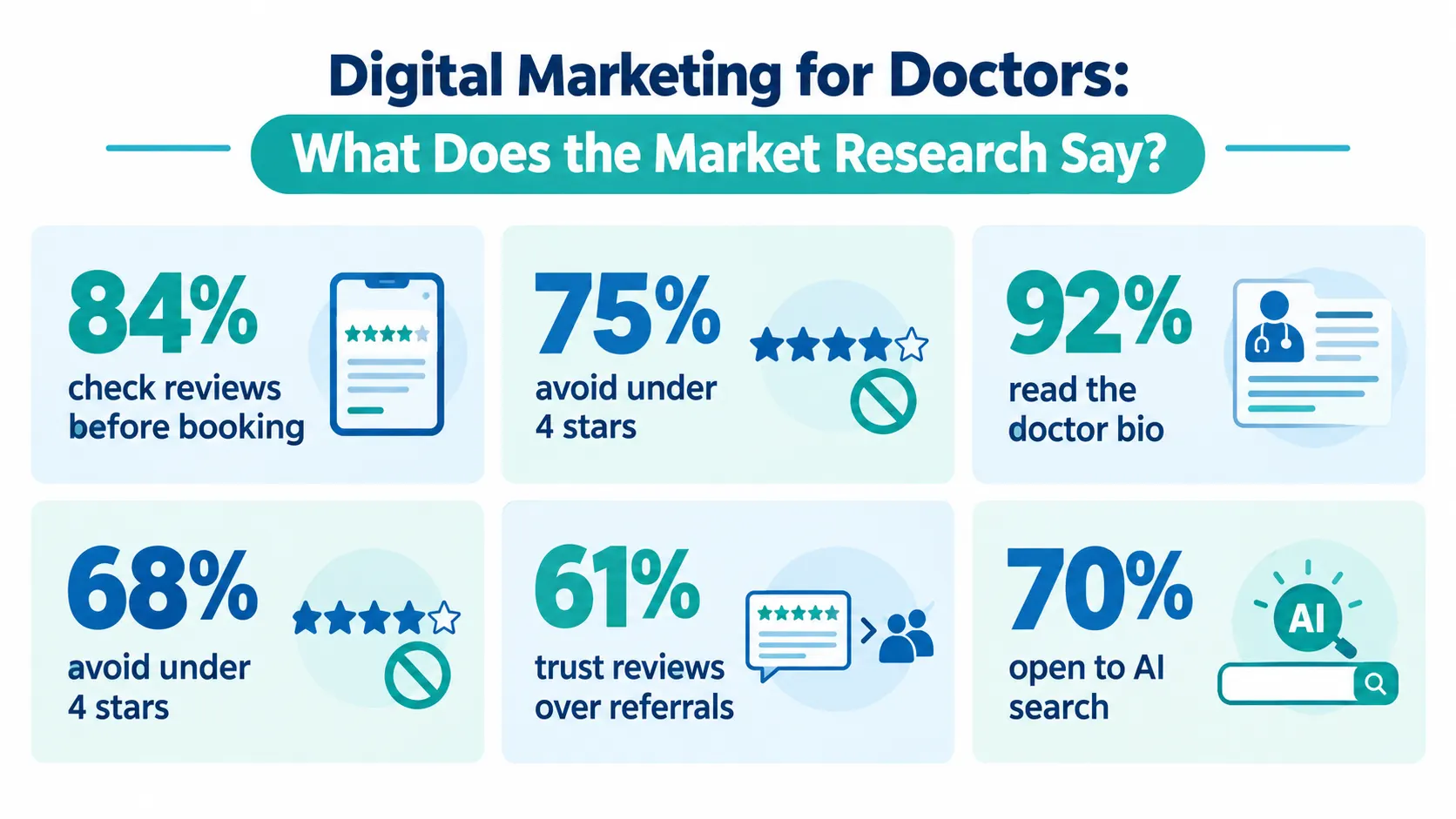
A case study is only as strong as its evidence. Here is the research that proves patients now behave like shoppers, which is the entire reason this market exists.
Note: a patient decides whether to trust a doctor long before they ever meet one, using reviews, a bio, and a search result. A doctor with a weak online presence is losing patients silently, and never learns why. That silent loss is the pain a marketer gets paid to fix.
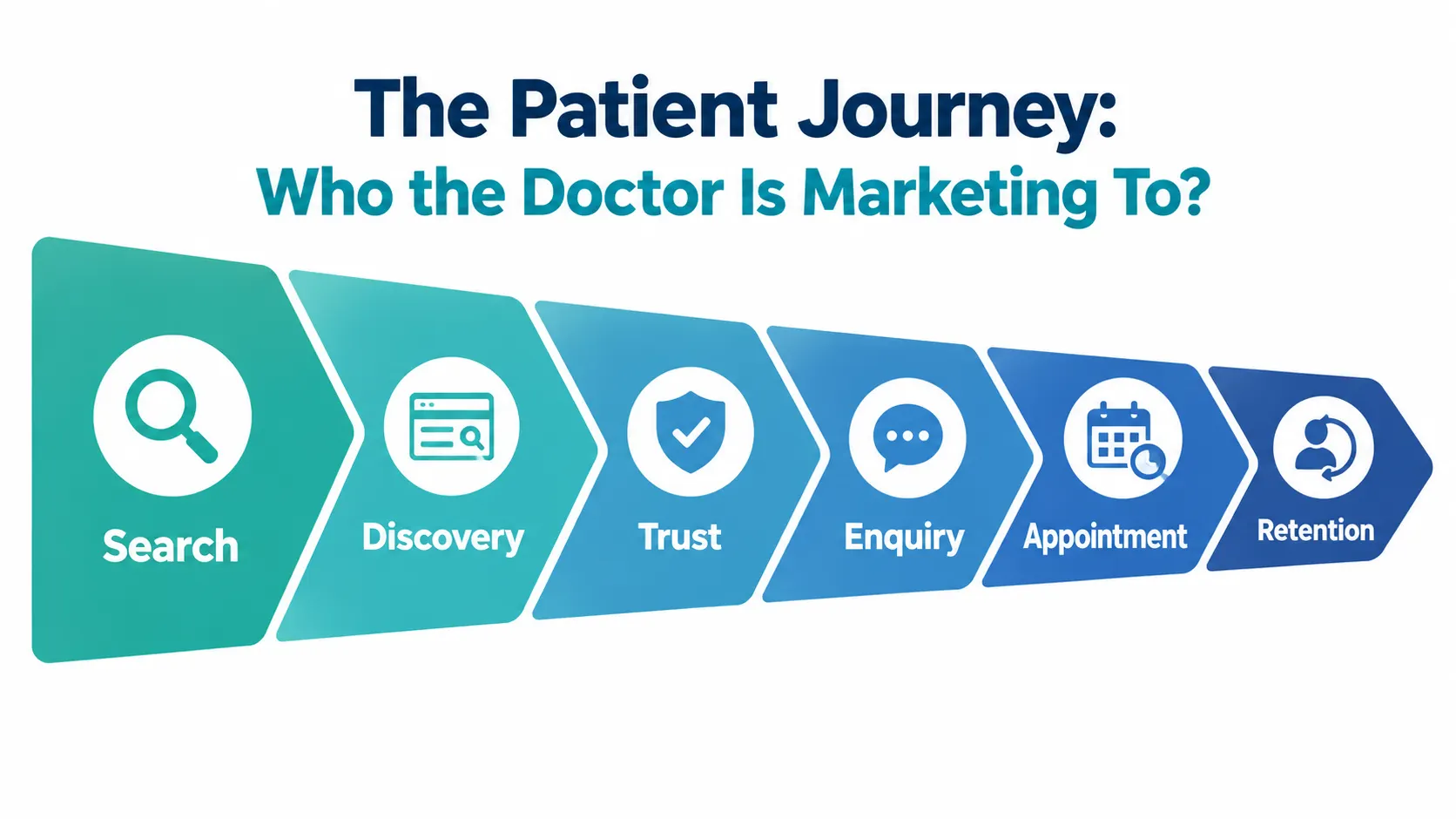
Before you run a single campaign, you have to understand the audience the doctor is trying to reach. Every strategy exists to move a stranger through one simple journey:
Search → Discovery → Trust → Enquiry → Appointment → Retention.
Picture it. A patient searches “skin doctor near me.” A strong Google Business Profile and website help them discover the clinic. Reviews and helpful content build trust. A click-to-call or WhatsApp button turns that trust into an enquiry. A smooth booking turns the enquiry into an appointment. Good follow-up keeps them coming back and referring others, which is retention.
Miss one link in that chain and the patient drops off, usually without ever saying why. Your job as a marketer is to find the broken link and repair it. That single sentence is the heart of this entire career.
These are the core strategies, in rough priority order for most practices. Notice that the cheapest and highest-impact moves come first.
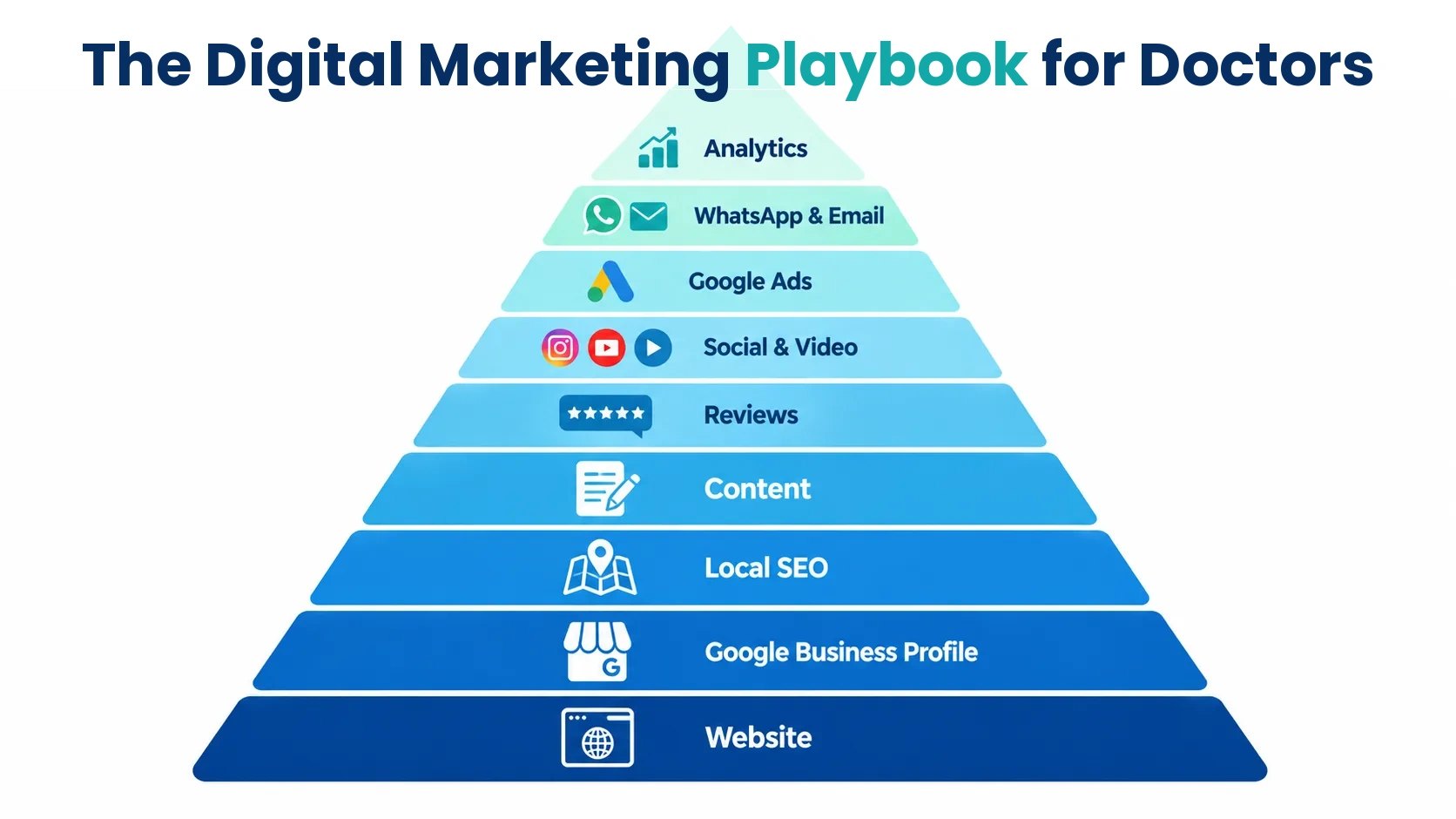
Here is how the main channels work in practice, which is the part you will get paid to execute.
This is the foundation. A complete, verified Google Business Profile with correct hours, photos, services, and steady reviews is what makes a clinic show up in the local Maps pack. Location pages on the website, with consistent contact details across the web, reinforce it. For a local doctor, this single channel often beats everything else.
Doctors have knowledge patients desperately search for. Turning “what causes acne,” or “when should I see a cardiologist,” into clear articles and short videos builds authority with both search engines and patients. This is also what AI answer engines pull from, which we will cover shortly.
Given the data above, reviews are not optional. The work is a system: ask satisfied patients at the right moment, make leaving a review effortless, and reply to every single one professionally. A steady flow of recent, well-handled reviews is one of the strongest trust signals a clinic can own.
Short, honest clips that explain a condition or answer a common worry build familiarity. Familiarity builds trust, and trust books appointments. Glossy production is not the point. Clarity and consistency are.
Paid search buys instant visibility for high-intent searches like “dermatologist in Kolkata.” You pay per click, so it works best for new clinics that need patients this month, or for competitive specialities where organic ranking is slow.
The quiet retention engine. Appointment reminders, follow-up messages, and useful health tips keep patients returning and reduce no-shows. Low cost, high loyalty.
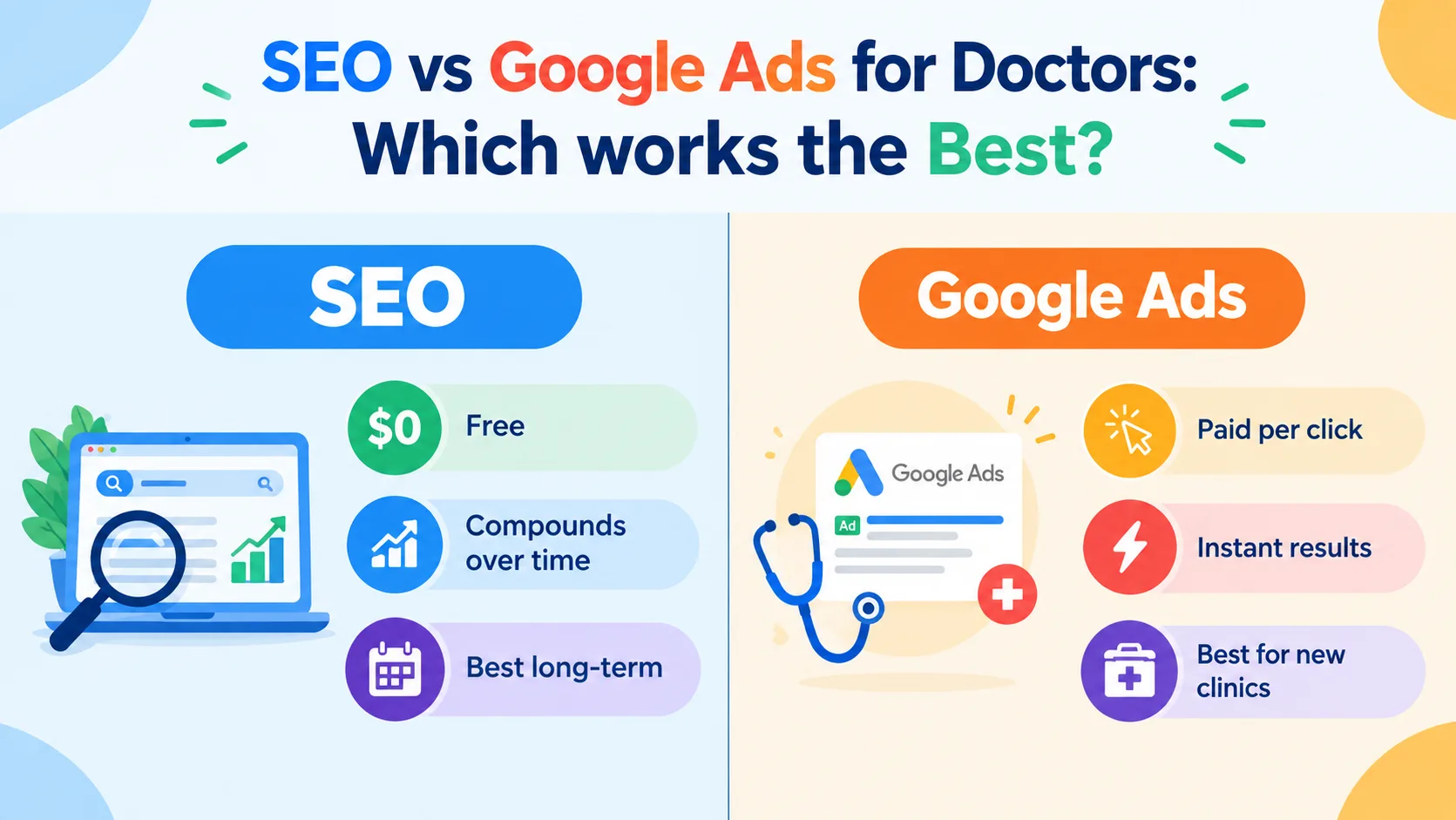
Both work, but they solve different problems.
SEO builds durable, free visibility over months, and it compounds. Google Ads buys instant visibility for a fee, and it stops the moment you stop paying.
The smartest practices run both. Ads bring patients today while SEO lowers the cost of winning them tomorrow. Knowing when to recommend which is exactly the judgment a client pays a marketer for.
Search is shifting from links to answers. Patients now ask tools like ChatGPT, Google’s AI Overviews, and voice assistants “who is a good cardiologist near me,” then act on the summary they get.
This is not a fringe trend. As noted in the data section, reporting in Medical Economics on a 2025 Rater8 survey found around 70% of patients are open to or already using AI tools to research physicians.
To appear in these AI answers, a doctor needs clear, well-structured content, accurate listings, and strong reviews, because that is exactly what AI engines pull from. Very few marketers understand this yet, which makes it one of the sharpest edges a fresher can build right now.
Every good case study includes what goes wrong. In doctor marketing, the biggest mistakes are not creative flops. They are compliance failures.
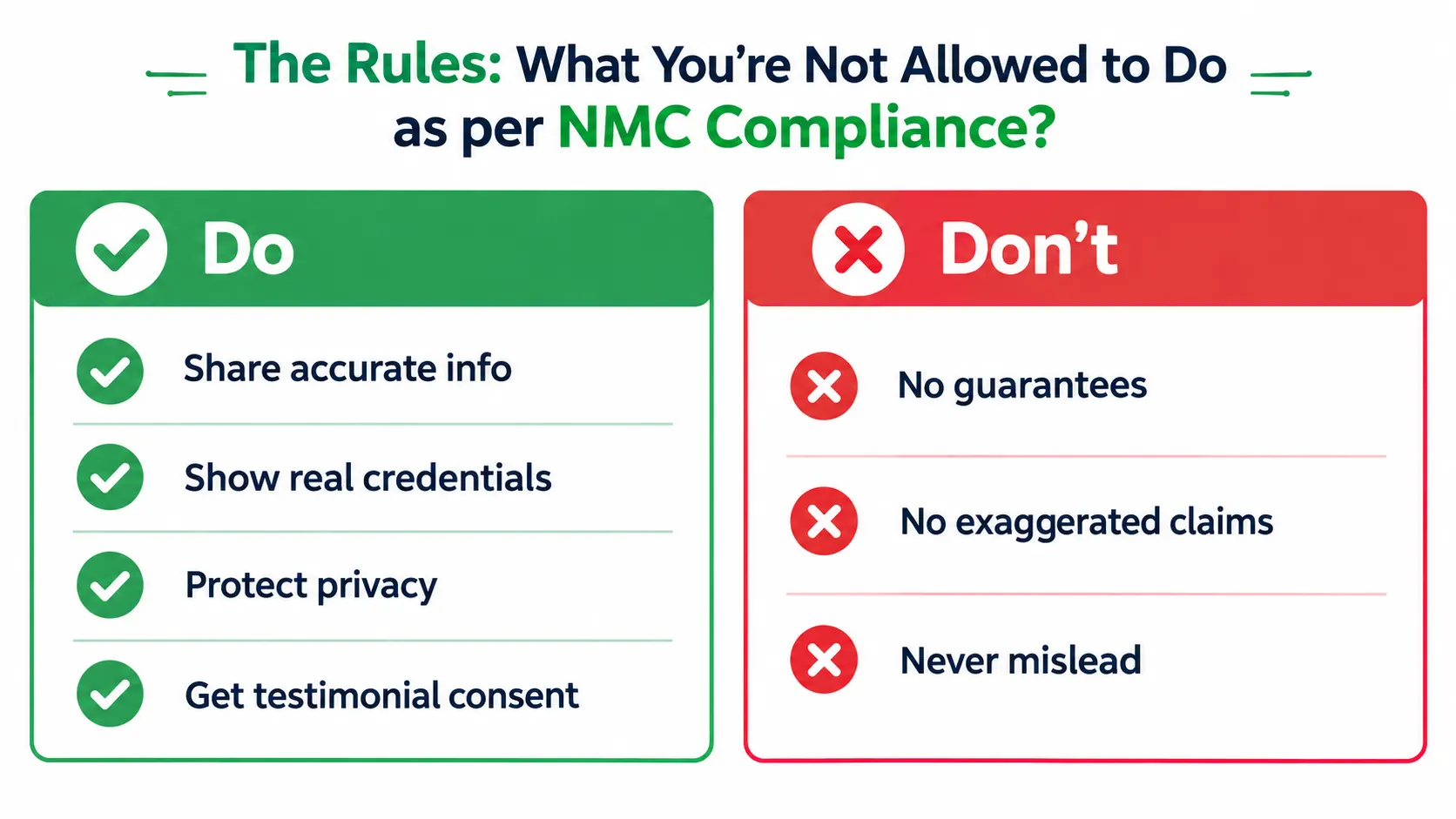
In India, the National Medical Commission’s code of conduct restricts how doctors may advertise and solicit patients. Break these rules, and you can damage your client’s licence and your own reputation. So this section is not optional reading.
The safe path is patient education, not self-promotion:
Ethical marketing here is not just the compliant choice. It is the version patients actually trust, which means it also performs better. Learn these rules early, and you instantly stand out from marketers who do not know them.
There is no single price, because cost depends on the goal, not a fixed package. A solo clinic and a multi-city hospital chain live in completely different budgets.
The main factors are the city, the speciality, the competition, how many channels are used, how much content is produced, and the ad spend. A Google Business Profile is free to set up. A basic website and local SEO are modest costs. Google Ads scale with the budget and can be paused anytime.
The winning approach is simple: start small, prove that one channel brings enquiries, then reinvest in what works. Chasing every tactic at once is the fastest way to waste money, and the fastest way to lose a client’s confidence.
You do not need expensive software to begin. Most of the real work runs on a small, affordable toolkit that you can learn hands-on:
Learning these tools is exactly where the career opportunity opens up, because these are the same tools every digital marketing role expects you to know.
This is where the case study becomes personal. Every strategy above needs someone to run it, and that someone does not need a medical degree.
The demand is broad. Digital already makes up close to 46% of India’s total advertising spend and keeps growing at a double-digit annual rate. Globally, the US Bureau of Labour Statistics projects marketing roles will grow faster than the average occupation through 2032. Healthcare is simply one high-value niche inside that boom.
The skills are learnable: SEO, content writing, social media, Google and Meta Ads, keyword research, and analytics. Common entry roles include Digital Marketing Executive, SEO Executive, Social Media Executive, and Performance Marketer.
The path is refreshingly clear:
One healthcare campaign in your portfolio is worth more than a page of certificates, because it proves you can do the job before anyone hires you to do it.
For doctors, a strong digital presence is now part of good practice. It helps the right patients discover, trust, and reach them before a competitor does.
For students and freshers, that same reality is an open door. Healthcare is one of the most rewarding niches to apply digital marketing skills, from local SEO to performance marketing, precisely because the demand is high and the trained supply is low. You looked at this market the way an analyst would. You saw the gap, the data behind it, the playbook that fixes it, and the rules that protect it.
The only step left is to build the skill. A structured course with real projects is the fastest, most practical way to start.
Digital marketing for doctors uses search engines, websites, social media, online reviews, and other digital channels to improve a practice’s visibility, build patient trust, share information, and encourage appointments.
For most clinics, start with a well-optimised Google Business Profile, a professional website, and local SEO. Together, these build visibility, attract nearby patients, and establish credibility without a large advertising budget.
Yes, doctors can use digital advertising in India while following applicable National Medical Commission guidelines. Advertisements should remain truthful, avoid misleading claims or guarantees, and focus on genuine healthcare information.
Yes. Healthcare digital marketing is largely skills-driven, so freshers from commerce, arts, science, or any background can enter the field by learning practical digital marketing skills and gaining hands-on experience.
Start by learning SEO, social media, Google Ads, content marketing, and analytics. Build a practical portfolio through projects, then gain industry experience through internships, freelance assignments, or entry-level roles.

 }})