
Courses
Digital marketing for restaurants is now what fills tables, not just good food. A restaurant can serve a great meal, keep loyal regulars, and still see empty seats. The reason is simple. Being good at food does not make a restaurant easy to find.
A customer choosing where to eat tonight does a lot first. They search Google, compare nearby places, read reviews, scroll photos, and check menus. For restaurants, the digital journey now shapes what happens offline. That is why digital marketing for restaurants has become a core business skill, not an afterthought.
This matters at India’s scale. The NRAI India Food Services Report 2024 projects the industry will reach ₹7,76,511 crore by 2028. That is an 8.1% CAGR. The sector already employs around 8.5 million people. It adds about 1.9% of India’s GDP. DataReportal reported 806 million internet users in India in January 2025. It also counted 491 million social media identities. A huge online audience now sits between a hungry customer and a nearby restaurant. That gap is where digital marketing for restaurants does its real work.
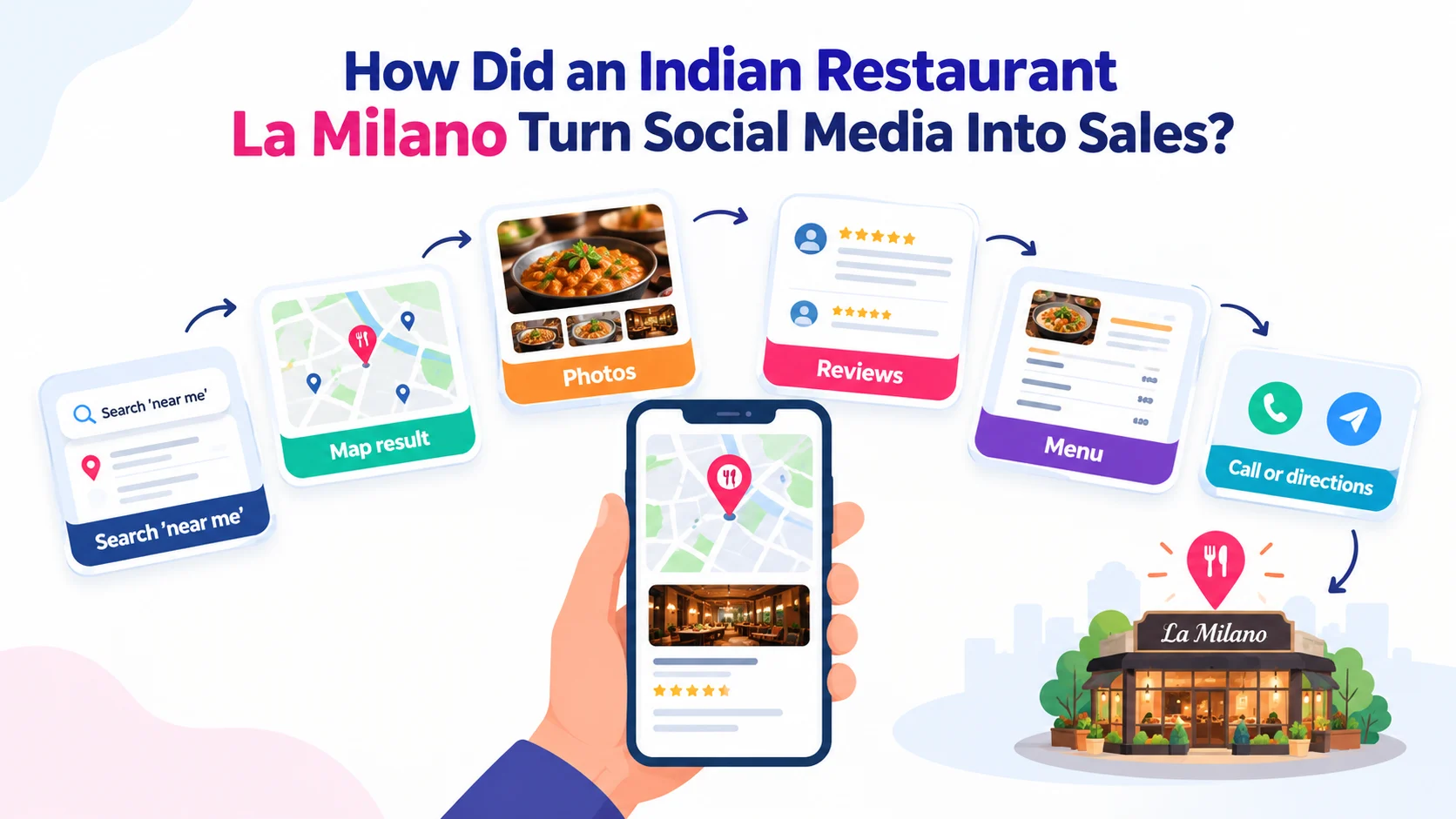
La Milano is a restaurant partner on Swiggy. It used Swiggy’s Smart Links to link its social posts straight to its online menu. Smart Links launched in 2024. The tool lets a restaurant share one link across Instagram, Facebook, and WhatsApp. That link sends customers straight to the menu. It also tracks which channels drive visits and orders. Swiggy reported that La Milano saw a 13% rise in menu visits on campaign days in February. Revenue rose 10% on those days after it added Smart Links. Across the programme, Swiggy reported more than 4 million menu sessions across 35,000 restaurant partners. Almost 60% of Smart Link orders came from new users. These are company-reported figures, not audited results, so read them that way.
The interesting part is not the 10%. It is the mechanism. La Milano stopped treating social media as a branding channel on its own. Instead, it tied social discovery to a clear action: see the post, click the link, view the menu, order. That is digital marketing for restaurants working as a system, not a set of scattered posts. The question shifts too. It moves from “How many people saw our post?” to “How many people went from seeing our content to ordering?” The second question is far more useful. Most restaurants never ask it.
To see how that looks in practice, consider a made-up but realistic case: The Corner Plate.
Most restaurants struggle online for one reason. They have digital accounts but no system to turn them into customers. The Corner Plate is a clear example. Four problems stood out. First, it was hard to find for specific searches. Its pages showed its name but not what it offered. Second, its Google presence worked like a static address, not a managed asset. Third, its social posts showed dishes but gave people little to decide on. Fourth, its marketing was cut off from measurement. The owner could see likes and views. He could not tell which activity drove calls, directions, or orders. This is where a digital marketer stops being a content creator. The job becomes solving a business problem.
When people are ready to eat, they search with intent. They type terms like family restaurant near me, best restaurant in [location], vegetarian restaurant near me, and dinner near [Kolkata]. Capturing that demand starts with keyword research. It begins not with “What should we post?” but with “What do people search for when they want to eat?” These queries show intent. Someone who types “restaurant” may still be browsing. Someone who types “family restaurant near me” is close to deciding. A low-volume keyword with strong local, ready-to-buy intent can beat a broad keyword with thousands of searches. The lesson for a new SEO is clear. Keyword research is about the customer behind the search, not just popular terms.
For a local restaurant, the Google Business Profile is not just a listing. It is often the first impression. Google says local ranking depends on three things: relevance, distance, and prominence. Complete information helps Google judge relevance. Reviews feed prominence. So the marketer checks the profile end to end. That means the right category, correct address and hours, contact details, website, and menu. It also means strong food and ambience photos, useful attributes, reviews, review replies, and ordering or booking options. The goal is simple. When someone finds the restaurant on Google, the profile should answer every quick question. Many customers never reach the homepage.
A restaurant should post four kinds of content: product, experience, decision, and local. Product content shows signature dishes, new items, popular combos, and veg or seasonal options. Experience content shows the space, seating, family dining, and prep behind the scenes. Decision content answers real questions. What should two people order? What suits a family dinner? What works for a quick lunch? Local content reflects the neighbourhood and local occasions. The principle is simple. Create content because the customer needs to know something, not because the brand needs to post. That one shift makes content useful for both search and social.
When a customer compares two similar restaurants, reviews often break the tie. The BrightLocal Local Consumer Review Survey 2026 found clear patterns. Positive reviews make 85% of consumers more likely to use a business. Negative ones put off 77%. And 54% visit a business website after reading positive reviews. A review rarely ends the research, though. BrightLocal found that 66% of consumers keep researching after a positive review. Only 34% are ready to buy or book. So the review, profile, website, and social posts must tell one story. A customer should never go from strong reviews to an old website with poor photos and no menu.
This is also where a learner sees the point. A restaurant account is rarely a one-skill job. Reading reviews as data, writing replies, and keeping one story across channels already pulls in SEO, copywriting, and analytics at once. That is the connected thinking a good course is built to teach.
With the organic base in place, paid ads become an option. They are not a default, though. The first question is not “Should we run Google Ads?” It is “What action are we paying for?” That could be calls, direction requests, bookings, online orders, menu visits, or offer redemptions. Each goal needs its own design. Someone searching for a nearby restaurant has very different intent from someone watching a food video. So the marketer thinks through audience, intent, message, landing page, conversion, and cost. This is why paid marketing is analytical work, not just making an ad.
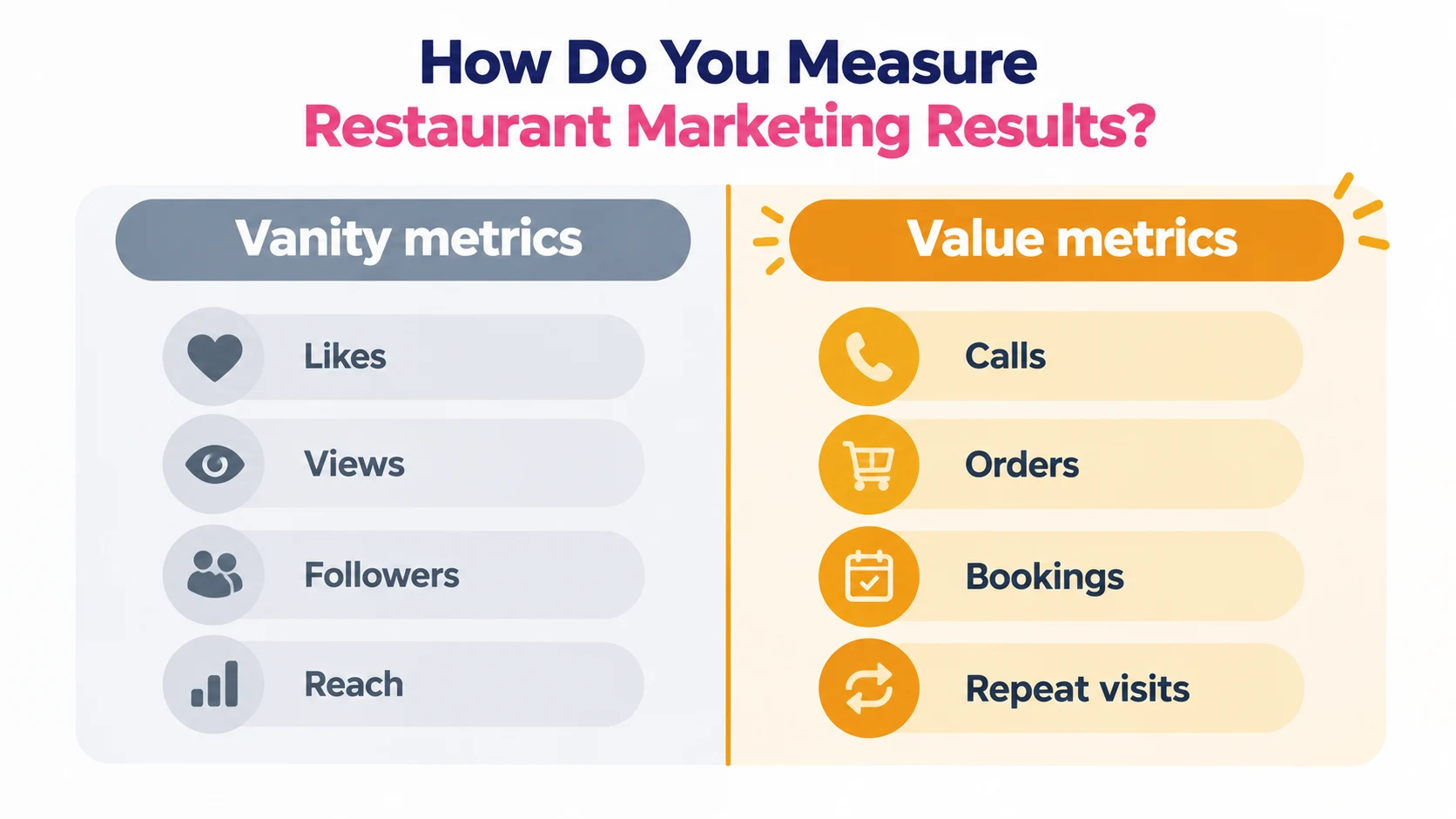
After SEO, local setup, content, and paid ads, the restaurant needs to measure. A simple framework tracks the whole journey, not just vanity metrics. Measure discovery through search visibility and profile views. Measure engagement through website visits, menu views, and social activity. Measure intent through calls, direction requests, and booking clicks. Measure conversion through orders, bookings, and enquiries. Track retention through repeat visits. Track reputation through review volume and sentiment. The weighting varies by restaurant. A dine-in place cares most about calls, directions, and bookings. A delivery-led one cares about orders and cost per order. This measuring layer is what separates digital marketing for restaurants from guesswork. A post with thousands of views is interesting. A campaign that drives real customer actions is useful.
Notice there was no single magic tactic. No one viral reel. No clever SEO trick. The work was connective. A customer can now search for a restaurant and find The Corner Plate. They check Google Maps, read reviews, view photos, and scan the menu. Then they visit or call, eat, and leave a review. That connected path is the real job of digital marketing for restaurants. It builds a measurable bridge between customer intent and business action.
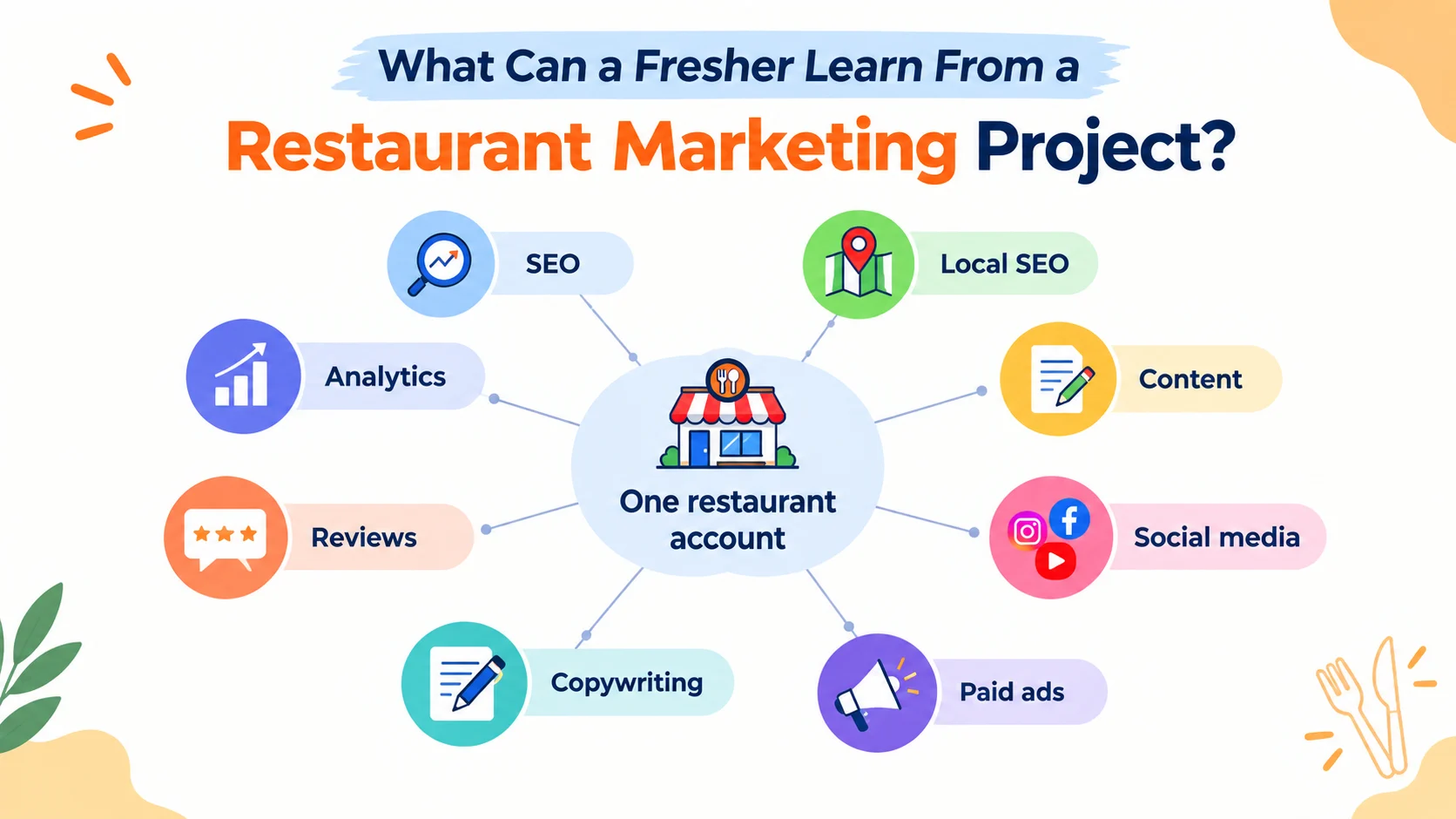
A fresher can learn almost the whole digital marketing stack from one restaurant account. A client rarely says “Please post on Instagram.” The real brief is closer to this: “We are getting attention. Help us learn whether it brings customers.” Answering that pulls in many skills at once. It needs SEO and local SEO, content, social media, Google Ads, analytics, copywriting, review management, and AI-assisted research. All of it sits inside one business problem. A business does not hire someone just for knowing a tool. It hires people who know why an activity is done and how to measure the result.
The skills also transfer. A marketer who understands digital marketing for restaurants can use the same logic elsewhere. It applies to clinics, salons, colleges, real estate, retail, e-commerce, and home services. The industry changes. The core logic stays much the same. For a learner, one path works well. Treat a sample business like The Corner Plate as a portfolio project. Build a buyer persona. Research keywords. Audit a Google Business Profile. Plan a 30-day content calendar. Write local SEO pages. Draft a Google Ads campaign. Design a landing page built for conversion. Then present your recommendations to the owner. That shows how you would solve a real problem, not just that you have learned digital marketing.
Digital marketing for restaurants is no longer about posting food photos or boosting posts. It is about being easy to find when customers search. It is about looking trustworthy when they compare. It is about being useful when they evaluate, and easy to choose when they act. India’s food-services market is growing. Its online audience is huge. Digital food platforms operate at scale. All of this has changed how restaurants reach customers. But technology alone does not create results. A restaurant still needs someone who can combine customer intent, local SEO, content, paid media, reviews, and analytics into one working system.
That is the bigger lesson, and it goes well beyond restaurants. Digital marketing is not about mastering single tools. It is about using them to move a real customer from search to decision, and from attention to action. Want to build these skills through practical, project-based training? IDCM’s Adavnced Diploma in Digital Marketing covers SEO, PPC, social media marketing, content, web analytics, and AI, with industry-relevant projects.
Neither replaces the other. SEO and a well-managed Google Business Profile build discovery that keeps working over time. Paid ads buy fast, controllable visibility for a set action, like bookings or online orders. Most restaurants start with the organic base. They add paid campaigns once they know which action they want to pay for.
There is no fixed figure. Cost depends on goals, location, and whether the work is in-house or outsourced. A good way to budget is by objective, not by channel. Decide what a call, booking, or order is worth. Then set spend against that value and track the cost per result.
It varies by channel. Paid ads can drive traffic and orders within days. SEO, local setup, and review building usually take a few months to build up. Judging both on the same timeline is a common mistake. Judge each against the right horizon.
Yes. Most local customers now check Google, Maps, reviews, and social media before they visit. This is true even for a nearby place. A complete, well-reviewed Google Business Profile alone can sway many walk-in and call decisions. That makes a digital presence matter at any size.
A few matter most. The key ones are local SEO and Google Business Profile management, review and reputation handling, decision-focused content, and intent-based paid campaigns. Add analytics to track the customer journey. The real skill in digital marketing for restaurants is connecting these, not treating each as a separate tool.

 }})