
Courses
If you studied literature, economics, or accounting, someone has probably told you that you are not “technical enough” for digital marketing. They are wrong. In fact, digital marketing for arts and commerce students is one of the most underrated career routes in India today.
In my daily routine, most of my time is dedicated researching about new updates in the field of digital marketing, working with brands, training institutes, and interacting with hundreds of freshers. However, what I have noticed is quite noteworthy.
The same pattern repeats. All the B.A and B.Com graduates think their degree is a liability. What they don’t understand is that: it is actually an advantage that they were never taught to use.
Hence, this guide is for BA students, B.Com graduates, and anyone from an arts or commerce background. You will learn what digital marketing is, why your degree matters more than you think, and how to build a real, well-paying career in India.
Short answer: Digital marketing is skill-based, with no degree-stream requirement. Arts students have a natural edge in content writing, SEO, copywriting, and social media. Commerce students have one in performance marketing and analytics. With a focused 3–6 month plan and real projects, a fresher can become job-ready and start at roughly ₹2.8–4.5 LPA, and scale fast once results show.
Let me ask you something. What does a digital marketer actually do?
They write copy that makes people buy. They tell brand stories on social media. They figure out what people search for and build content that answers it. And they read data, spot patterns, and act on them.
Sound familiar? That is what a good arts or commerce education already trains you to do. A B.Com graduate understands how businesses make money, how pricing works, and what ROI means. That is the foundation of performance marketing. A BA in English or Mass Communication already writes better than most working content marketers. Studied economics or statistics? You have a head start in marketing data analytics.
The field does not need more people who can code. It needs people who understand human behaviour, communicate clearly, and tie a campaign to a business outcome. That is you.
Digital marketing means promoting products and services through online channels: search engines, social media, email, content, and paid ads.
In India, the shift is no longer a prediction. It has already happened. Digital media now accounts for nearly 46% of India’s total ad spend, in a market that has crossed ₹1,00,000 crore (Crisil Intelligence, via IBEF). Furthermore, digital marketing has overtaken television as the country’s largest ad medium. And it is still growing. Bain & Company expects India’s digital ad market to grow about 15% a year through 2029. Every rupee spent needs a person to plan it, write it, run it, and measure it.
Here is the part that matters for you. Employers now hire for what you can do, not the label on your degree. The WEF Future of Jobs Report 2025 found that about 30% of Indian companies plan to move to skills-based hiring and drop formal degree rules. Moreover, the global average is just 19%. In a skills-first field, a portfolio of real work beats a certificate. If you are weighing digital marketing for arts and commerce students as a path, the timing is good.
Here are the roles where arts and commerce students find their first footing.
Studied English, journalism, or mass communication? You already have the most in-demand skill in the field: clear writing. The work covers blog posts, website copy, social captions, newsletters, and ad copy. It is the entry point into almost every other role. Moreover, it also opens the door to content writing and copywriting, writing words that sell, which is among the highest-paid skills in marketing.
Managing a brand on Instagram, LinkedIn, Facebook, or YouTube takes creativity, consistency, and a feel for each audience. It does not take a tech degree. You already use social media. Therefore, the shift is learning to think like a strategist while you do.
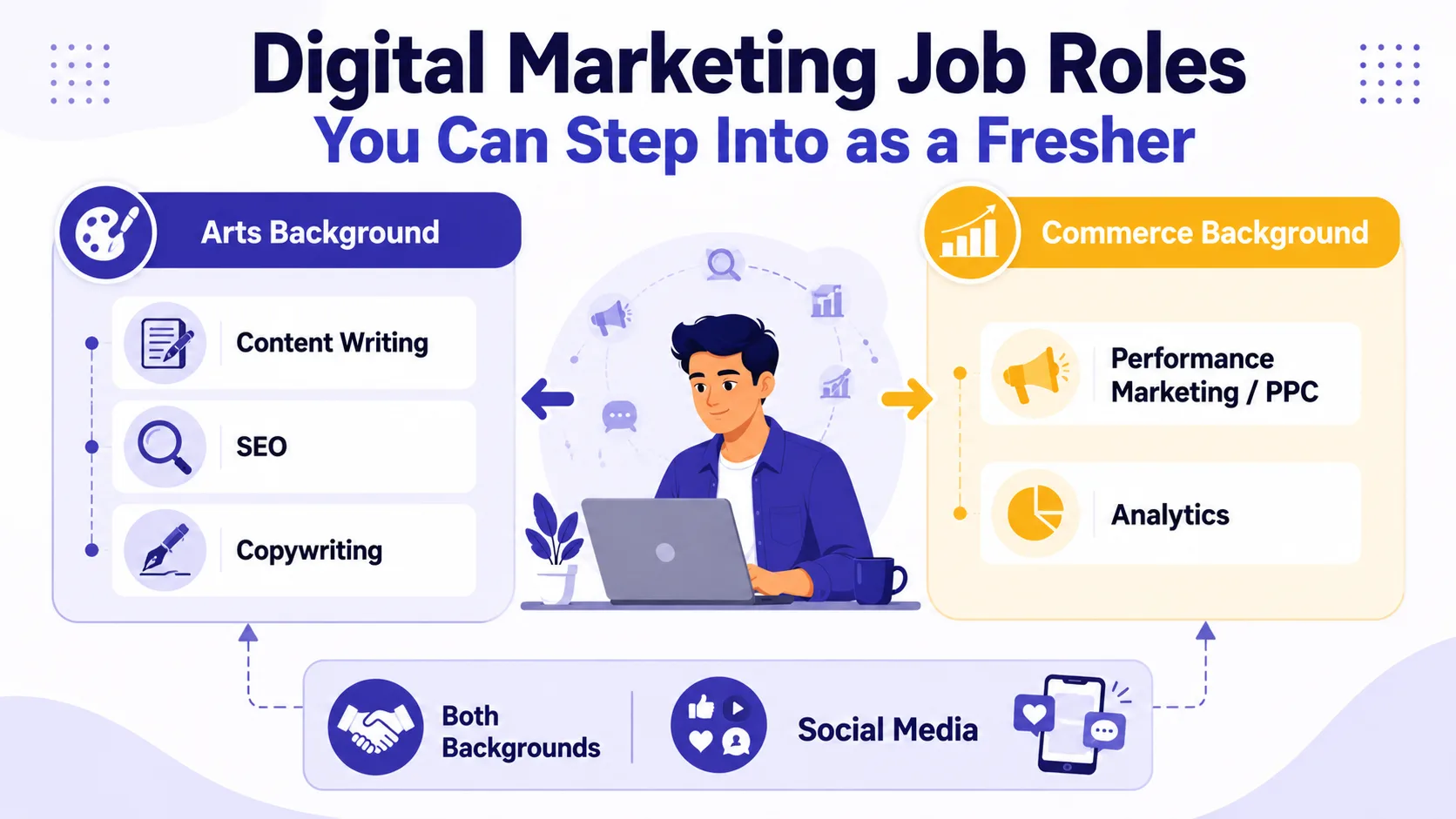
SEO makes a website show up on Google when people search. The job is writing and structuring content, reading search intent, and improving visibility. The writing load is high. An arts student who thinks about the reader is a natural fit. Moreover, having a free SEO certification from Google or HubSpot is a strong start for your career.
This is where commerce students shine. Performance marketing means running paid ads on Google and Meta, managing budgets, reading data, and optimising for results. B.Com graduates who know margins and percentages pick it up fast. It is also the highest-paying specialisation in Indian digital marketing.
Drawn to visual work, from fine arts, design, or just Canva? Marketing design is a strong path. Teams always need thumbnails, carousels, infographics, and ad creatives.
A commerce background in economics, statistics, or accountancy fits a data role well. Hence, the work means reading dashboards, judging campaign performance, and turning numbers into decisions.
These are market benchmarks from Glassdoor India and AmbitionBox (2025–26). They show what the industry pays on average. They are not a promise of what you will earn.
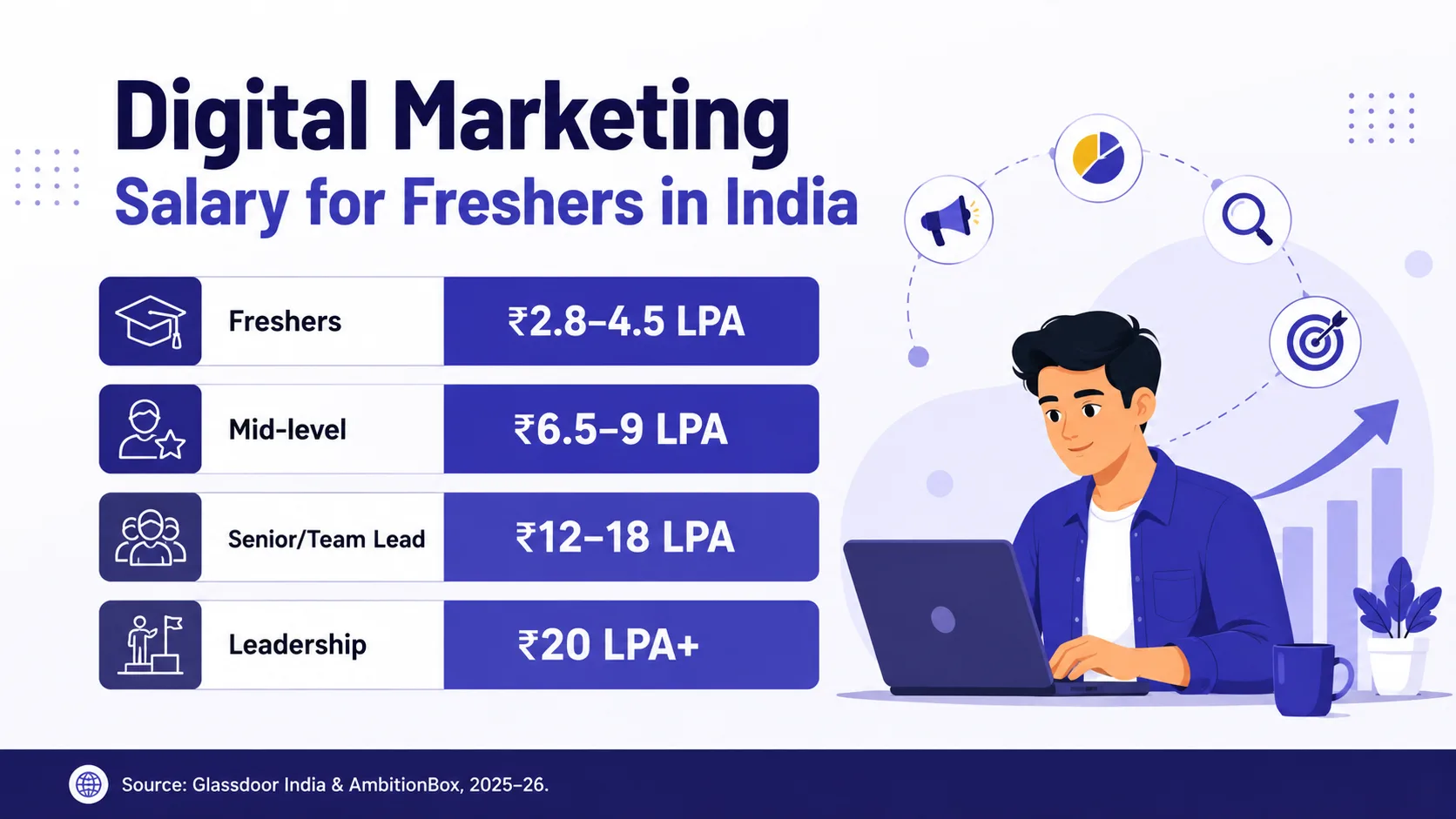
Performance marketing sits at the top. Glassdoor India puts a Performance Marketing Manager at around ₹12.65 LPA on average, with top earners near ₹24.5 LPA. SEO and content roles start lower. They scale strongly once you can show results.
What you earn depends more on results than on your job title. Two freshers can join on the same package and sit at ₹4 LPA and ₹9 LPA apart within two years. The reason is simple. One manages tasks. The other points to track are traffic growth, leads generated, and ROAS improved. An SEO who shows rankings, or a paid-media exec who proves ROAS, does not stay at the bottom for long.
You do not need to learn everything. You need the right things in the right order.
First, learn how the internet works as a marketing channel. Cover the basics of SEO, Google Ads, Meta Ads, content marketing, and email. Free resources from Google, HubSpot, and Meta cover all of it.
Most beginners make the same mistake. They learn a little of everything and master nothing. Pick one area: content writing, SEO, social media, or performance marketing, and go deep first.
Certifications signal commitment. A Google Ads certification, or an SEO certification from a recognised institution, is worth the time. A fresher with a real certificate and real work is an easy hire.
Do not wait for a job to start. Write sample posts. Run a small social account for a passion project. Help a local shop with its Instagram. Manage content for a college society. This is proof of work, and it sets you apart from every fresher holding the same certificate.
Most guides skip this. You do not need a job to start earning. Freelancing is a real income, even for beginners. Small businesses on Fiverr, Upwork, and LinkedIn need content writers, social media managers, and basic SEO help. They cannot afford a full-time hire. Freelancing while you study pays you now and builds the portfolio that gets you hired faster. It also teaches you to deliver under real pressure, which no course can copy.
Every guide tells you to build a portfolio. Almost none tell you why most fresher portfolios get rejected in under ten seconds.
Here is what happens on the other side of the table. A hiring manager opens twenty portfolios for one opening. Seventeen of them look identical: the same Google Digital Garage certificate, a mock ad for an imaginary coffee brand, and a line that says “grew this account” with no starting number. When everything looks the same, none of it counts. The portfolio that was supposed to set you apart is the exact thing that makes you forgettable.
What a reviewer is actually scanning for:
| What freshers submit? | What gets a callback? |
|---|---|
| A practice project from the course everyone took | A real stakeholder, even an unpaid one: a local shop, an NGO, a college society, a family business |
| “Increased followers to 2,000” | “From 300 to 2,000 followers in 8 weeks, here is the link” |
| A screenshot with no date | A live link, or a dated screenshot showing before and after |
| Five mock projects | One real project documented properly |
| A list of tools you know | Proof you used a tool to change a number that mattered |
Three rules that separate a working portfolio from a decorative one:
First, a result with no baseline is treated as fiction. “Grew traffic” means nothing. “Grew organic traffic from 40 to 310 sessions a month between January and March” means you can be trusted with data.
Second, proof has a hierarchy: a live link beats a dated screenshot, which beats a claim typed in a document. Push everything you can up that ladder.
Third, one real project done properly outranks five invented ones. Reviewers can tell the difference instantly, and the invented ones quietly cost you credibility rather than adding to it.
The realization: the goal was never “have a portfolio.” It was “have proof that looks nothing like the other nineteen in the pile.”
The standard advice is to specialise early. It is half right, and the missing half can keep you unemployed longer.
Here is the contradiction. Specialisation pays more over a career, but most freshers do not get their first job at a company that wants a specialist. They get it at a small agency, a startup, or a local business in a tier-2 or tier-3 city, and those employers want someone who can write a post, schedule it, run a basic ad, and update the website, all in the same week. A fresher who can only do technical SEO is harder to place there, not easier.
So the honest answer is: it depends on the kind of employer you can realistically land first. Use this to decide.
The trap to avoid: over-specialising before your first job can quietly price you out of the exact entry-level jobs that are actually open to freshers. Go deep once you are inside and can see which specialisation the market near you rewards.
The realization: “specialise early” is not wrong, it is conditional. The condition is who signs your first offer letter.
Almost every fresher guide, including the ones that compete with this one, is written in English and quietly assumes the whole market is in English. It is not, and that gap is an opportunity sitting in plain sight.
According to the IAMAI-Kantar Internet in India Report 2024, India had around 886 million active internet users in 2024, nearly 98 percent of whom accessed content in Indic languages, and about 57 percent of urban users said they prefer content in regional languages. The audience is overwhelmingly non-English. The supply of marketers who can write and strategise well in Bengali, Hindi, Tamil, Telugu, Marathi, or Malayalam is far thinner than the supply who can do it in English. Thin competition plus real demand is where a fresher gets leverage.
If you are fluent in a regional language, that fluency is a sellable, scarce skill, and no coding bootcamp can manufacture it.
Where language becomes your differentiator:
| Role | Why does a vernacular speaker has the edge? |
|---|---|
| Regional content writing | Brands expanding beyond metros need native writers, not translated English |
| Vernacular social media | Captions, scripts, and comment replies that sound local, not machine-made |
| Local SEO | Regional search queries are underserved and less competitive |
| Regional ad copy | Tone and idiom decide whether an ad converts in that market |
| YouTube and reel scripting | Regional-language video is where a lot of the new attention is going |
One caution: Translation is not localisation. Running English through a tool and getting regional output is not the skill. The skill is cultural nuance, idiom, and knowing what actually persuades that audience. That is a humanities strength, and for now it is one of the harder things for AI to replace.
How to prove it: run a small blog or social account in your language, aimed at a real local audience, and show the engagement you earned from that audience.
The realization: the “non-technical” regional fluency you were treating as irrelevant may be the single most marketable thing you own.
Comfortable advice gets repeated because it is easy to share. Here is where the common wisdom has drifted from what actually happens in hiring rooms and on the job.
| Myth | Reality |
|---|---|
| “You need zero technical skill.” | True for entry roles, but basic spreadsheets, GA4, and no-code tools are now assumed rather than optional. The bar quietly rose. |
| “A certificate gets you hired.” | Certificates are table stakes. Not having one can hurt you, but having one no longer sets you apart, because everyone applying has the same ones. |
| “Freelancing is easy early income.” | The skill that actually pays is finding and keeping clients, not the marketing work itself. That is the part most freshers underestimate and the reason many quit. |
| “AI will replace digital marketers.” | AI replaces the marketer who cannot use it and raises the output expected from the one who can. The writing edge erodes fastest here, so judgment becomes the moat. |
| “High follower count means a good social media marketer.” | Reviewers look at engagement, relevance, and whether you can connect activity to an outcome. A big number with no story behind it reads as noise. |
| “Your degree subject is your advantage.” | It is a starting advantage, and a real one. But it commoditises within a year unless you convert it into judgment and documented proof of work. |
The realization: several things you were told to chase are now either outdated or simply the minimum. The real differentiators have moved somewhere else, and knowing that early saves you a wasted year.
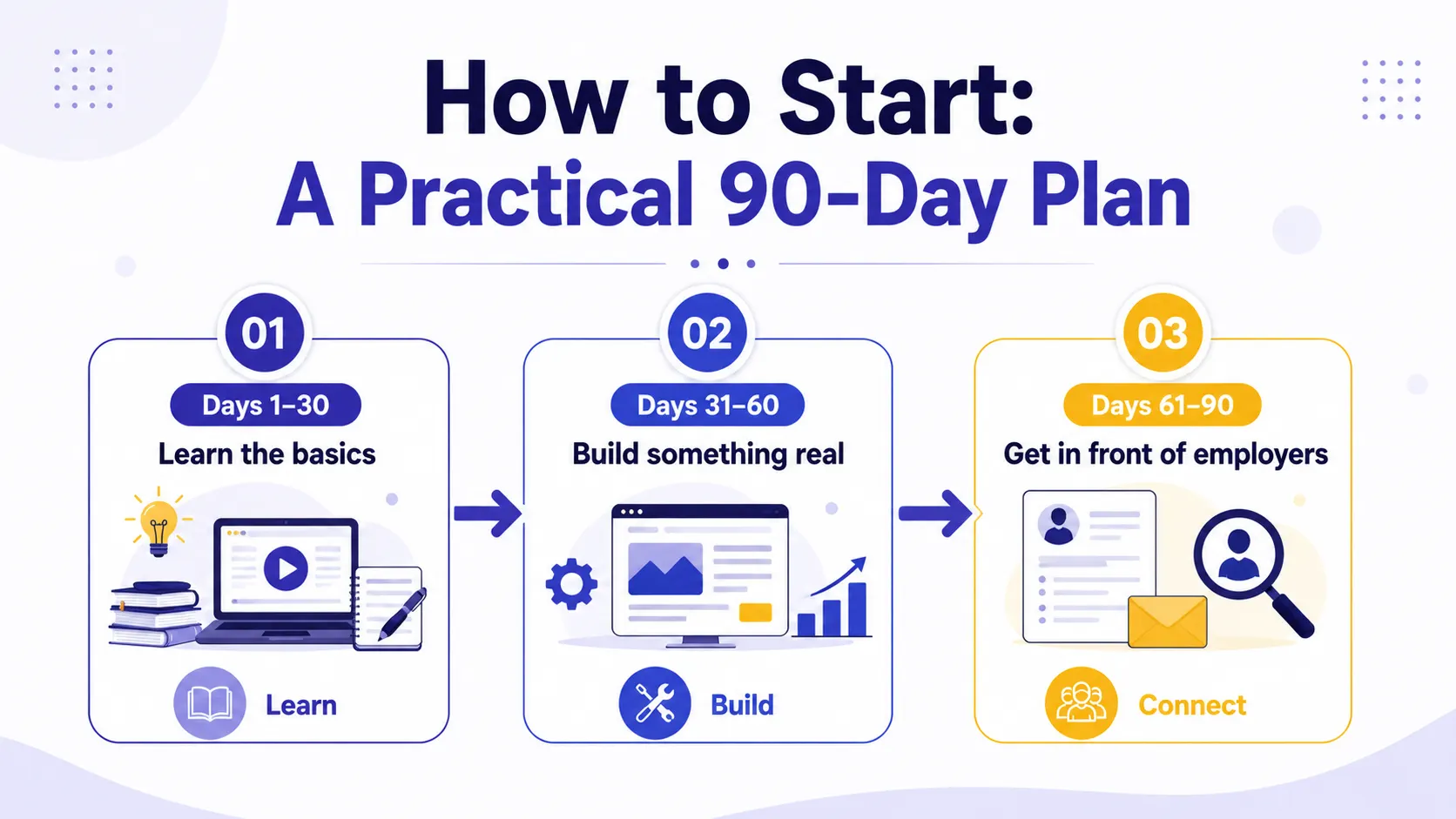
Finish one free certification; Google Digital Garage is a solid start. Read one marketing blog a day. Get fluent in the terms: CTR, CPC, ROAS, bounce rate, organic versus paid traffic.
Start a blog or a niche social account on a topic you care about. Apply what you learn. Publish five pieces. Track what works. That is your first portfolio item.
Update LinkedIn with your skills, certifications, and projects. Apply for internships on Internshala, LinkedIn, and Indeed. Ask for feedback every time. A three-month internship beats another year of pure theory.
This path moves faster than most options open to arts and commerce graduates.
Digital marketing is also one of the most remote-friendly careers. You can freelance, join a team, or build an agency. Many of India’s best marketers did not start in engineering or with an MBA. Some came from English literature. Others came from commerce colleges in tier-2 cities, or communications courses nobody had heard of. The common thread was simple. They started, they practised on real work, and they made that work visible. This is what makes digital marketing for arts and commerce students such a fast track.
This section is for readers who already understand the basics. If you are still learning what SEO and PPC mean, bookmark it and come back once you have run a real project.
Most guides stop at “track your results.” They never teach the difference between the three kinds of metrics, and that difference is what separates a junior who stays stuck from one who moves up fast.
The ladder has three rungs:
Why this matters in an interview or a client pitch: a fresher who says “I increased traffic 200 percent” gets taken apart the moment someone asks “did leads or revenue move?” Learn to climb from rung one to rung three when you describe your work.
Four things to get right at this level:
Know your ceiling, too. A fresher controls some metrics directly and only influences others. Being clear about which is which makes you sound more credible, not less.
The realization: the gap between a stuck junior and a fast-rising one is rarely effort or tools. It is whether you can connect your work to money and say so without overclaiming.
A good beginner-friendly certificate in digital marketing course, or you can even look for a Diploma in Digital Marketing Course, which covers SEO, social media, Google Ads, content marketing, email, and basic analytics, AI-powered digital marketing with practical assignments, not just theory. Look for live project work, not only videos. Check the institute’s placement track record. Ask about batch sizes. A large batch with no personal attention is not worth your money, whatever the brand name.
Eligibility is simple. Digital marketing is skill-based. There is no mandatory degree. BA students, B.Com graduates, and students from mass communication, fine arts, or science all qualify equally.
Arts and commerce students have underrated themselves for too long. This field rewards clear writing, human insight, commercial thinking, and data sense. That is exactly what a humanities or commerce education builds. The industry is growing. Employers hire on skill, not degree. The salary path is strong, which is why digital marketing for arts and commerce students is a fit, not a fallback. The only thing left is to start building skills today, not tomorrow.
Yes. In several roles, arts students have a natural advantage. Content writing, copywriting, social media, and SEO all reward communication, critical thinking, and an understanding of people. For many specialisations, an arts background is a reason to hire someone over an engineer
Yes, commerce graduates suit performance marketing, Google Ads, and analytics well. Reading numbers, managing budgets, and tying data to outcomes is a real edge. That is exactly what B.Com and BBA students build over three years.
Glassdoor India and AmbitionBox 2025–26 data put freshers at roughly ₹2.8–4.5 LPA. It varies by role, city, certifications, and internships. Paid-ad roles tend to start higher. Thus, the content roles start lower but scale well. These are market benchmarks, not a guaranteed outcome.
No. It is a skill-based field with no stream requirement. Anyone who has finished 10+2 can start. Diploma programmes usually ask for graduation in any stream, but the subject of your degree does not affect eligibility.
No, not for most roles. Content writing, social media, copywriting, Google Ads, and SEO need no code. Some technical SEO work benefits from basic HTML, but you can learn that on the job.
It depends on your strengths. Arts students often start fastest in content writing and SEO. Commerce students move quicker into performance marketing and analytics. Social media suits both. Pick one and go deep.
About three to six months of structured learning, plus steady practice and one internship or live project. Free Google, HubSpot, and Meta certifications run in parallel. Real output matters more than credentials, so start producing early.
Yes. Content writing, social media management, and basic SEO are the most freelance-friendly roles. Fiverr, Upwork, and LinkedIn have steady small-business demand. Freelancing while you study builds income, experience, and portfolio at once.
Start with free, recognised ones: Google Digital Garage (fundamentals), Google Ads (performance roles), HubSpot Content Marketing (content and SEO), and Meta Blueprint (social media). Job posts often list these as preferred.

 }})